
UT Austin Finds Large Robot AI Models Simply Don't Forget When Fine-Tuned
A UT Austin study finds that plain LoRA fine-tuning on a stream of tasks beats sophisticated continual RL methods for large robot policies.
 Pro
Takeaways
- UT Austin study shows simple sequential fine-tuning with LoRA beats sophisticated continual RL methods for VLA models.
- Tested across LIBERO, RoboCasa, ManiSkill on OpenVLA-OFT, Pi-0, and OpenVLA with GRPO.
- Seq. FT shows under 2% forgetting and often beats the multi-task oracle on zero-shot generalization.
- Ablations prove all three ingredients (pretrained VLA, LoRA, on-policy RL) are required; removing any one causes catastrophic forgetting.
- LoRA prevents uneven per-layer weight updates rather than merely limiting rank, explaining its retention advantage.
- Code released at github.com/UT-Austin-RobIn/continual-vla-rl.
Continual learning has long been haunted by catastrophic forgetting: train a network on task B and it tends to lose task A. A decade of research has produced elaborate defenses like weight regularization, experience replay, and parameter isolation. A new empirical study out of UT Austin argues that for the specific case of large Vision-Language-Action (VLA) models trained with reinforcement learning, most of that machinery is unnecessary. Just fine-tune on the next task. It works.
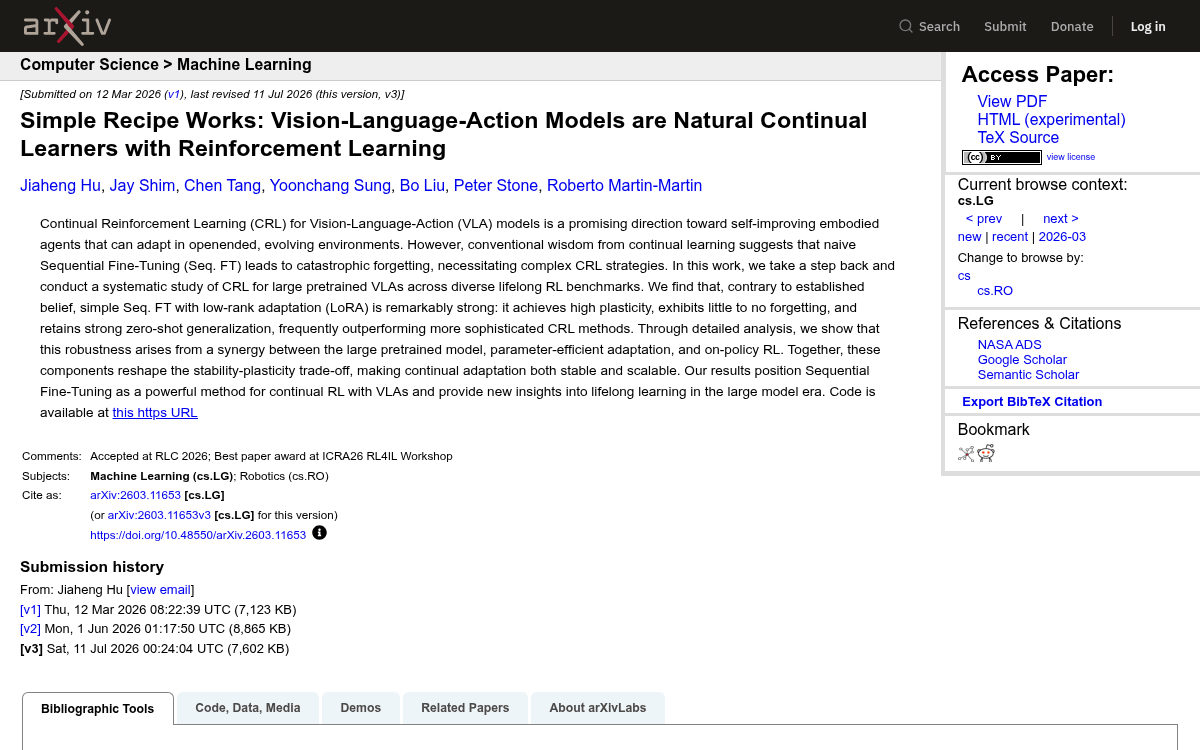
The paper, Simple Recipe Works: Vision-Language-Action Models are Natural Continual Learners with Reinforcement Learning, systematically benchmarks eight continual learning algorithms across five robot manipulation suites and three different VLA architectures. The headline finding: simple Sequential Fine-Tuning with low-rank adaptation (LoRA) is remarkably strong, achieving high plasticity, exhibiting little to no forgetting, and retaining strong zero-shot generalization, frequently outperforming more sophisticated CRL methods.
The problem with the old playbook
Continual reinforcement learning (CRL) is the setting where an agent must learn a stream of tasks one after another, without going back to old data. The classical worry is that Sequential Fine-Tuning is prone to catastrophic forgetting, where the model's performance on previously learned tasks degrades substantially as it adapts to new ones. Standard fixes fall into three camps:
- Regularization methods like Elastic Weight Consolidation that penalize changes to important weights.
- Replay methods that keep a buffer of old trajectories or logits and mix them into training.
- Parameter isolation that allocates a fresh set of task-specific weights each time.
Each of these buys stability at the cost of plasticity, the ability to actually learn the new task. That trade-off is the classic stability-plasticity dilemma. The authors ask whether it still applies when the underlying model is a billion-parameter pretrained VLA rather than a small network trained from scratch.

The setup
The experiments use Group Relative Policy Optimization (GRPO), a stable policy-gradient method that has achieved strong empirical performance in large-scale post-training, together with rank-32 LoRA adapters. Three base models are tested: OpenVLA-OFT (autoregressive with action chunking), Pi-0 (flow-matching head on PaliGemma), and the original OpenVLA. The benchmarks span LIBERO-Spatial, LIBERO-Object, LIBERO-Long, RoboCasa, and ManiSkill.
Four metrics are tracked: average final success (AVG), negative backward transfer (NBT, i.e. forgetting), forward transfer (FWT), and zero-shot success on held-out tasks (ZS). The authors compare against Elastic Weight Consolidation, Expert Replay, Dark Experience Replay, Dynamic Weight Expansion, SLCA, RETAIN, and a multi-task oracle upper bound.
What the numbers say
On LIBERO-Spatial, Sequential Fine-Tuning hits 81.2% average success with only 0.3% forgetting. EWC scores 66.1%, RETAIN 66.0%, and SLCA 69.9%, all losing significant plasticity. The multi-task oracle reaches 85.8%. The same pattern holds on Object (93.2% for Seq. FT vs. 95.7% oracle) and Long-Horizon suites.
Even more striking, Seq. FT often exceeds the multi-task oracle on zero-shot generalization to held-out tasks. On LIBERO-Spatial, Seq. FT reaches 57.1% zero-shot success while the oracle sits at 51.2%. Task-order permutations, camera perturbations, lighting changes, and robot base repositioning barely move the needle: the NBT stays below 2% for all experiments, with frequent negative values, indicating the same absence of catastrophic forgetting that we noticed earlier. Finally, the ZS performance maintains a consistent edge over the multitask oracle, demonstrating the surprising ability of Seq. FT to boost generalization.
Why it actually works
The interesting part is the mechanism. Ablations show that removing any one of the three ingredients (pretrained VLA, LoRA, on-policy RL) breaks the effect. Replace RL with supervised fine-tuning and NBT jumps from 0.3% to 78.7%. Swap the 7B VLA for a 12M parameter network and forgetting hits 11.4%. Drop LoRA and do full fine-tuning and forgetting climbs to 40.9%.
The intuition for each piece:
- On-policy RL is implicitly conservative. Policy gradient updates only reweight probability mass where the current policy already has support, so the policy can only drift gradually from its pretrained distribution. Supervised fine-tuning has no such constraint and can shove probability mass anywhere the dataset points.
- Large pretrained models have a huge null space. In high dimensions, random gradient directions are nearly orthogonal to the directions that matter for old tasks. The authors measure this by computing the Fisher energy along the gradient direction and find it is only 0.02 for the 7B OpenVLA-OFT versus 0.16 for the small policy.
- LoRA prevents uneven per-layer damage. A subtle finding: even with LoRA rank 512 (matching full fine-tuning's effective rank), LoRA (with rank 512) achieves substantially better NBT performance than full fine-tuning (0.6% vs 40.9%), even though their mean per-layer effective ranks are comparable (303.4 vs. 324.7). The difference is variance across layers. Full fine-tuning lets a few layers undergo huge structural changes; LoRA spreads the update more evenly.
Plasticity survives because RL is information-poor
A previous paper by Biderman et al. noted LoRA underperforms in supervised pretraining because it lacks capacity. Why doesn't that show up here? The authors argue that policy gradient methods such as GRPO learn based on the advantage function, which only provides O(1) bits of information for each episode under a sparse reward setup. A rank-32 LoRA has around 100M trainable parameters, more than enough to absorb the signal from 50k rollouts. Supervised learning gives you far richer per-episode information, which is where LoRA starts to bottleneck. RL and LoRA fit each other by accident.
When it matters and when it doesn't
The practical implication is that teams doing RL post-training on large robot policies can drop their replay buffers and regularizers. The open-source implementation shows the baseline is just LoRA plus GRPO. A few caveats:
- Continuous diffusion-head VLAs (like Pi-0) are more sensitive and may need lower LoRA rank to avoid policy drift.
- The gap to the multi-task oracle on average success is real but small (typically under 5%) and can be closed by training the weaker tasks longer.
- Sparse-reward on-policy RL is doing a lot of the heavy lifting. Off-policy RL or dense supervised objectives likely will not enjoy the same free lunch.
The broader point the authors push is that the classical framing of continual learning, dominated by fear of catastrophic forgetting, may be the wrong lens for the era of large pretrained foundation models. When your base model is already competent and your updates are conservative and low-rank, the more interesting problems become sample efficiency, forward transfer, and preserving the generalization the base model came with.