
UT Austin Cracks Why Robot Sim-to-Real Co-Training Jumps from 29% to 74%
New study reveals why mixing simulation and real robot data works, identifies two hidden mechanisms, and delivers a method that nearly doubles success rates.
Takeaways
- New paper from UT Austin, Amazon FAR, and NVIDIA explains when and why sim-and-real co-training works.
- Identifies two mechanisms: structured representation alignment (~50% of loss variance) and importance reweighting (~20%).
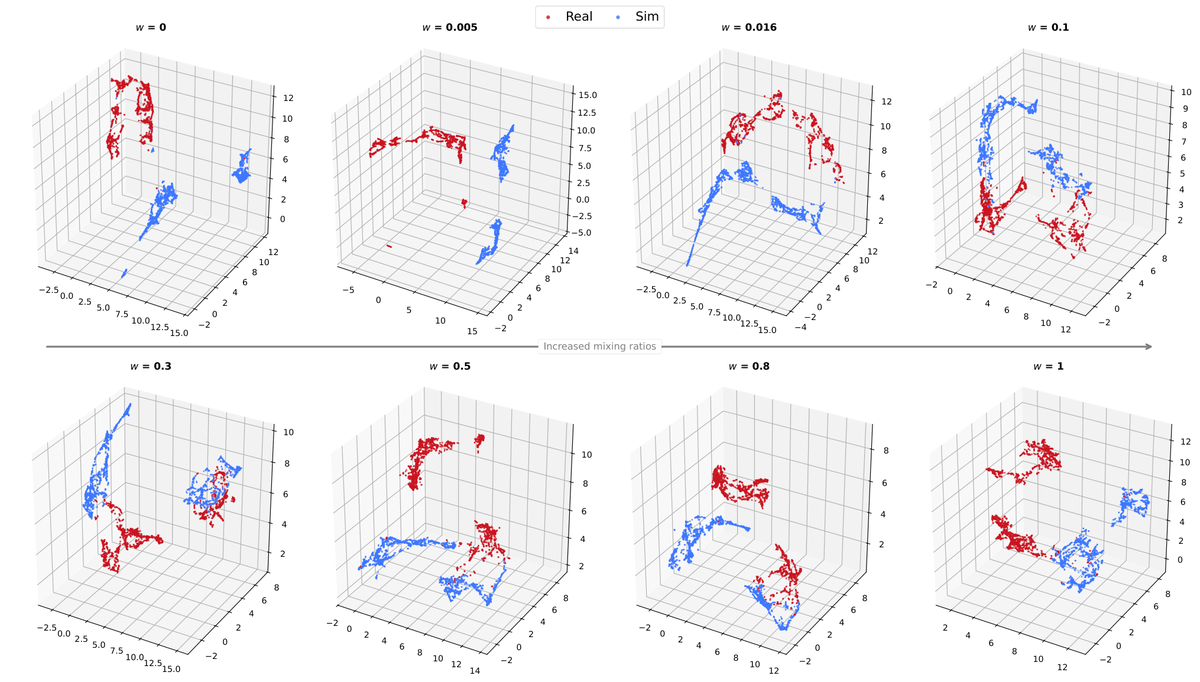
- Three regimes emerge: disjoint (no transfer), structured aligned (sweet spot), overlapping (negative transfer).
- Proposed CFG-ADDA method hits ~74% real-world success, roughly doubling the real-only baseline of 29%.
- Alignment emerges implicitly at balanced mixing ratios; Wasserstein distance correlates 0.6-0.8 with success.
- Includes practical recipe for picking mixing ratios based on dataset sizes and domain gap.
Anyone training a modern robot policy has probably tried co-training: mix a small pile of expensive real-world demonstrations with a mountain of cheap simulation data and hope the network generalizes. It works surprisingly often, but nobody has been able to say exactly why, or when it will backfire. A new paper from researchers at UT Austin, Amazon FAR, and NVIDIA opens up the black box.
The team, led by Yu Lei and Yuke Zhu, published A Mechanistic Analysis of Sim-and-Real Co-Training, a theoretical and empirical dissection of what happens inside a co-trained diffusion policy. They identify two intrinsic effects governing performance: structured representation alignment, which plays the primary role, and an importance reweighting effect that operates at a secondary level. Building on those findings, their proposed method lifts real-world success rates from around 29% to roughly 74%.

The mystery inside the mixing bowl
Co-training has quietly become the default recipe for robot learning. With advances in high-fidelity physics simulators and automated trajectory generation, huge sim datasets are cheap to produce, and many works have demonstrated the effectiveness of sim-and-real co-training on challenging manipulation tasks with both small diffusion policies and large Vision-Language-Action models. Practitioners still choose their mixing ratios by feel, and results swing wildly. Sometimes adding more sim data helps; sometimes it produces a policy that confidently executes the wrong motion.
Because a co-trained diffusion policy jointly learns a visual encoder and a score-based action head, the authors split the analysis into two spaces: the latent representation space where observations live, and the conditional action space where predictions are sampled.
Two mechanisms, ranked by importance
The first mechanism, structured representation alignment, is about how the encoder organizes sim and real observations. It describes a balance between cross-domain representation alignment and domain discernibility: alignment enables transfer of task-relevant knowledge from simulation to real, while discernibility lets actions adapt to domain-specific factors rather than merely copying from the source. Push too hard on either side and the policy breaks.