
USTC Unlocks JPEG XS Screen Compression for Real Hardware at 38 Mpixels/s
A four-stage pipelined FPGA design accelerates JPEG XS Intra Pattern Copy displacement search to 38.3 Mpixels/s at 277 mW, clearing a key hardware bottleneck.
 Pro
Takeaways
- First FPGA architecture for the Displacement Vector search in JPEG XS Intra Pattern Copy.
- Four-stage pipelined DV comparison engine with parallel residual calculation across four IPC groups.
- Group-and-unit memory layout with on-chip TLB replaces scattered precinct-based access, enabling burst reads.
- Hits 38.3 Mpixels/s at 277 mW on Xilinx Artix-7 XC7A35T running at 100 MHz.
- 6.1% power-efficiency gain plus 7.5% fewer LUTs and 8.4% fewer FFs versus the baseline layout.
- Targets JPEG XS screen-content use cases: remote desktop, KVM, broadcast IP transport.
Screen content compression is one of those unglamorous corners of video engineering that quietly runs modern life. Every remote desktop session, every KVM-over-IP link in a broadcast studio, every cloud gaming stream leans on it. A new paper out of the University of Science and Technology of China tackles a specific bottleneck in that pipeline: getting the Intra Pattern Copy (IPC) tool in JPEG XS to actually run in real hardware.
Why JPEG XS cares about screen content
JPEG XS is the ISO/IEC codec built for broadcast studios, Pro-AV networks, automotive links and even VR/AR glasses where you need visually lossless quality with sub-frame latency. The first edition supported RGB and YCrCb, the second added CFA Bayer compression, and the third edition improved compression for screen and mixed video content. That third-edition push is what motivates this work.
To squeeze extra efficiency out of screen content, the JPEG committee has been layering in new tools. Temporal Differential Coding (TDC) performs temporal predictions between adjacent frames, and Intra Pattern Copy (IPC) performs intra-copy predictions within a single frame. IPC uses a wavelet-domain prediction framework to reduce image structural redundancy and achieves notable BD-PSNR improvement on screen content. Think of it as spotting a repeated icon, glyph or UI element elsewhere in the same frame and coding it as a small offset plus a residual, rather than from scratch.
The bottleneck nobody wanted to build
IPC has four main stages in its prediction loop: DV search, pattern compensation, mode selection, and a reconstructed precinct buffer. The displacement vector (DV) search is the one that hurts. It has to iterate through every candidate offset and pick the one that minimizes coding cost, and it is the most computationally intensive, resource-intensive and delay-sensitive module, becoming a critical bottleneck in terms of hardware complexity and latency that hinders the practical deployment of IPC in real-time hardware systems.
Prior FPGA and ASIC work on motion estimation for H.264 or HEVC doesn't transfer directly. Those designs assume regular pixel-block memory access and fixed partitions, whereas JPEG XS IPC operates on grouped, frequency-domain wavelet coefficients scattered across sub-bands. That mismatch is exactly what the authors set out to fix.
How the architecture works

The design splits into two engines. A residual calculation engine pulls original and reconstructed wavelet coefficients from DRAM into query FIFOs (Q0-Q3) and candidate FIFOs (C0-C3), one pair per IPC Group. A SIG_MAG_SUB block splits each 32-bit sign-magnitude coefficient and runs four parallel subtraction paths to produce signed residuals. Those flow into residual FIFOs and then into the DV comparison engine.
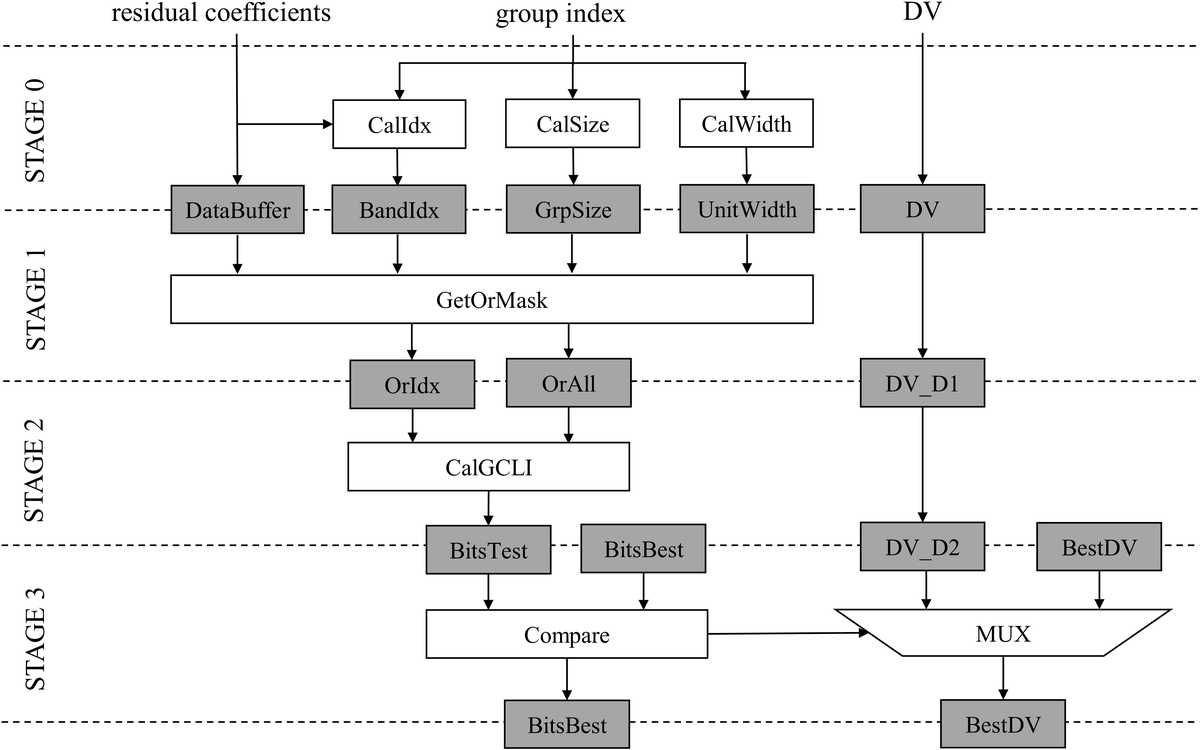
The DV comparison engine is a four-stage pipeline:
- Stage 0 loads residuals and derives per-group parameters (band index, group size, unit width) so the pipeline can adapt to variable block widths.
- Stage 1 computes a bitwise OR mask across the group in
GetOrMask. - Stage 2 runs the GCLI (greatest coded line index) bit-count calculation to estimate the cost of coding each candidate residual.
- Stage 3 compares the candidate cost against the running best and updates the winning DV.
The memory trick that pays off

The more interesting contribution is how coefficients are laid out in DRAM. The naive layout (Method 0) stores reconstructed and original coefficients in two precinct-based banks with linear addressing. That looks clean, but IPC's access pattern is group-based, so blocks from different sub-bands end up scattered and each one needs its own address computation.
Method 1 flips the organization: coefficients are grouped by IPC Group and Unit instead of by precinct. All sub-band blocks belonging to one IPC Unit sit under a single base address plus a fixed offset, which enables burst reads and kills the per-band address arithmetic. An on-chip TLB RAM stores the variable block lengths, indexed by group.
Numbers on the Artix-7
Implemented on a Xilinx Artix-7 (XC7A35T) at 100 MHz, the memory-optimized design hits 38.30 Mpixels/s at 277 mW, compared with 35.98 Mpixels/s at 276 mW for the baseline layout. That's a 6.1% improvement in power efficiency (138.27 Mpixels/s/W), while LUT and FF usage drop by 7.5% and 8.4% respectively, at the cost of a few extra BRAMs. End-to-end latency is 73.01 ms and rate-distortion matches the IPC reference software.
| Metric | Method 0 (baseline) | Method 1 (proposed) |
|---|---|---|
| Throughput | 35.98 Mpixels/s | 38.30 Mpixels/s |
| Power | 276 mW | 277 mW |
| Power efficiency | 130.36 Mpixels/s/W | 138.27 Mpixels/s/W |
| LUTs | 13.93 K | 12.89 K |
| FFs | 23.80 K | 21.79 K |
Why this matters
IPC as an algorithm has been floating around in the JPEG XS literature and in a recent IEEE TCSVT paper, but algorithmic BD-PSNR wins are meaningless if nobody can build the encoder into a broadcast card or a KVM appliance. This is the first published FPGA architecture for the DV search stage, and it demonstrates that the tool can run at real-time-relevant throughput inside a modest power budget, which is the number that matters for ASIC follow-ons. There is no public code release yet; the paper describes the architecture and reports synthesis results only.
If you are working on video-over-IP infrastructure, remote desktop pipelines, or JPEG XS SDK integration, this is the kind of hardware groundwork that decides whether the third-edition screen-content tools actually ship in silicon or stay stuck in the reference encoder.