
USTC's TransDex Teaches Robots to Grasp Invisible Glass at 83% Success
A new visuo-tactile policy from USTC reconstructs transparent object geometry from noisy point clouds, hitting 83% success on pouring, shaking, and rotating tasks.
 Pro
Takeaways
- TransDex hits 83% average success on transparent object manipulation, vs 0-47% for prior 3D baselines. Paper
- Transformer pre-trained to reconstruct object geometry from noisy, 70%-masked hand-object point clouds.
- Fine-grained fusion of global cloud, interaction cloud, tactile position points, and tactile force via stacked self and cross-attention.
- Differentiated prediction: MLP head for arm pose, diffusion head for 16-DoF dexterous hand actions.
- Ablations show pre-training adds 60 points, tactile 76 points, differentiated heads 83 points to success rate.
- Generalizes to unseen objects (80%), complex backgrounds (80%), and challenging lighting (73%) zero-shot.
Transparent objects are a nightmare for robots. Glass cups and lab flasks refract and reflect light in ways that wreck depth sensors, leaving point clouds full of holes and noise. Add a five-fingered hand that occludes itself during a grasp, and the 3D perception pipeline most manipulation policies rely on falls apart. A team at the University of Science and Technology of China is pitching an end-to-end fix called TransDex, and it lands an 83% average success rate on real transparent object tasks where prior methods score 0-47%.
Why transparent objects break 3D policies
Most recent dexterous manipulation work has moved from 2D images to 3D point clouds because spatial structure generalizes better. The catch: depth cameras hate glass. Existing solutions typically bolt on a separate module that does depth completion or transparent object segmentation first, then generates a grasp pose from the cleaned-up scene. Approaches like ClearGrasp, SwinDRNet, and ClearDepth follow this two-stage pattern.
Two things go wrong with that pipeline. First, the dexterous hand itself occludes the object during interaction, so the completion module produces bad geometry right when you need it most. Second, most of these systems are open-loop grasp planners, so they cannot react to slipping, contact loss, or a wobbling cup mid-motion. The TransDex paper notes that even Maniptrans, a recent human-to-robot skill transfer method that included transparent object trials, topped out at an 18.44% success rate.
The core idea: learn to hallucinate the object from the grasp
TransDex splits into two phases. First, a Transformer encoder is pre-trained to reconstruct the full 3D shape of an object from a heavily corrupted hand-object point cloud. Then that encoder is frozen into a visuo-tactile motor policy that predicts arm and hand actions.

The pre-training task is set up as query point classification. Given a noisy, masked hand-object point cloud, the network has to predict, for dense query points sampled in 3D space, the probability that each point belongs to the target object. Concretely, the pipeline does this:
- Uniformly sample points on the dexterous hand and object in a PyBullet grasping scene built from the ClearPose transparent object dataset.
- Add random noise to the object points and split the cloud into patches using Farthest Point Sampling plus K-Nearest Neighbors.
- Randomly mask a large fraction of patches (up to 70%) before feeding the visible ones through a pre-encoder and Transformer encoder.
- Generate dense query points, label points that lie on the true object surface as positive and everything else (including the hand) as negative, then let a Transformer decoder score each query.
The design intentionally hides masked patch positions from the decoder, forcing the model to reason from visible geometry alone rather than cheating with location hints. A contrastive loss on the cls token pushes different grasping instances to produce distinct representations. In simulation, the pre-trained network reconstructs objects at an L2 Chamfer Distance of 8.1 x 10^-3 in a normalized [-1, 1]^3 space, even with 70% masking and injected noise.
Fusing vision, tactile position, and tactile force
The downstream policy runs on a 7-DOF arm with a 16-DOF cable-driven dexterous hand from USTC's own lab, equipped with PaXini tactile arrays. Fingertip pads carry 12x6 taxel grids and finger pads carry 10x6, each taxel reading two tangential and one normal force component. Two RealSense D435 cameras handle depth, and demonstrations are collected via a Manus Metaglove with OptiTrack tracking.

Perception is decomposed into four streams that get encoded separately:
- A global scene point cloud with RGB, processed by an MLP encoder.
- A cropped hand-object interaction point cloud, run through the pre-trained Transformer encoder (only the cls feature is kept).
- Tactile-based points computed via forward kinematics from every taxel currently registering force, giving dense contact geometry that the depth camera misses on glass surfaces.
- Raw tactile force arrays reshaped into an image and fed through a CNN.
Fusion happens through M rounds of stacked self-attention and cross-attention. The spatial features (global cloud, hand-object cls, tactile positions) go through self-attention, while the tactile force feature attends into that latent as a query. The final self-attention output drives an MLP policy head that predicts the arm's 6-DoF end-effector pose. The final cross-attention output conditions a diffusion policy head that denoises the 16-dimensional dexterous hand action over K steps. This split, which the authors call differentiated prediction, is the key architectural bet: force-modulated features shape finger motion, spatial features shape arm trajectory.
Results on real hardware
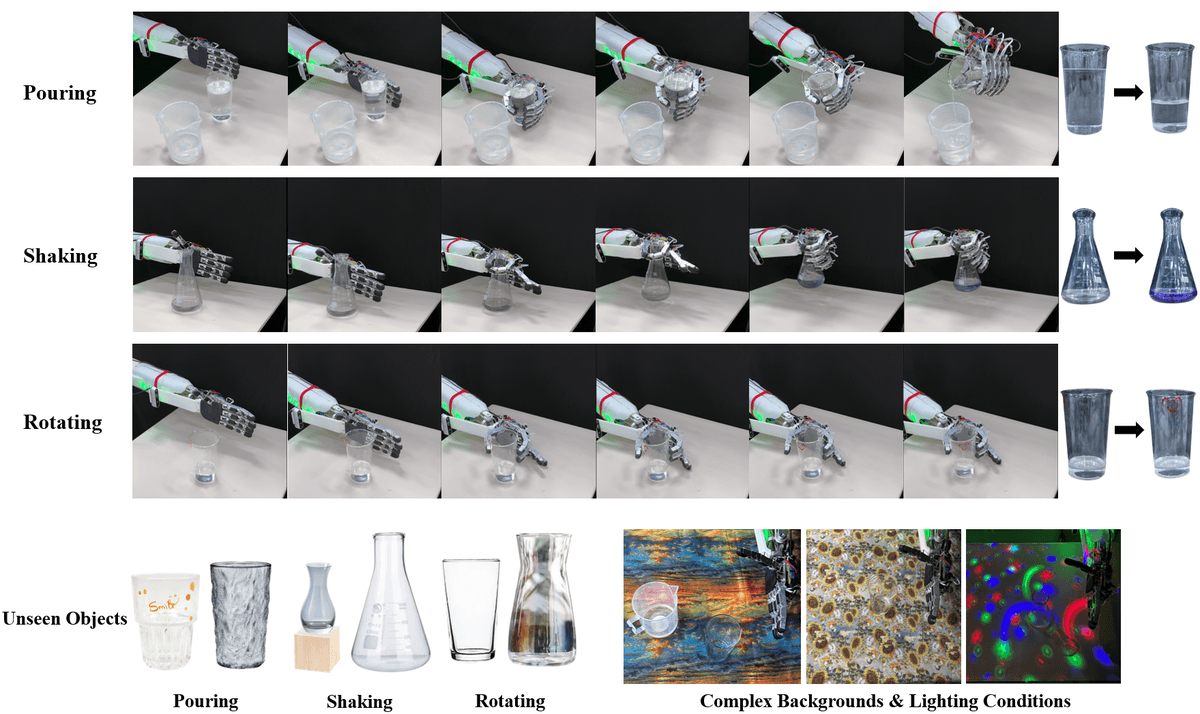
Three tasks were evaluated on the physical setup: pouring water from a glass cup into a measuring cup, shaking a conical flask containing a glucose and NaOH solution until it turns purple, and rotating a glass cup 90+ degrees using thumb, index, and middle fingers.
| Method | Pouring | Shaking | Rotating | Avg |
|---|---|---|---|---|
| 3D-ViTac | 0% | 0% | 0% | 0% |
| DP3 | 10% | 0% | 50% | 20% |
| 3DTacDex-P | 70% | 50% | 20% | 47% |
| TransDex | 100% | 80% | 70% | 83% |
The ablations are the more interesting numbers. Removing differentiated prediction (using one shared head for arm and hand) drops the average to 0%. Removing tactile inputs drops it to 7%. Removing the point cloud reconstruction pre-training and training the encoder from scratch drops it to 23%. All three components pull real weight, but pre-training alone is worth 60 percentage points.
Generalization tests are also strong. Under unseen complex backgrounds the policy holds 80%, under challenging lighting 73%, and on unseen transparent objects 80%. A 2D image variant using the 3DTacDex architecture scored 0% on rotating under the same complex conditions, since transparent object contours blur into cluttered backgrounds in RGB.
Where it helps and where it does not
The most useful signal here is that a self-supervised reconstruction objective, trained purely in simulation, can teach a Transformer to reason about object shape from grasp configuration alone, and that this transfers zero-shot to noisy real point clouds when tactile contact points are supplied. That is directly relevant to anyone building manipulation policies for glassware, lab automation, kitchen robotics, or any scene where depth sensing is unreliable.
The limitations are honest. Pre-training data is fully simulated, so more complex real-world scenes still need adaptation. The tactile sensors have finite spatial resolution and update frequency, which caps performance in contact-rich cases like re-establishing finger contact on wide-mouth vessels during rotation (this was the main failure mode on unseen objects). And the paper does not release checkpoints or datasets publicly at the time of writing, though a project page is referenced. Anyone wanting to reproduce this will need the specific USTC dexterous hand and PaXini tactile stack, or a close equivalent.