
USTC's SCL Trains Llama to Read Medical Records 5x Cheaper
A new training framework called Span-Centric Learning cuts ICD coding training time by 5x while making LLM predictions auditable with evidence.
 Pro
Takeaways
- Span-Centric Learning (SCL) trains LLMs for ICD coding using short evidence spans instead of full clinical documents. Paper
- Llama-3.1-8B with SCL gains 8.2 macro-F1 on ACI-Bench versus standard SFT, at 20% of training cost.
- Training time drops from 210 hours to 40 hours on a single H20 GPU, a 5.2x speedup.
- Three-tier span dataset: gold pairs from ICD Alphabetic Index, silver from Llama-3.1-70B mining, synthetic from GPT-5.1.
- Model outputs evidence spans before codes, enabling human auditing; human-corrected evidence boosts Micro-F1 to 78.0.
- Uses MDACE and ACI-Bench benchmarks; no public code release announced yet.
Medical coding is one of those unglamorous but load-bearing tasks in healthcare: every diagnosis in a clinical document has to be mapped to a standardized ICD code for billing, epidemiology, and analytics. A team from USTC and iFlyHealth just published a paper arguing that the way we currently fine-tune LLMs for this task is both expensive and interpretability-destroying, and that there's a much cheaper path built on short evidence spans instead of full clinical notes.
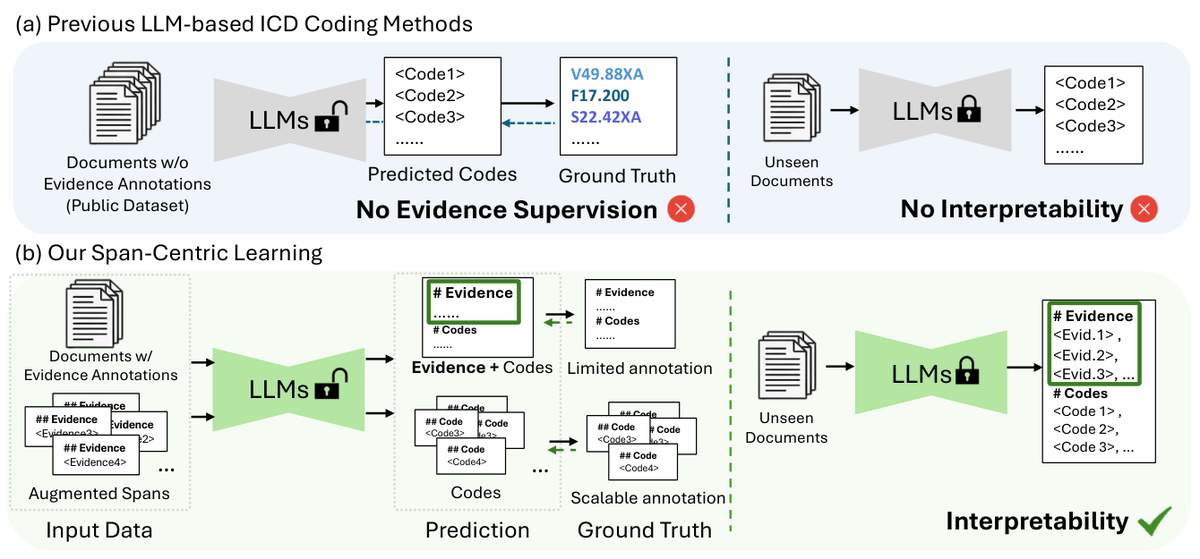
Their framework, called Span-Centric Learning (SCL), lets a Llama-3.1-8B model beat standard supervised fine-tuning by 8.2 macro-F1 points while using roughly 20% of the training cost. It also forces the model to emit textual evidence for each predicted code, which means a human coder can actually verify what the model did.
Why ICD coding breaks LLM fine-tuning
The core issue is data. Official coding guidelines require that each assigned code be traceable to explicit supporting evidence in the medical record, but almost no public dataset provides those evidence annotations. The only publicly available dataset with expert-annotated evidence is MDACE, a small subset of MIMIC-III whose limited scale restricts it to evaluation rather than training.
That leaves three bad options for anyone trying to build an automated coder:
- Use large proprietary LLMs like GPT-4.1 in a training-free pipeline, which is a non-starter for hospitals with privacy constraints.
- Fine-tune a smaller LLM on code-only labels, which boosts coding accuracy at the cost of sacrificing the LLM's inherent evidence-grounding ability.
- Train discriminative classifiers with label attention, which produce codes but not the kind of explicit textual justification clinicians need to audit.
On top of that, MIMIC-IV clinical notes average around 1,500 words, so fine-tuning over full documents is computationally punishing.

The key insight: decompose the task
The authors observe that document-level ICD coding is really three sub-tasks stitched together: evidence localization, evidence aggregation, and code assignment. Localization and code assignment are largely local operations that can be learned from short evidence spans. Aggregation, the part that requires reading across a long document, is more general and needs only a handful of fully-annotated examples to learn.
SCL exploits this by using two training signals in parallel:
- Document-level supervision: fewer than 200 MDACE documents with human-annotated evidence spans teach the model how to scan a full note, pull out relevant spans, and assign codes end-to-end.
- Span-level supervision: around 150k short (evidence, code) pairs teach the model the actual medical-to-code mappings without any long-document overhead.
Building 150k evidence-code pairs without annotators
The span-level dataset is where the interesting engineering lives. SCL constructs three tiers:
- Gold pairs come from the ICD Alphabetic Index, the authoritative reference human coders already consult. Terms are paired with their default ICD codes.
- Silver pairs are mined from MIMIC-IV using a two-stage Llama-3.1-70B pipeline: first extract candidate evidence spans for each code from each note, then consolidate them per-code into a small set of representative expressions.
- Synthetic pairs fill in ICD codes that no public dataset covers. For each uncovered code, GPT-5.1 is prompted with the nearest neighbor code in the ICD-10-CM hierarchy plus its associated evidence, and asked to infer plausible supporting text.
Numbers that matter
On the MDACE benchmark with Llama-3.1-8B, SCL reaches 59.3 Micro-F1 and 35.2 Macro-F1, compared to 57.4/34.5 for standard SFT and 40.0/29.1 for the agentic CLH baseline on the same backbone. On the out-of-distribution ACI-Bench, the Macro-F1 gap widens to 8.2 points over SFT.
Training efficiency is the other headline. Standard SFT on 100k MIMIC-IV documents takes 70 hours per epoch for a total of 210 hours on a single H20 GPU, while SCL on 200 evidence-annotated documents plus 150k spans takes 4 hours per epoch and 40 hours total, roughly a 5.2x reduction.
The interpretability payoff is real too. Because the model outputs evidence spans before codes, a human coder can inspect and revise them. Replacing model-generated evidence with human-annotated evidence at inference time raises Micro-F1 from 59.3 to 78.0 and Macro-F1 from 35.2 to 54.8, suggesting a genuinely useful human-in-the-loop workflow.
What SCL is not good at
A few caveats worth flagging. The synthesized silver and synthetic spans inevitably contain noise, and the authors acknowledge they haven't systematically studied how span quality affects downstream performance. The framework was only evaluated on English clinical notes with ICD-10; multilingual generalization is future work. And while the paper reports strong gains on rare and unseen codes, the underlying benchmarks themselves are known to have annotation quality issues, so the absolute F1 numbers should be read with some caution.
Why this matters beyond ICD coding
The broader lesson is a training-data pattern: when your ground-truth task involves long documents but the underlying knowledge is local, you don't need long-document annotations at scale. A small aggregation-teaching set plus a large span-level knowledge base can outperform brute-force document fine-tuning. The authors explicitly frame span-centric learning as a general strategy for clinical NLP tasks where document-level supervision is expensive but span-level knowledge is cheap to synthesize or mine.
No code repository is linked in the paper as of this writing, so anyone wanting to reproduce SCL will need to rebuild the pipeline from the described prompts and the public MDACE, MIMIC-IV, and ACI-Bench datasets. Given the modest hardware requirements, a single H20 with 96GB VRAM, that's a reasonable weekend project for a motivated team.