
USTC Researchers Map How Deep Learning Is Reinventing Adaptive Testing
A comprehensive ML-focused survey maps how deep learning, reinforcement learning, and meta-learning are reshaping adaptive testing for both humans and AI model evaluation
 Pro
Takeaways
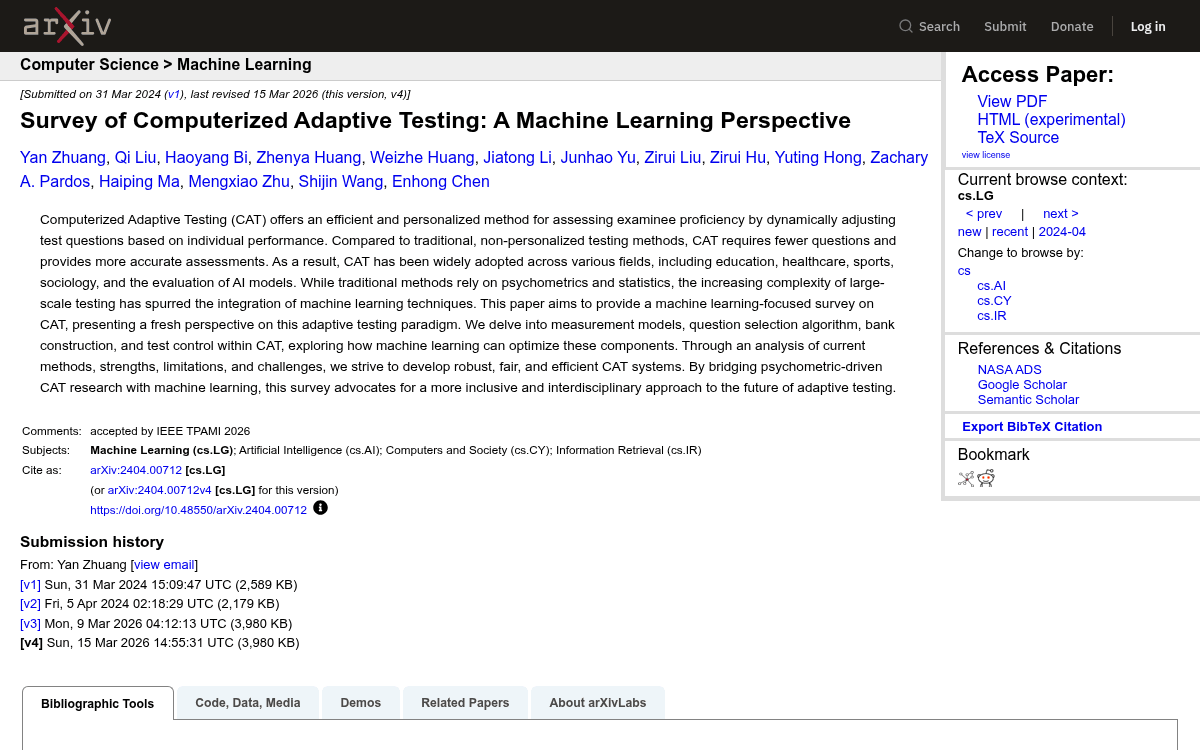
- Researchers from USTC, UC Berkeley, and iFLYTEK publish the first ML-focused survey of Computerized Adaptive Testing (CAT), covering the full system lifecycle. [Paper]
- CAT dynamically selects questions based on estimated ability, requiring fewer questions for the same accuracy as fixed tests like the GRE and GMAT.
- Five question-selection paradigms are surveyed: statistical (Fisher/KL), active learning, reinforcement learning, meta-learning (BOBCAT), and subset selection (BECAT), with data-driven methods outperforming classical baselines.
- A key new application: CAT principles can shrink LLM benchmarks to under 3% of original size while accurately ranking over 5,000 models, slashing evaluation compute costs.
- Test control challenges (exposure, fairness, robustness, search efficiency) are covered in depth, with tree-based indexing reducing question search from O(|Q|) to O(log|Q|).
- Code and datasets are open-sourced at EduCAT and EduData on GitHub.
Every time you take the GRE or GMAT, a quiet algorithm is deciding which question to show you next. That algorithm is the heart of Computerized Adaptive Testing (CAT), a paradigm that has been quietly running high-stakes assessments for decades. Now, a team of 15 researchers from USTC, UC Berkeley, and iFLYTEK has published what they claim is the first comprehensive survey of CAT through a machine learning lens, cataloging how deep learning, reinforcement learning, and meta-learning are transforming every component of the system.
The core problem CAT solves
CAT offers an efficient and personalized method for assessing examinee proficiency by dynamically adjusting test questions based on individual performance, requiring fewer questions while providing more accurate assessments than traditional fixed tests. The central challenge is deceptively simple to state: given a large bank of questions, which one should you ask next to learn the most about someone's ability as quickly as possible?
Traditional approaches borrowed from psychometrics, specifically a framework called Item Response Theory (IRT), which models each question by three parameters: difficulty (the ability level at which you have a 50% chance of getting it right), discrimination (how well the question separates high from low performers), and a guessing factor. Almost all major adaptive tests for humans, such as SAT and GRE, are developed using IRT, because the methodology can significantly improve measurement reliability and interpretability. The question selection rule is equally clean: pick the question whose difficulty best matches your current estimated ability, maximizing the statistical information gained from each response.

Why statistics alone isn't enough anymore
While traditional methods rely on psychometrics and statistics, the increasing complexity of large-scale testing has spurred the integration of machine learning techniques. The problem is scale and diversity. Modern online education platforms accumulate millions of examinee responses. Static, hand-crafted selection rules can't exploit that data. And the same framework is now being asked to evaluate not just students, but AI models.
CAT has also been increasingly used to assess AI capabilities, such as textual entailment recognition, chatbots, machine translation, and general-purpose AI systems. Existing benchmarks like MMLU contain 14,000 questions, and evaluating a single LLM on the full HELM benchmark can consume over 4,000 GPU hours. By leveraging adaptive testing, researchers can analyze the characteristics of benchmark questions to customize assessments for each AI system and estimate the latent traits behind each model's responses, rather than merely calculating accuracy.
The four pillars of a CAT system
The survey organizes the entire CAT lifecycle into four components, each of which ML is now touching:
- Measurement Model: Estimates the examinee's current proficiency from their response history. Ranges from classical IRT to deep learning models like NeuralCD, which uses a non-negative neural network to capture complex examinee-question interactions.
- Selection Algorithm: The core of CAT. Picks the next question to maximize information gained. This is where the ML revolution is most visible.
- Question Bank Construction: Building and maintaining the pool of questions, including annotating difficulty, discrimination, and knowledge concepts. LLMs are beginning to play a role here as automated annotators and item generators.
- Test Control: Governing fairness, exposure balance (preventing the same questions from being overused), robustness to guessing, and search efficiency over large banks.
Five generations of question selection
The survey's most technically dense contribution is its taxonomy of selection algorithms, which the paper traces through five distinct paradigms:
- Statistical algorithms (Fisher/KL Information): Classic approaches that score each question by how much statistical information it provides about the examinee's ability. Simple, interpretable, and still dominant in production systems. The limitation is that they are model-specific and require expert design for each new measurement model.
- Active Learning: Treats question selection as a model-agnostic data selection problem. The MAAT framework, for example, picks questions that would produce the largest gradient update to the proficiency estimate, making it work with any underlying measurement model.
- Reinforcement Learning: Frames the entire test as a Markov Decision Process, where the policy (selection algorithm) is learned from large-scale response data. A Transformer-based Q-Network named NCAT incorporates a Double-Channel Performance Learning module that independently captures diverse aspects of examinee performance, and a Contradiction Learning module that identifies inconsistencies in examinee behavior such as guessing and slipping.
- Meta-Learning: Learns a general selection strategy across thousands of examinees that can rapidly adapt to a new individual. The BOBCAT framework uses bi-level optimization: an inner loop estimates proficiency for a specific examinee, while an outer loop optimizes the selection policy across all examinees in the training set.
- Subset Selection: Reframes the problem globally. Instead of picking questions one at a time, BECAT finds the subset of T questions whose gradient signals best approximate those of the entire question bank, providing theoretical upper bounds on estimation error.

The performance comparison across these paradigms is telling. On the ASSISTments and Eedi2020 datasets, data-driven methods (RL, meta-learning) consistently outperform statistical baselines, with BECAT achieving AUC scores of 71.44 at step 5 and 73.61 at step 20 on ASSISTments with IRT, compared to Fisher Information's 67.95 and 71.33 respectively. The subset selection approach achieves this without any training, relying instead on theoretical guarantees.
| Category | Model-Agnostic | Needs Training | Key Advantage | Key Limitation |
|---|---|---|---|---|
| Statistical (Fisher/KL) | No | No | Simple, interpretable | IRT-specific, expert design needed |
| Active Learning | Yes | No | Flexible, gradient-based | Ignores latent model parameters |
| Reinforcement Learning | Yes | Yes | Learns from data, sequential | Training cost, potential data bias |
| Meta-Learning | Yes | Yes | Fast adaptation per examinee | Training cost, potential data bias |
| Subset Selection | Yes | No | Theoretical error guarantees | Weaker at early test stages |
The hidden complexity: test control
Beyond accuracy, real-world CAT systems must manage several competing constraints that the survey covers in depth. Exposure control prevents the same questions from being overused, which matters both for test security in human exams and for data contamination in LLM benchmarks. It has been observed that benchmarks released before the creation date of an LLM's training data generally perform better than those released afterward, making exposure control a necessary measure to improve reliability of AI assessments.
Fairness is a three-way problem in CAT: bias can enter through the measurement model (skewed training data), the question bank (culturally unequal questions), or the selection algorithm itself (Fisher Information systematically favors high-discrimination questions, which may correlate with specialized knowledge). Search efficiency is a practical bottleneck: brute-force selection over a large question bank is O(|Q|) per step. Tree-based indexing methods can reduce this to O(log|Q|), a critical improvement for real-time testing at scale.
What's now possible that wasn't before
The survey's most forward-looking section addresses LLM evaluation. One study reduces six commonly used benchmarks to less than 3% of their original size while accurately estimating the performance of over 5,000 LLMs. This is the practical payoff of applying CAT principles to AI evaluation: faster, cheaper, and more principled benchmarking.
The authors also envision LLMs playing a dual role inside CAT systems themselves, acting as automated item generators and metadata annotators, essentially functioning as "librarians" that can draft new questions on demand and tag them with difficulty estimates, knowledge concept labels, and common error patterns. This would allow question banks to scale without proportional human annotation cost.

Limitations and open problems
The survey is candid about where ML-based CAT falls short. Despite superior benchmark performance, data-driven methods have not replaced statistical approaches in production systems. In testing scenarios that prioritize interpretability or efficiency, statistical methods remain predominant. Deep learning models for proficiency estimation are black boxes, which is a serious problem in high-stakes testing where examinees and institutions may need to audit or appeal results.
Other open challenges include:
- Cold-start proficiency estimation: CAT is inherently a few-shot problem, and deep learning models trained on population-level data may not generalize well to unusual individual response patterns.
- Multi-dimensional assessment: most current systems estimate a single ability score; modeling fine-grained knowledge mastery across many concepts simultaneously remains hard.
- Process data: response time, mouse movements, and hesitation patterns carry proficiency signal that current models largely ignore.
- Fairness-accuracy tradeoffs: enforcing equitable treatment across demographic groups often requires deviating from the statistically optimal question sequence.
The team has open-sourced implementations of the surveyed CAT models at EduCAT on GitHub, along with a companion dataset library at EduData covering ASSISTments, EdNet, Junyi, and Eedi2020. For anyone building adaptive assessment systems, whether for students or for evaluating the next generation of language models, this survey is the most complete map of the terrain available.