
USC's TS-Reasoner Hits 98.6% Accuracy Where GPT-4o Keeps Failing
USC researchers built TS-Reasoner, an agent that decomposes time series queries into structured operator pipelines, outperforming GPT-4o, o1 and ReAct on multi-step inference.
 Pro
Takeaways
- TS-Reasoner is an LLM agent that decomposes time series queries into structured operator pipelines with error and quality feedback.
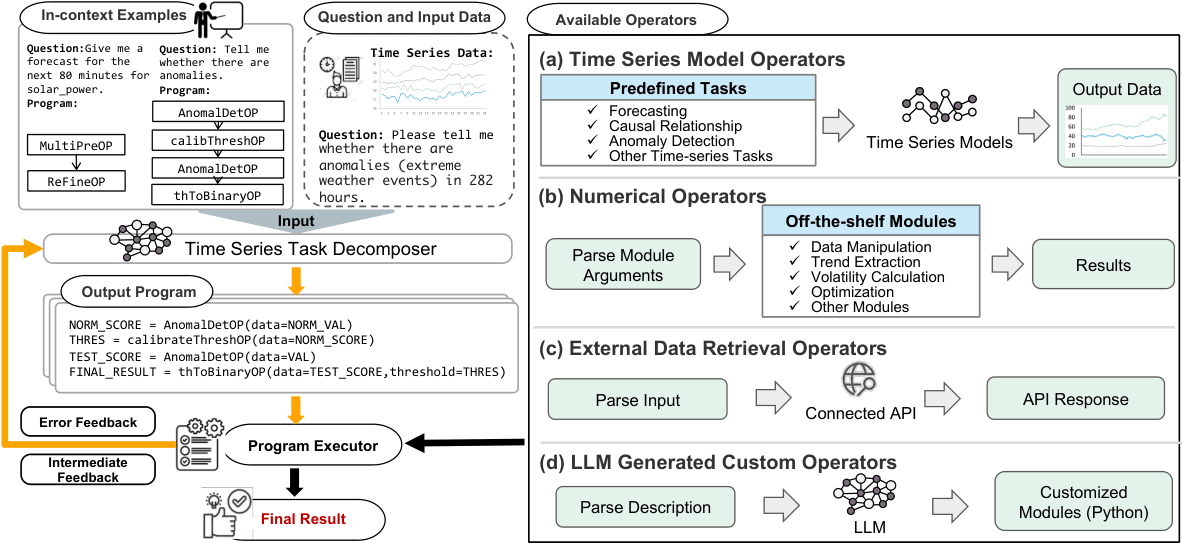
- The toolkit includes 57 operators spanning forecasting models, statistics, external data APIs, and LLM-generated custom code.
- On predictive tasks with covariates it hits 98.6% success at 0.062 MAPE, beating GPT-4o, o1, DeepSeek and ReAct.
- On TimeSeriesExam causality it improves 87% over the strongest baseline through program-aided statistical analysis.
- Ablations show custom operators drive constraint handling, while retrieval operators cut MAPE by roughly 50%.
- Code and the ~500-task benchmark are available on GitHub; LLaMA 3.1 70B matches GPT-4o performance.
Ask a general-purpose language model to forecast the next hour of electricity load while keeping ramp rates below a fixed threshold, and you quickly discover the gap between reasoning and computing. The model can talk about the problem, but the numbers rarely check out. A new system from USC called TS-Reasoner attacks that gap by treating the LLM as a planner rather than a calculator, pairing it with a toolbox of 57 specialized time series operators.
The paper, accepted at TMLR, formalizes what the authors call multi-step time series inference: analytical workflows that involve fetching covariates, running forecasting or diagnostic models, checking domain constraints, and iterating on the result. Existing time series foundation models handle individual subtasks well but lack mechanisms for instruction following, workflow assembly, and constraint-aware reasoning. LLMs bring the reasoning and stumble on numerical precision.
Why plain LLMs keep failing on time series
The failure modes are well documented. LLMs struggle with temporal pattern recognition and numerical computation because of discretization artifacts and their optimization for token prediction rather than numerical estimation. Asking GPT-4o to output a 68-value load forecast that satisfies a hard megawatt constraint is essentially asking it to do arithmetic through token sampling.
Retraining a foundation model to fix this is expensive and brittle. TS-Reasoner takes the opposite path: keep the LLM, but move all the numbers to code.
An LLM that writes pipelines, not predictions
The architecture separates high-level reasoning from computational execution. A task decomposer, embodied by an LLM, reads a natural-language query along with in-context examples of operator definitions and sample task-solution pairs. It emits a sequence of operator calls. A program executor runs them. If something breaks or the output looks wrong, an error message flows back to the decomposer for a revised plan, up to