
USC's MemRoPE Generates Coherent Hour-Long AI Video Without Retraining
A new training-free method keeps a fixed-size cache while generating hour-long autoregressive videos without identity drift or quality collapse.
 Pro
Takeaways
- MemRoPE is a training-free framework enabling hour-scale autoregressive video generation with fixed-size KV cache.
- Memory Tokens use dual long-term and short-term EMA streams to compress all past keys.
- Online RoPE Indexing stores unrotated keys and applies rotary embeddings at attention time, avoiding phase cancellation.
- Beats Self-Forcing and Rolling Forcing baselines with 98.3% and 82.6% user preference respectively on LongLive.
- Highest VBench-Long scores across 30-second to 1-hour durations, gap widens with video length.
- Code at github.com/YoungRaeKimm/MemRoPE; accepted to ECCV 2026.
Generating a coherent hour of video with an autoregressive diffusion model has been a losing battle against memory. Sliding-window caches forget the beginning of the clip, characters slowly morph into strangers, and motion drifts into a loop. A new paper from USC, MemRoPE, proposes a training-free fix that keeps the cache small, keeps the identity stable, and does not require retraining the base model.
The core idea is simple to state: instead of keeping raw historical frames or dropping them, keep a running summary of everything the model has seen, and be careful about where positional embeddings enter the pipeline. The method requires no additional training and enables unlimited generation with a fixed-size KV cache, preserving both subject identity and visual fidelity throughout continuous long-form generation.

Why long autoregressive video breaks
Autoregressive video diffusion models generate frames one chunk at a time, conditioning each new frame on a cache of past keys and values. That cache has to be bounded, so implementations resort to a first-in-first-out sliding window. Existing sliding-window caches discard past context, causing fidelity degradation, identity drift, and motion stagnation over long horizons, and current approaches preserve a fixed set of early tokens as attention sinks, but this static anchor cannot reflect the evolving content of a growing video.
An attention sink is a small set of early tokens that the model always attends to, borrowed from the language-model trick that stabilizes streaming inference. It works for short extensions, but a fixed anchor from second one cannot possibly describe what is happening at minute forty. Recent alternatives like Deep Forcing tried to intelligently compress the cache, but MemRoPE's authors argue those approaches converge to stagnant token sets and cause abrupt visual shifts.
There is a second, subtler problem: Rotary Position Embeddings (RoPE). RoPE rotates each key vector by an angle tied to its position, and most cache implementations store the already-rotated keys. If you try to average keys from different timesteps, you are averaging vectors with different rotations, which mathematically cancels information rather than compressing it.
Two mechanisms that only work together
MemRoPE introduces two co-designed components. The first, Memory Tokens, replaces eviction with aggregation. Instead of dropping old tokens or selecting and retaining discrete anchor tokens, the method maintains a fixed number of memory tokens that continuously absorb information from new frames using an Exponential Moving Average, providing a compressed, evolving summary of the entire video history.
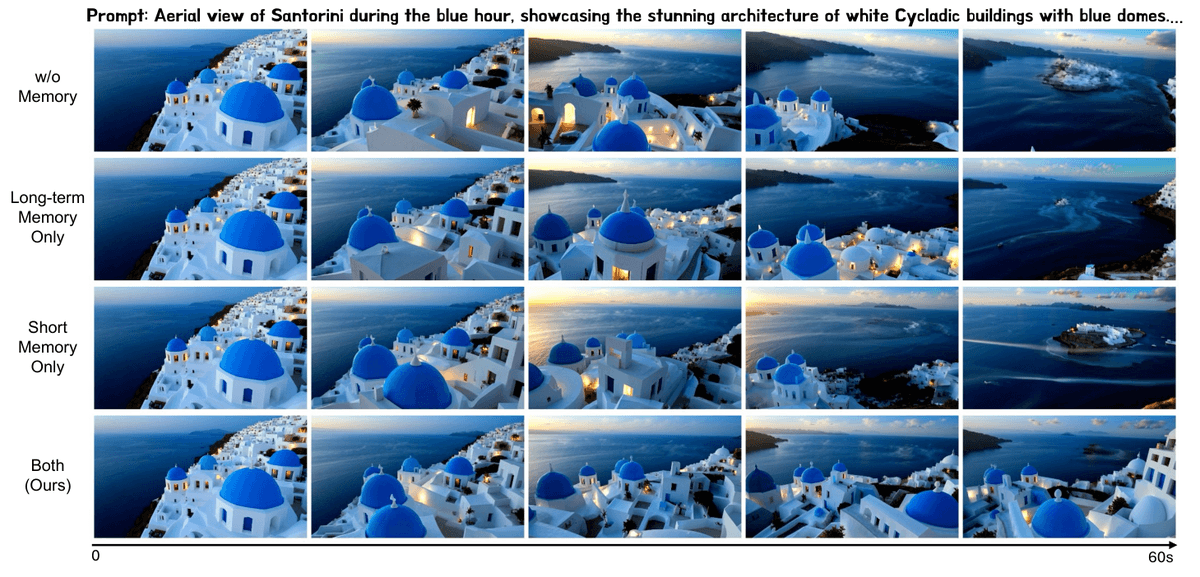
Crucially, there are two parallel EMA streams with different decay rates. The long-term stream uses a small decay rate to accumulate the full generation history, which stabilizes global identity and persistent scene elements. The short-term stream uses a larger decay rate to track recent dynamics. Think of it as a slow-moving average for who the character is, plus a fast-moving average for what they are currently doing.

The second component, Online RoPE Indexing, is what makes averaging keys actually work. Standard Rotary Positional Embeddings entangle positional information with the keys, making EMA aggregation destructive due to phase cancellation, so the method decouples positional embeddings from the cached keys, applying RoPE only online during the attention calculation, enabling clean temporal aggregation. At each step, the entire active cache, including sink tokens, memory tokens, the local window, and the current query, receives a contiguous zero-indexed map, and RoPE is applied fresh using those block-relative indices. That keeps every index within the model's trained range, sidestepping the RoPE extrapolation cliff that plagues long generation.
The paper frames these as mutually enabling. Position decoupling makes temporal aggregation mathematically well-defined; aggregation is what makes a fixed-size cache viable for unbounded video. Neither piece works alone.
How it holds up
The authors evaluated MemRoPE on two autoregressive base models, Self-Forcing and LongLive, at durations ranging from 30 seconds to one full hour. On VBench-Long, MemRoPE posted the highest average scores across every tested duration on both base models, and the gap over baselines widened monotonically with length. It performed especially well on metrics that punish long-range drift: Aesthetic Quality, Imaging Quality, and Subject Consistency.
A user study with 30 participants across six perceptual dimensions showed 98.3% overall preference for MemRoPE over Self-Forcing, and 82.6% preference over Rolling Forcing when using LongLive as the base. Ablations show the dual EMA streams capture complementary information, and the method is robust to hyperparameter choice, with average scores varying by less than 0.7 points across 12 decay-rate combinations.

What it will not fix
MemRoPE has honest limits. As a training-free method built on a frozen checkpoint, per-frame quality is bounded by the base model, and the EMA aggregation is also lossy by design, which may limit precise recall of distant content. If you need a specific object from minute two to reappear exactly at minute fifty, an averaged memory token is not going to give you that. The technique also inherits any content, physics, or motion weaknesses of Self-Forcing or LongLive underneath it.
Where it fits
The paper is on arXiv and code is published at YoungRaeKimm/MemRoPE on GitHub, and it has been accepted at ECCV 2026. Because it is a training-free, plug-and-play inference-time modification, it can be dropped onto existing autoregressive video diffusion checkpoints without new training runs or architectural surgery. It sits in a fast-moving cluster of long-form video work that includes Infinity-RoPE and Deep Forcing, and points at the same conclusion those papers are converging on: the bottleneck for infinite video is not model capacity, it is how the model remembers.
Practical use cases the authors call out are continuous world simulation, cinematic long takes, and synthetic data generation for training downstream models. Anywhere you want a stream of frames that stays on model for tens of minutes without collapsing into a fever dream, this is a useful primitive.