
USC's HumDex Opens Humanoid Robot Training With 91.7% Success for Under $200
A portable IMU-based teleoperation rig plus two-stage imitation learning lets a Unitree G1 handle whole-body dexterous tasks like scanning barcodes and hanging towels.
 Pro
Takeaways
- HumDex is a portable IMU-based teleoperation system for humanoid whole-body dexterous manipulation, open-sourced on GitHub.
- A learned MLP replaces per-frame optimization for mapping human fingertips to 20-DoF robot hand joints.
- Two-stage imitation learning pretrains on human data, then fine-tunes on robot data to bridge the embodiment gap.
- Beats a vision-based TWIST2 baseline: 91.7% vs 74.6% teleop success, 80% vs 57.5% policy success.
- Doubles generalization to unseen objects and backgrounds compared to robot-only training on PickBread.
- Includes a sub-$200 DIY SlimeVR build that nearly matches the commercial VIRDYN mocap suit.
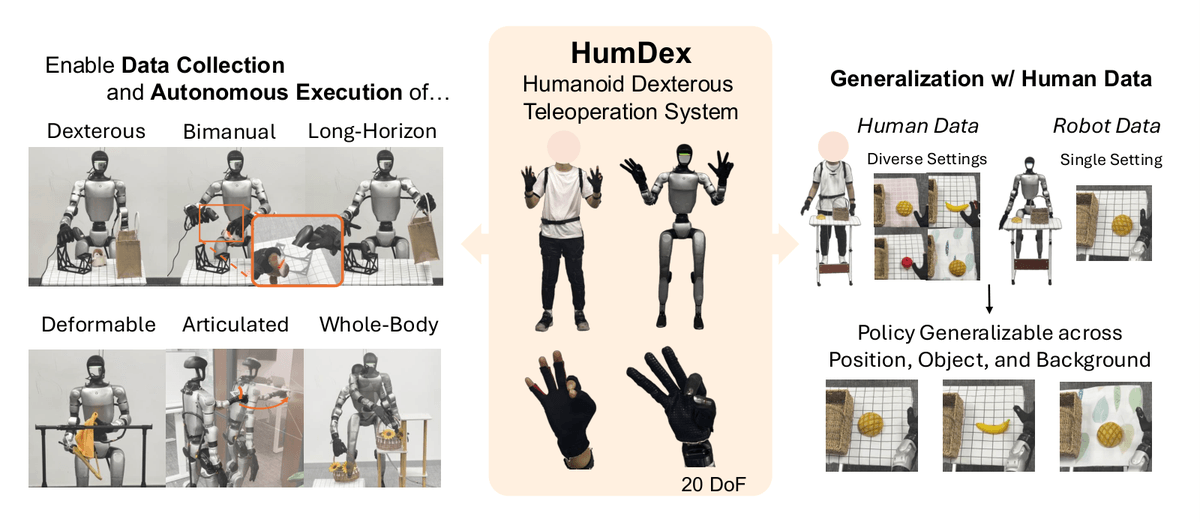
Collecting demonstration data for humanoid robots with dexterous hands is one of the ugliest bottlenecks in robotics. Motion capture rooms are precise but immobile, exoskeletons are heavy, and VR headsets lose tracking the moment your hand disappears behind an object. A team from USC's Physical Superintelligence Lab and WorldEngine AI is trying to end that trade-off with HumDex, a fully open-sourced teleoperation stack built around IMU trackers, a learned hand retargeter, and a two-stage imitation learning recipe that pretrains on cheap human data before fine-tuning on the robot.
Why vision-based teleop keeps breaking
Current humanoid teleoperation systems fall into two camps, each with a painful compromise. Despite recent advances in humanoid motion retargeting and low-level locomotion policies, dexterous hand control still largely relies on optimization-based retargeting, leading to reduced accuracy and limited generalization. On the hardware side, mocap and exoskeleton rigs are accurate but tethered to a room, while VR headsets are portable but blind whenever the operator's hands leave the sensor's field of view. That is fatal for any task involving tool use, because the tool itself occludes the fingers doing the work.
HumDex sidesteps the visibility problem entirely by using a 15-node inertial motion capture suit plus inertial gloves. Because IMUs measure motion locally, they don't care whether your hand is behind your back or wrapped around a barcode scanner. The team also ships a DIY alternative built on the open-source SlimeVR ecosystem for under $200, using ICM-45686 IMUs and nRF52840 radios running the Enhanced ShockBurst protocol to survive crowded Wi-Fi environments.

Teaching an MLP to move fingers
The other half of the system is a new approach to hand retargeting, the process of mapping human finger poses onto a robot hand with different geometry. Most systems solve a per-frame inverse kinematics problem, which is slow and prone to weird artifacts like fingers collapsing into easier-but-wrong poses. HumDex replaces this with a tiny supervised MLP.
The network takes the 3D positions of the five fingertips in the wrist frame (15 numbers) and outputs the 20 joint angles of the WUJI dexterous hand. It uses a finger-wise modular design where each finger gets its own subnetwork:
Input(3) -> FC(128) -> LeakyReLU -> BN
         -> FC(128) -> LeakyReLU -> BN
         -> FC(4)   -> Tanh
Training data comes from about 20 minutes of glove recording (~20k paired frames) with joint targets solved offline via optimization-based IK. Once trained, the MLP runs in constant time and produces noticeably cleaner motion than the per-frame optimizer, especially for finger individuation tasks like the rock sign or touching individual fingers to the thumb.

Human data as a pretraining substrate
The most interesting contribution is arguably the two-stage training pipeline. The tracker suit lets the same operator collect data either by driving the robot (slow, hard) or by just doing the task themselves (fast, easy). The obvious problem is that human kinematics don't match the G1 kinematics, so you can't just replay human motions on the robot.
The team's solution is deceptively simple. Stage one trains an Action Chunking Transformer policy exclusively on human demonstrations, using retargeted joint targets as the action and approximating the missing proprioceptive state with the previous timestep's action. Stage two fine-tunes the same policy on a small amount of robot teleoperation data to close the embodiment gap.
Naively mixing the two datasets does not work. The complete failure of the Mix baseline (0% success) highlights the challenge of the embodiment gap, because the network is forced to map similar visual states to two conflicting action distributions. Sequential training avoids that conflict.
The numbers
The team evaluated on five tasks that stress different capabilities: Scan&Pack (grab a barcode scanner and pull its trigger), HangTowel, OpenDoor, PlaceBasketOnShelf, and PickBread. Against a vision-based baseline built on TWIST2 plus vision-based hand tracking:
- The baseline could not perform Scan&Pack at all because the scanner occludes the fingers; HumDex hit a 90% teleoperation success rate.
- On the four tasks both systems could attempt, HumDex cut collection time for 60 episodes from 59.8 to 44.3 minutes, a 26% speedup.
- Teleoperation success rate averaged 91.7% versus 74.6% for the baseline.
- Policies trained on HumDex data hit 80.0% success versus 57.5% for the baseline.
For generalization on PickBread, a policy trained only on 50 robot episodes overfit hard, dropping to 30% success on unseen backgrounds. The two-stage policy pretrained on 700 human episodes covering varied positions, objects, and backgrounds roughly doubled that, reaching 25/30 on unseen backgrounds and 20/30 on unseen objects. The cheap SlimeVR 14-node build came within a couple of trials of the commercial VIRDYN suit, though dropping to 7 nodes noticeably hurt complex bimanual tasks.
What it is good for, and what it is not
HumDex is aimed squarely at people trying to bootstrap humanoid manipulation policies without an expensive mocap studio. The full code, hardware bill of materials, and hand retargeting network are on GitHub, and the pipeline supports the Unitree G1 out of the box with modular low-level controllers including TWIST2 and SONIC. The framework is hardware-agnostic on the tracking side too, mixing and matching Vdmocap, SlimeVR, Vdhand, Manus, and Xsens.
The authors are honest about the limits. Training data is still small by foundation-model standards, hand data covers only a narrow slice of possible postures and does not include force feedback, and the G1's payload caps what behaviors are physically executable. The failure analysis shows the remaining rough edges clearly: the door task sometimes unlatches successfully but stalls before reaching the 45 degree threshold because the locomotion policy doesn't walk far enough forward, and PickBread occasionally grasps empty air when the object appears in positions far outside the fine-tuning distribution.