
USC's DreamPlan Teaches Robots to Handle Cloth and Ropes, Nearly Doubling AI Performance
A new framework lets robots learn deformable object manipulation from imagined video rollouts, doubling success rates without massive real-world data.
 Pro
Takeaways
- DreamPlan fine-tunes a VLM planner using video world model rollouts, avoiding costly real-robot RL. Paper
- Qwen3-VL-8B + DreamPlan hits 0.60 average score vs 0.35 for Qwen3-VL-32B zero-shot on deformable tasks.
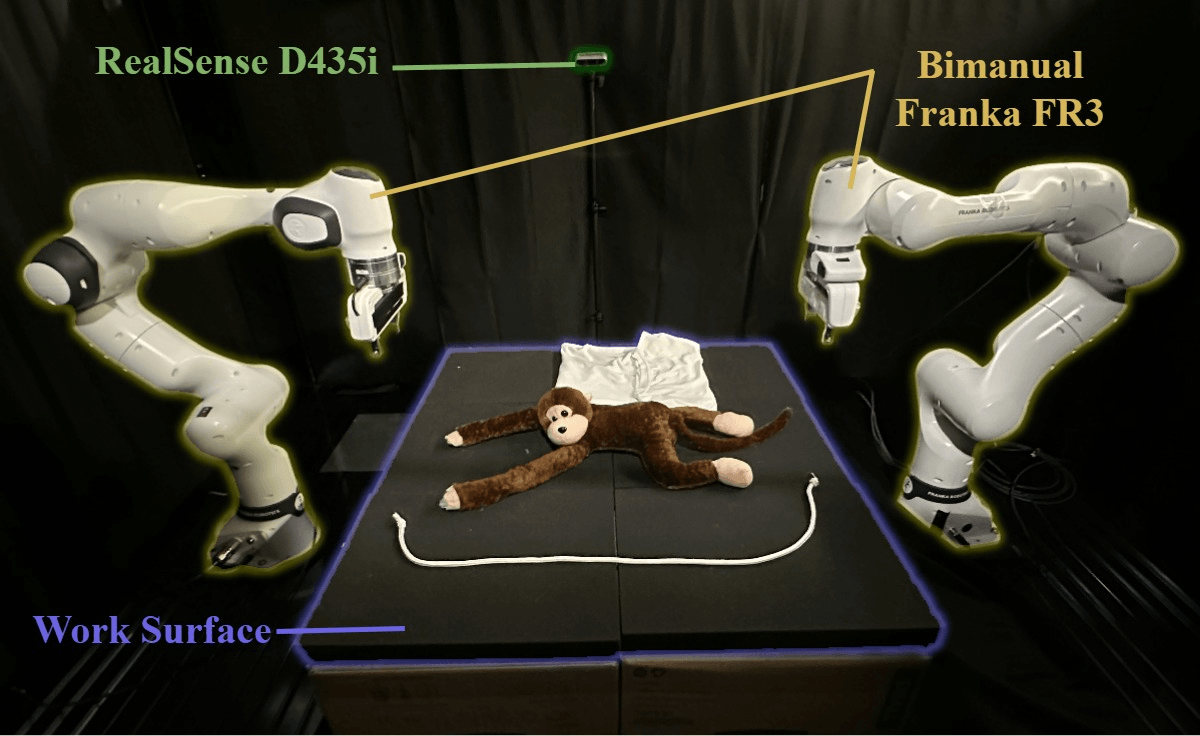
- Trained on only ~2000 trajectories collected in about 4 hours of autonomous robot interaction.
- Uses ControlNet-style conditioning of CogVideoX-5B on rendered robot arm motions.
- Best-of-K sampling plus ORPO decouples slow video diffusion from the policy gradient loop.
- Inference takes ~1 second vs 900-2600 seconds for sampling-based world-model verification. Project
Robots that can reason about the world using large vision-language models still struggle to actually move things around, especially when those things are ropes, cloth, or squishy toys. A new framework called DreamPlan from the USC Physical Superintelligence Lab and Toyota Research Institute tries to fix that by fine-tuning a VLM planner entirely inside the imagination of a video world model, sidestepping the need for large-scale physical rollouts.
On three real-world deformable manipulation tasks, DreamPlan pushes a Qwen3-VL-8B planner from an average score of 0.33 up to 0.60, nearly doubling the performance of the strongest zero-shot baseline while running inference in about one second per decision.
Why VLM planners keep fumbling ropes and cloth
The paper starts from a well-known frustration in the VLA world. VLMs trained on broad multimodal data have strong semantic priors and reasoning ability, which makes them attractive as zero-shot planners that generate high-level plans, subgoals, or tool-use commands from visual observations and language instructions. They tend to do well with rigid objects that behave predictably, and much worse when contact physics starts to matter.
Zero-shot VLM planners lack task-specific physical knowledge, so their actions can be semantically plausible but physically ineffective because the model cannot reliably anticipate how objects will respond to contact, force, and gravity. Reinforcement learning is the obvious fix, but running RL directly on a real robot to fine-tune a multi-billion parameter policy is expensive, unsafe, and painfully slow. Simulators help, but building high-fidelity, efficient ones for deformable objects remains very hard, which introduces a severe sim-to-real gap.
Training a physics tutor from failed attempts
DreamPlan's insight is that even a mediocre planner produces useful data. The zero-shot VLM is first deployed to collect exploratory interaction data in the target environment, and although the initial planner has a low success rate and yields a dataset dominated by failed or sub-optimal attempts, that data still contains dense signals about action-outcome causality. That's enough to train an action-conditioned video generation model that learns the physics implicitly.