
URDF-Anything+ Turns a Single Photo Into a Robot-Ready 3D Object in 35 Seconds
A single RGB image now produces fully executable URDF robot models, with joints, limits, and geometry generated end to end by one diffusion transformer.
 Pro
Takeaways
- URDF-Anything+ generates full simulation-ready URDF articulated objects from a single RGB image end to end.
- An autoregressive diffusion transformer predicts each part's geometry and joint parameters from a shared latent.
- Achieves 0.879 part IoU and 0.129 rad joint axis error, beating PhysX-Anything while running 16x faster.
- Real-Follow-Sim builds per-scene digital twins so sim-only policies transfer zero-shot to a Franka arm.
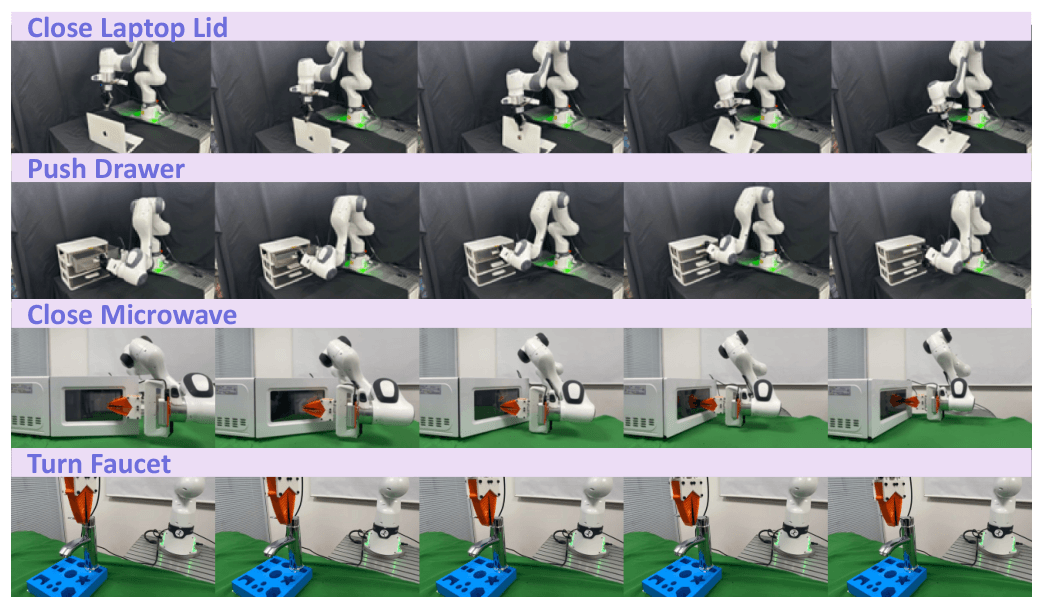
- Real-robot success: 100% laptop closing and 90% drawer closing, beating real-data training baselines.
- Limitations: no mass, friction, or material estimation, and training data biased to common categories. Project page.
Getting a robot to interact with a drawer, laptop, or faucet in simulation usually means an engineer sits down and hand-authors a URDF file, specifying every rigid link, every joint axis, and every motion limit. A team from Peking University, Oxford, and the University of Washington has now shown a model that skips that entire step. URDF-Anything+ takes a single RGB image and autoregressively generates a simulation-ready articulated object, complete with part meshes and joint parameters, in about 35 seconds per part.
The framework also introduces a deployment scheme called Real-Follow-Sim, where the simulator is dynamically rebuilt to match the real scene rather than forcing a policy trained in sim to bridge the gap on its own. In real-robot trials, that flipped paradigm pushed the success rate on closing a laptop lid from 80% to 100%.

Why articulated 3D is a mess
A URDF (Unified Robot Description Format) file is what physics engines like Isaac Sim or MuJoCo actually consume. For an articulated object, the model has to solve two coupled subproblems at once. It must decompose the object into rigid parts, and for every pair of connected components recover the joint origin, rotation axis, joint type, and motion limits, all from partial visual cues.
Prior work has mostly punted on this by chaining together specialists. Some methods retrieve part meshes from a fixed asset library and fit articulation on top, which caps quality at whatever the library contains. Others hand segmentation off to a vision-language model and then synthesize joints separately, or first segment part-level point clouds and generate joint code with a dedicated head. Such pipelines compound error across stages or generalize poorly beyond categories well represented in retrieval libraries.
One transformer, one shared latent
URDF-Anything+ collapses that pipeline into a single autoregressive diffusion model. Given an image, it uses a pretrained DINOv3 encoder for visual features and TripoSG to reconstruct a whole-object 3D latent. Those two signals become the global context for autoregressive generation.
At each step, a diffusion transformer denoises what the authors call a shared latent. That single latent is then decoded two ways:
- A geometry head projects it into a 3D shape latent, which TripoSG's decoder turns into a mesh via marching cubes.
- Four lightweight MLP heads read the same latent to predict joint origin, joint axis, joint type, and lower/upper motion limits directly (no diffusion needed for these scalars).
After a part is decoded, it is merged with the previously generated geometry, resampled as a point cloud, and re-encoded to update the context for the next step. The autoregression stops when the model predicts a special end-of-token latent, defined as a zero vector in latent space. During inference, if the distance between the predicted latent and that zero vector drops below a threshold, generation halts. A redundancy check also ends generation when a new part overlaps too much with an existing one.

Because everything decodes from one shared latent, geometry and articulation stay consistent. In a multi-stage pipeline, an axis prediction can easily point away from the hinge that segmentation actually found. Here, both come from the same feature vector.
The numbers
Training uses a curated mix of PartNet, PartNet-Mobility, and PhysX-3D. Stage 1 runs for 500 epochs on 16 NVIDIA A800 GPUs on image plus part-geometry supervision, then Stage 2 adds another 100 epochs with the end-of-token signal and full URDF articulation supervision turned on. Losses combine the diffusion objective, an EoT loss, and an L1 loss for continuous joint parameters plus cross-entropy for joint type.
On the benchmark suite, URDF-Anything+ posts state-of-the-art numbers across geometry and joint metrics against URDFormer, SINGAPO, Articulate-Anything, and PhysX-Anything:
| Method | Part IoU | Whole IoU | Axis Err (rad) | Origin Err (m) | Time / part (s) |
|---|---|---|---|---|---|
| URDFormer | 0.202 | 0.243 | 1.071 | 0.504 | 41.88 |
| Articulate-Anything | 0.563 | 0.627 | 0.230 | 0.267 | 380.57 |
| SINGAPO | 0.382 | 0.462 | 0.670 | 0.404 | 52.30 |
| PhysX-Anything | 0.784 | 0.813 | 0.191 | 0.103 | 578.38 |
| URDF-Anything+ | 0.879 | 0.930 | 0.129 | 0.062 | 34.70 |
The speedup is as interesting as the accuracy. Prior methods that depend on repeated vision-language model calls take five to ten minutes per part; URDF-Anything+ finishes in about a third of a minute because it runs as a single-pass generative model with no retrieval or symbolic reasoning in the loop.
Flipping sim-to-real into real-follow-sim
The second contribution is a deployment paradigm the authors call Real-Follow-Sim. Rather than training a policy in a generic simulator and hoping it transfers, they capture RGB-D of the actual scene, run URDF-Anything+ to generate a URDF, align it to the observed point cloud with ICP, scale it to physical size, and drop it into Isaac Sim as a per-scene digital twin. A Diffusion Policy is then trained entirely in that digital twin and executed on a Franka arm zero-shot.
The real-robot results, 20 trials per task:
- Close laptop lid: 100% with Real-Follow-Sim vs 80% with conventional Sim-to-Real, and 85% with a policy trained on real teleop data.
- Close drawer: 90% vs 75% Sim-to-Real, and 75% with real data.
- Swapping URDF-Anything+ out for Articulate-Anything inside Real-Follow-Sim drops laptop closing to 75%, showing that URDF fidelity matters end to end.
A simulation-only policy backed by a good digital twin now beats a policy trained on real demonstrations of the same task. That is the practical result hiding behind the reconstruction benchmarks.
Where it stops working
The authors are upfront about the gaps. Training data still skews toward common household categories, so rare articulated structures may not generalize. More importantly, the model predicts geometry and kinematics but does not estimate mass distribution, friction, or material dynamics, so contact-rich behaviors in simulation may still diverge from reality even when the shape is correct.
There is also an ordering assumption baked into training: parts are generated in a canonical Z-X-Y bounding-box order with the immobile base first. The ablation confirms this matters. Random link ordering drops part IoU from 0.805 to 0.630 and roughly doubles axis error, which suggests the autoregressive factorization is sensitive to how the training data is structured.
Code and model weights have not been released as of the paper posting; the project page hosts qualitative demos and the paper. For anyone building manipulation policies, teaching robots in simulation, or generating populated interactive environments, this is the direction to watch: rather than curating asset libraries, you point a camera and get a functional URDF back.