
UoR's Structured Prompting Beats Fine-Tuned Models at Reading Word Meaning
A new SemEval paper shows that telling GPT-4o exactly how to reason beats fine-tuned transformers at graded word sense disambiguation
 Pro
Takeaways
- New benchmark task: SemEval-2026 Task 5 requires predicting how plausible a word sense is (1-5 scale) in short ambiguous stories, not just picking the "correct" sense.
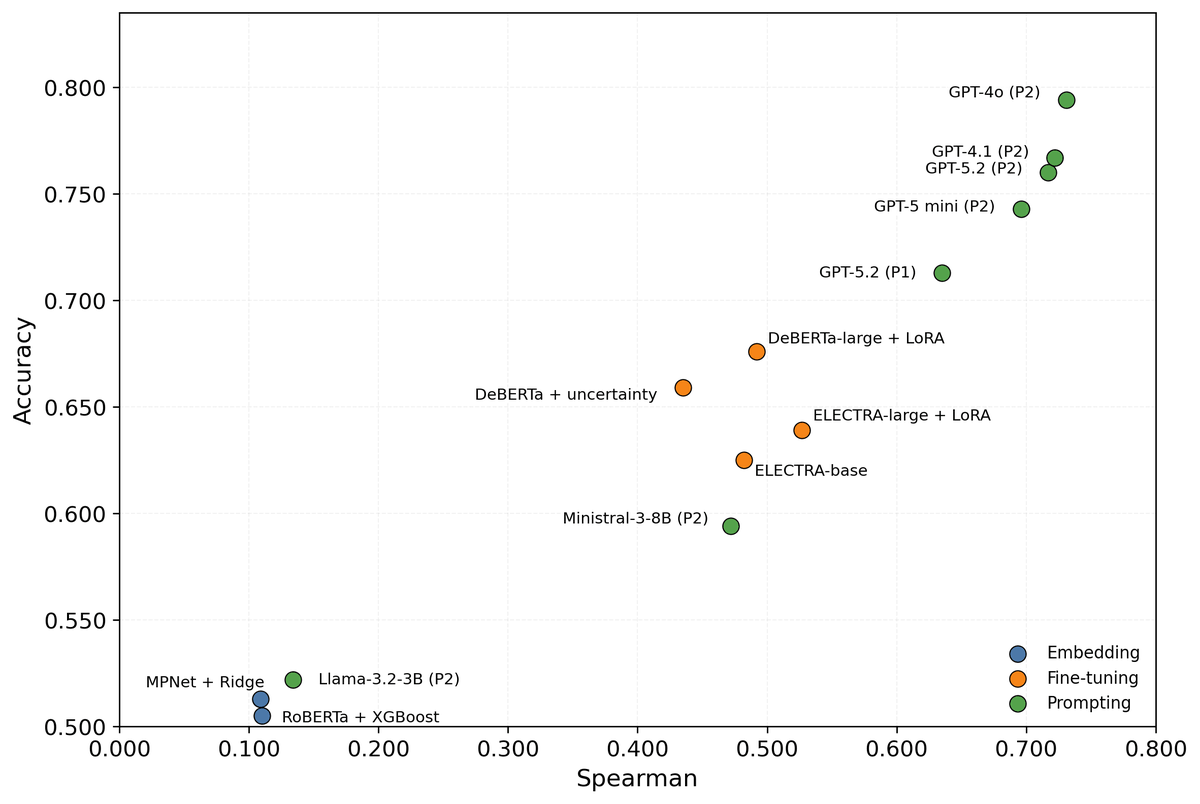
- Structured prompting wins: GPT-4o with explicit decision rules (rho=0.731, acc=0.794) outperforms fine-tuned transformers and embedding-based methods on the test set.
- Prompt design > model scale: Switching from few-shot to structured prompting on GPT-5.2 gains +0.082 Spearman; GPT-4o with the right prompt beats GPT-5.2 with the same prompt.
- Fine-tuning overfits: DeBERTa-large+LoRA drops from rho=0.606 (dev) to 0.435 (test), struggling to generalize to unseen homonyms.
- Hardest cases: Mid-range ratings (3.5-4.5) and high-annotator-disagreement samples are where all models fail most.
- Code is open-source: Full implementation available at github.com/tongwu17/SemEval-2026-Task5.
Word sense disambiguation -- figuring out what a word means in context -- has long been treated as a classification problem: pick the one correct sense. But language is messier than that. When someone says "He told his girlfriend he would give her a ring," both the jewelry sense and the phone-call sense can feel plausible depending on the surrounding story. A new paper from the NCL-UoR team tackles this graded version of the problem head-on, and its central finding is striking: telling a model how to reason about a sentence matters far more than which model you use, or even whether you fine-tune it at all.
The Problem With "One Right Answer"
Traditional Word Sense Disambiguation (WSD) assumes a single correct interpretation per word. This does not always reflect how humans perceive meaning -- ambiguity, underspecification, and subjective factors such as individual linguistic experience can all influence which word senses are perceived as plausible in a given context. The result is that human intuitions and model predictions frequently diverge, especially in narrative settings where surrounding sentences shift the plausibility of competing meanings.
To address this, Gehring and Roth introduced AmbiStory, a dataset where a target sentence is constructed to be ambiguous while surrounding sentences provide indirect cues that shift the relative plausibility of competing senses. Annotators assigned plausibility ratings on a 1-5 Likert scale, allowing multiple senses to receive non-zero support. SemEval-2026 Task 5 is built on this dataset, and the NCL-UoR paper is one of the first systematic comparisons of how different modeling families handle it.
The Dataset: Short Stories, Slippery Words
The task uses the AmbiStory dataset, a collection of short narrative stories designed to probe lexical ambiguity. Each story consists of a three-sentence precontext that establishes the narrative setting, a target sentence containing the homonym, and an ending sentence that may disambiguate it toward one of its senses. The dataset contains 2,322 training stories, 600 development stories, and 942 test stories, covering 188 unique homonyms in training alone.
Systems must predict the plausibility of each sense on a scale from 1 (implausible) to 5 (highly plausible), and are evaluated on two metrics: accuracy within one standard deviation of the average human judgment, and ranked (Spearman) correlation between model predictions and aggregated human judgments.
Three Approaches, One Clear Winner
The paper pits three families of methods against each other on the same task:
- Embedding-based methods: Encode the story and candidate meaning as sentence vectors, extract similarity features (cosine, Euclidean, Jaccard overlap, etc.), and feed them into classical regressors like Ridge or XGBoost.
- Transformer fine-tuning: Fine-tune ELECTRA or DeBERTa with LoRA (Low-Rank Adaptation -- a technique that injects small trainable matrices into a frozen model, keeping parameter counts low) plus custom loss functions designed to handle annotator disagreement.
- LLM prompting: Use GPT-4o, GPT-4.1, GPT-5 mini, GPT-5.2, Llama 3.2, and Ministral with either few-shot examples or a structured prompt with explicit decision rules.

The structured prompting approach -- called P2 in the paper -- is the decisive winner. The core strategy decomposes plausibility judgment into component-level evaluations of precontext, target sentence, and ending, then combines them into a final rating via decision rules. On the test set, GPT-4o with structured prompting achieves Spearman rho = 0.731 and accuracy = 0.794, outperforming fine-tuned and embedding-based methods.
How the Winning Prompt Works
The P2 prompt is not a simple instruction. It gives the model a structured evaluation framework with three explicit steps and hard decision rules:
- Component-wise evaluation: The model is asked to separately assess the precontext ("does the setup make this meaning likely?"), the target sentence ("does the local usage support this meaning?"), and the ending ("does the conclusion reinforce this meaning?"). The ending is flagged as the strongest source of evidence.
- Hard decision rules: "If the ending clearly contradicts the proposed meaning, the rating must be 1 or 2." "A rating of 5 requires explicit confirmation in the ending and no contradictions elsewhere." "If evidence is mixed or unclear, choose the lower plausible rating."
- Impartial framing: The model is positioned as "an impartial evaluator" who should "base judgment only on the text given," reducing prior biases about word meanings.
Switching from few-shot prompting (P1) to this structured approach on GPT-5.2 alone yields a Spearman improvement of 0.082 on the test set -- a substantial jump that no amount of model scaling replicated.
Prompt Design Beats Model Scale
One of the most counterintuitive findings: GPT-4o with structured prompting (rho = 0.731) outperforms GPT-5.2 with the same prompt (rho = 0.717), suggesting the reasoning scaffold matters more than raw model capability for this task. The gap between P1 and P2 on the same model is larger than the gap between models using the same prompt.
Fine-tuned transformers tell a more complicated story. DeBERTa-large with LoRA and a custom uncertainty-aware loss -- which penalizes predictions only when they fall outside the range of human annotator disagreement -- reaches 0.767 accuracy on the development set. But it drops to 0.659 on the test set, a sign of overfitting to the specific homonyms seen during training. The embedding-based methods fare worst: both MPNet+Ridge and RoBERTa+XGBoost achieve Spearman correlations below 0.15 on the test set, confirming that static similarity features cannot model the compositional, multi-sentence reasoning this task demands.
Where Every Method Still Struggles
The error analysis reveals two consistent failure modes across all approaches:
- Mid-range ratings are hardest. Samples with gold ratings in the 3.5-4.5 range have the highest mean absolute error. Extreme cases (clear confirmation or clear contradiction by the ending) are much easier to predict than nuanced, partially-supported senses.
- High annotator disagreement compounds errors. Samples where human raters themselves disagreed (standard deviation >= 1.0) have a mean absolute error of 0.962, versus 0.765 for low-disagreement samples. The model is being asked to hit a moving target.

There is also a discretization problem: the prompt asks for a single integer, but gold labels are continuous averages of five human ratings. GPT-4o's predictions cluster at whole numbers while the gold distribution is smooth, which caps fine-grained calibration. The authors note that averaging multiple stochastic API calls or prompting for non-integer outputs could help, but was not explored here.
What This Means in Practice
The practical takeaway is not just about word sense disambiguation. Although widely used benchmarks suggest that LLMs can effectively disambiguate, their practical applicability in real-world narrative contexts remains underexplored -- and SemEval-2026 Task 5 addresses this gap by introducing a task that predicts the human-perceived plausibility of a word sense within a short story. Any application that needs to score the plausibility or relevance of a meaning in context -- semantic search ranking, reading comprehension, dialogue systems that track topic shifts -- faces a version of this problem.
The structured prompting approach is directly applicable without any training data or GPU budget. The key ingredients are decomposing the input into meaningful sub-components, providing explicit calibration rules that mirror how human annotators were instructed, and framing the model as an impartial evaluator rather than a language completer. The full code is available on GitHub at tongwu17/SemEval-2026-Task5, making it straightforward to adapt the prompting strategy to new domains or models.
The broader lesson is one that keeps surfacing across NLP tasks: when the evaluation criteria are well-defined and can be expressed in language, a carefully engineered prompt can outperform a model that has seen thousands of labeled examples. The ceiling for structured prompting on this task is still not clear -- the best system placed 9th on the competition leaderboard, and ensemble approaches using multiple LLMs are pushing accuracy above 0.88. The gap between prompt engineering and full ensemble methods remains the next frontier.