
UNSW Sydney Maps 200+ Papers to Fix Privacy in IoT Machine Learning
A new survey maps four privacy-preserving ML paradigms onto the messy realities of resource-constrained IoT devices, and shows why no single approach is enough.
 Pro
Takeaways
- New cross-paradigm survey unifies DP, FL, cryptographic PPML, and generative synthesis under an IoT-first lens.
- Reviews 200+ papers and maps attacks (MIA, gradient leakage, model inversion) to concrete defenses per paradigm.
- No single paradigm satisfies formal guarantees, robustness, utility, and edge deployability simultaneously.
- Recommends Flower combined with Opacus or TensorFlow Privacy as the most practical IoT stack.
- Argues for joint reporting of formal ε, empirical MIA metrics, and utility instead of single-dimension benchmarks.
- Flags foundation-model fine-tuning, LPWAN communication, and post-quantum DP as urgent open problems.
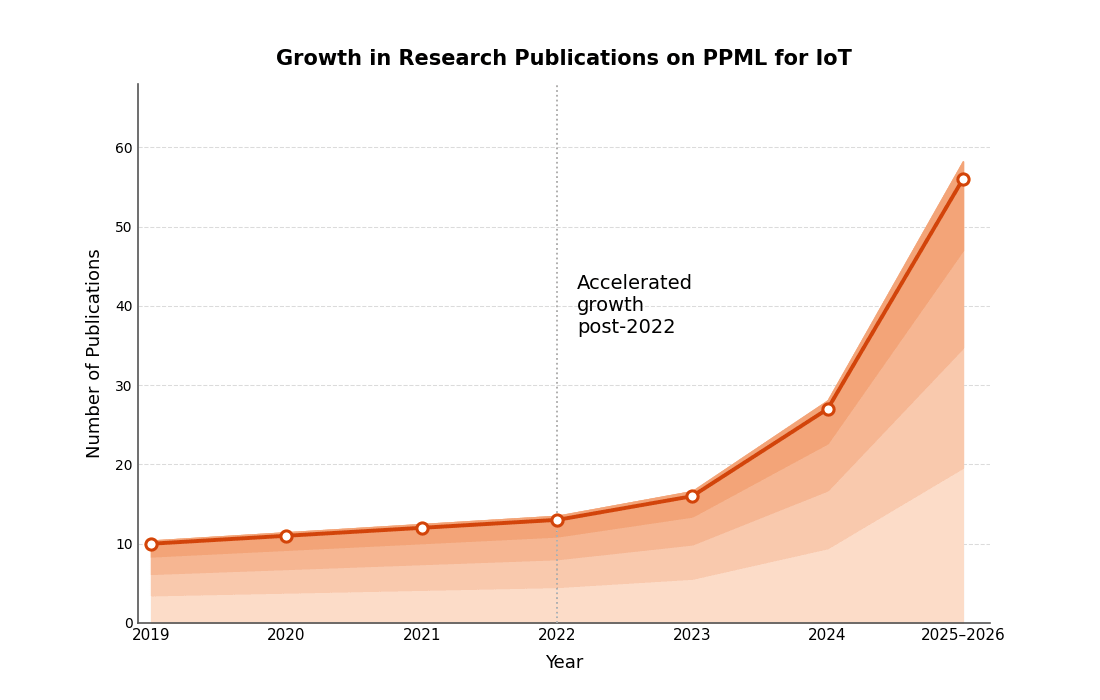
A new cross-paradigm survey tackles a problem that has quietly become one of the harder engineering trade-offs in modern ML: how to keep sensitive data private when the sensors generating it are cheap, battery-powered, and scattered across untrusted networks. The authors, from UNSW Sydney and TCS Research, review more than 200 papers and consolidate the field of privacy-preserving machine learning (PPML) into a single analytical framework aimed specifically at IoT deployments.
Unlike centralised learning settings, IoT systems are decentralised, bandwidth-limited, latency-sensitive, and vulnerable to privacy risks across sensing, communication, and distributed training pipelines. These characteristics limit the effectiveness of traditional protection methods. That mismatch is what makes IoT privacy hard: the standard PPML playbook was written for data centers with plentiful compute and trusted curators, neither of which describes a smart meter or a wearable.

Four paradigms, four sets of compromises
The survey organises PPML into four families, each with distinct guarantees and deployment costs:
- Perturbation-based (Differential Privacy). Injects calibrated statistical noise via Local DP, DP-SGD, or lightweight encodings such as DP-Bloom Filters to provide formal (ε, δ) guarantees at low computational cost, making them well-suited to edge devices, though the privacy-utility trade-off requires careful budget calibration.
- Federated Learning. Keeps raw data on-device, but formal guarantees require complementary mechanisms such as DP or secure aggregation, as decentralisation alone remains vulnerable to gradient leakage, model inversion, and poisoning.
- Cryptographic methods (HE, SMPC, TEEs). Strong confidentiality, but their computational and communication overhead constrains real-time feasibility in highly resource-limited deployments.
- Generative synthesis (GAN-based). Replaces real data with synthetic samples; while inference is lightweight, training is resource-intensive and privacy guarantees remain informal unless reinforced with DP or teacher-student mechanisms.

Mapping attacks to defenses
One of the more useful contributions is an explicit threat-to-defense mapping. The survey walks through the main attack classes, membership inference, model inversion, reconstruction, gradient leakage, adversarial perturbation, and traffic analysis, and shows which defenses actually address which threats. Gradient leakage is particularly nasty in FL: the attack solves an optimisation problem searching for an input-label pair whose gradient best matches the observed client gradient. Techniques such as iDLG improve convergence and reconstruction quality, enabling data extraction from a single shared gradient step.
A recurring lesson: no single mechanism covers every threat. DP mitigates membership inference but does not prevent model extraction. Secure aggregation blocks server-side inference but not malicious clients. Practical systems will need hybrids.
What to actually use
For teams building something today, the framework comparison is the most immediately actionable section. The authors survey TensorFlow Privacy, Opacus, Flower, PySyft, and FATE across DP support, FL support, privacy accounting, and IoT suitability. Their verdict: for IoT-focused work, Flower combined with Opacus or TensorFlow Privacy currently represents the most practical stack, balancing FL flexibility, DP accounting rigour, and edge deployment compatibility. PySyft and FATE are flagged as too heavy for microcontroller-class hardware.
On evaluation, the authors argue that most published work reports one dimension and ignores the others. They recommend jointly reporting formal privacy (ε, δ), empirical leakage (MIA AUC, attack success rate), and utility (accuracy, RMSE, or TSTR for synthetic data). For federated setups, per-round ε values are misleading without composition-aware accounting across the full training lifecycle.
Where the field is still stuck
The open problems section is refreshingly concrete. A few worth highlighting:
- Communication is the bottleneck, not compute. In bandwidth-constrained networks like LoRaWAN and NB-IoT, gradient exchange dominates the energy and privacy budget. Compression and DP noise interact in poorly understood ways.
- Foundation models leak in new ways. Fine-tuning on sensitive domain-specific data, capturing energy usage, mobility trajectories, or physiological signals, can implicitly encode personal patterns recoverable through membership inference, data extraction, or prompt-based attacks. Multimodal architectures make this worse via cross-modal re-identification.
- Quantum adversaries are coming. Classical DP was analysed under classical assumptions. Post-Quantum DP exists but lattice-based primitives are still too heavy for microcontrollers.
- Privacy budgets need lifecycle accounting. Reporting per-round ε in a system that retrains for years silently underestimates cumulative leakage.
The paper itself is a review with no released code, but the underlying frameworks it recommends, Flower, Opacus, and TensorFlow Privacy, are all open source. For anyone building privacy into an IoT pipeline, the taxonomy and threat-defense tables are a solid starting map, particularly the point that formal (ε, δ) guarantees are not the same thing as regulatory compliance, and neither one alone gets you a trustworthy system.