
UniVG Rivals Full Supervision on Blood Vessel Scans With Just 5 Images
UniVG generates diverse synthetic vessel images from just five labels, matching fully supervised segmentation across 11 tasks and five imaging modalities.
 Pro
Takeaways
- UniVG matches fully supervised vascular segmentation using only five annotated images across 11 tasks and five modalities
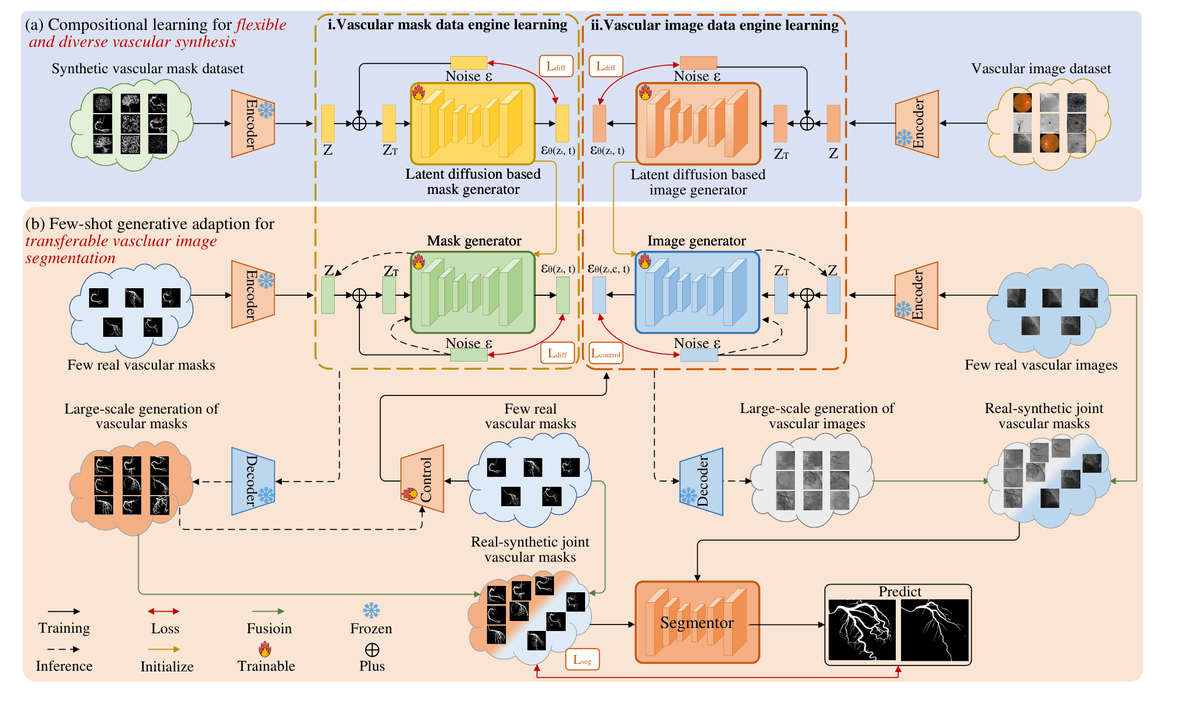
- Framework combines compositional learning with few-shot LoRA/LoHA generative adaptation on Stable Diffusion v1.5
- Achieves 79.34% average DSC, beating YoloCurvSeg by 2.36 points and edging out MedSAM
- Introduces UniVG-58K, a corpus of 58,689 vascular images spanning fundus, OCTA, OCT, brain DSA, and coronary DSA
- Generated masks score FID 80.90 against real coronary masks versus 231.96 for WGAN baseline
- Code and dataset released at github.com/XinAloha/UniVG
Annotating blood vessels pixel by pixel is one of the more thankless jobs in medical imaging. The structures are thin, branch unpredictably, and vary wildly between fundus photos, coronary angiograms, and OCT scans. A new paper introduces UniVG, a foundation model that sidesteps the annotation bottleneck by generating its own labeled training data, and it does so well enough to rival fully supervised baselines using only five real annotated images per task.
The annotation wall
Vascular segmentation matters clinically for diagnosis, screening, and surgical planning, but progress has been throttled by data scarcity. Collection is expensive, privacy rules restrict sharing between hospitals, and tracing every capillary takes a specialist hours. Vessels also branch in wildly variable topological patterns, so labeling runs far slower than annotating organs with predictable shapes.
Previous workarounds have their own problems. Weakly supervised methods struggle to generalize beyond the specific scene they were trained on. Pre-trained foundation models like SAM and MedSAM run into domain gaps because vessels look nothing like natural images, and their fixed architectures leave little room for the multi-scale feature extraction that thin, elongated structures demand.

Compositionality as a training trick
The core intuition behind UniVG is that vessels are compositional objects. Just as you can decompose a plant into branches and recombine them into new plants, you can break vascular networks into segments, bifurcations, and topological motifs, then reassemble them against different backgrounds to produce plausible new images. The authors specialize pre-trained generation models for the real vascular domain, enabling high-quality synthetic data from a handful of annotated examples.