
University of Zurich Study Shows AI Recommendations Quietly Lower Users' Evidence Bar
A controlled experiment with 290 participants shows recommendation-based AI quietly shifts users toward accepting weaker evidence, even when accuracy looks unchanged.
 Pro
Takeaways
- New study shows recommendation-driven AI creates hidden bias even when accuracy metrics look identical.
- 290-participant experiment used Signal Detection Theory to separate perception ability from evidence threshold.
- Recommendation users lowered their evidence bar significantly compared to controls; hypothesis-driven users did not.
- Domain expertise improved sensitivity but gave no protection against threshold drift induced by the interface.
- Hypothesis-driven users were slowest (48.5s) but improved discrimination the most across trials.
- Authors urge HCI to evaluate decision processes, not just accuracy and reliance, using evaluative AI framing.
Two forensic analysts examine the same case with different AI tools. One uses a system that suggests a match and highlights supporting evidence. The other uses a system that offers no recommendation but lets them probe alternative interpretations. Both reach the same suspect. Both feel confident. On every metric an HCI researcher typically reports, the systems look equivalent. A new study from the University of Zurich and the University of Queensland argues that this equivalence is an illusion, and that the recommendation-driven system has quietly nudged its user into requiring less evidence to accuse someone.
The paper, Same Performance, Hidden Bias, ran a web experiment with 290 participants and used Signal Detection Theory to separate what people can distinguish from how much evidence they demand before committing to a decision. Even when performance remained identical, recommendation-driven designs lowered participants' thresholds for sufficient evidence and introduced a hidden bias in their judgments, producing a shifted distribution of errors. The effect held for domain experts too.
Why accuracy metrics miss the story
Most human-AI decision-making studies report two things: task accuracy and reliance, meaning how often the human agrees with the model. The authors argue these numbers collapse two very different cognitive processes into one score. Decision-makers in AI-assisted settings engage in two distinct but interrelated processes: evaluating options and outcomes ("Is this a match?") and assessing the soundness of the advice ("Should I trust this output?"). When an AI hands over a recommendation, those two evaluations blur together, and the model's confidence starts to reshape what the user counts as enough evidence.
Signal Detection Theory (SDT) is the tool they use to pry those processes apart. It is a decades-old framework from perceptual psychology that models a decision as two independent quantities: sensitivity (d'), how well a person can tell a real signal from noise, and criterion (c), how much evidence they insist on before saying "yes." A liberal criterion means the user says "match" easily. A conservative one means they hold out. Two people can have identical accuracy while sitting at very different thresholds, and it is the threshold that determines the kind of errors they make.
Inside the puzzle-based experiment
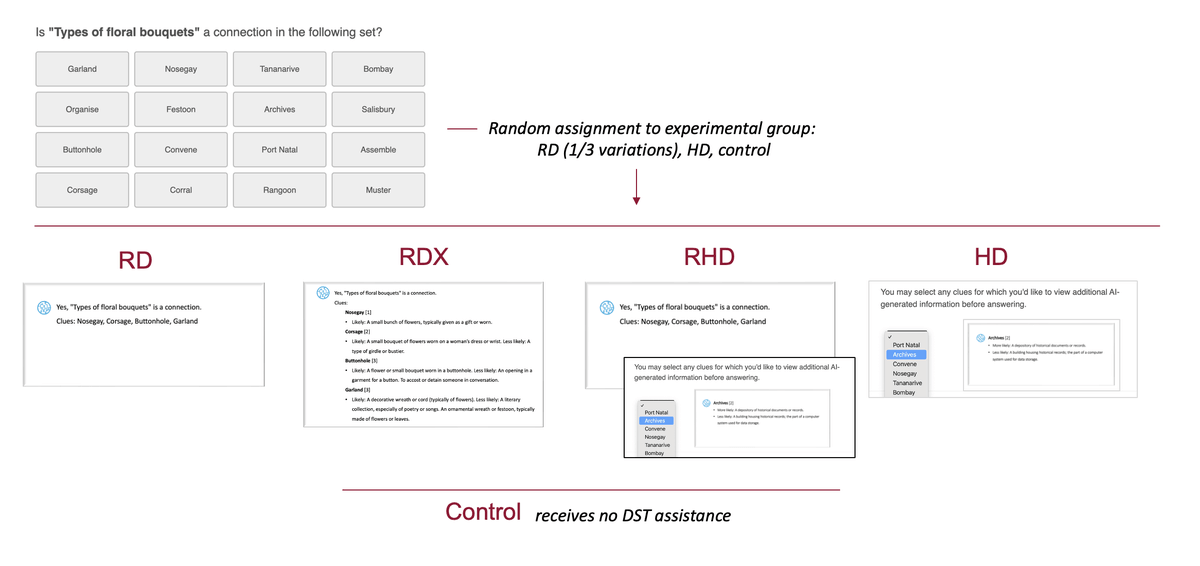
The team needed a task where humans and an AI are roughly comparable and where ground truth is known. They adapted the OnlyConnectWall dataset, which consists of word association puzzles containing misleading cues ("red herrings"). Participants saw sets of 16 words and had to judge whether a specific theme was present, making false positives and false negatives cleanly countable. AI assistance was simulated using pre-generated outputs from GPT-4, calibrated to achieve 70% accuracy, reflecting realistic but imperfect decision support behavior observed in prior work.

Participants were randomly assigned to one of five conditions that differed only in interface design:
- Control: no AI assistance.
- Recommendation-driven (RD): a binary AI suggestion.
- Recommendation plus explanation (RDX): suggestion with supporting information and uncertainty cues.
- Recommendation plus hypothesis exploration (RDH): suggestion plus tools to explore alternatives.
- Hypothesis-driven (HD): exploration tools with no recommendation at all.
Each participant did 10 training trials with feedback, then 10 testing trials without. Sensitivity and criterion were computed per phase using the standard formulas d' = Z(H) - Z(F) and c = -0.5 * [Z(H) + Z(F)], where H is the hit rate and F is the false alarm rate.
The results are quieter than the framing suggests
Brier score accuracy did not differ significantly across conditions. That is the whole point: on the dashboard, everything looks fine. Underneath, the picture changes. Compared to the Control, recommendation-driven conditions showed significantly more liberal (lower) decision thresholds, while the hypothesis-driven condition did not significantly differ from the control group. Participants in RD and RDX also significantly lowered their thresholds between the training and testing phases. No such temporal threshold adaptation appeared in the HD or Control groups.
In plain terms, users who saw AI recommendations gradually started accepting weaker evidence, and the more they interacted with the system, the further their bar drifted. Users who explored evidence without a recommendation held roughly the same line as people working alone. Decision time followed the pattern you would expect: participants in HD spent the longest at 48.5 seconds on average, while RD was the fastest at 28.9 seconds.
Sensitivity told a different story. All conditions showed significantly higher sensitivity in the test phase compared to training, with the largest improvement occurring in the HD condition. Hypothesis-driven users got better at telling real themes from red herrings. Recommendation-driven users mostly got looser about what counted as a theme.
Expertise is not a shield
A tempting response is that experts would resist the pull of a confident model. The data disagrees. Task knowledge and age significantly predicted sensitivity but had no effect on the decision criterion, meaning expert users are as susceptible to the hidden bias as novices. Expertise improves discrimination without immunizing the user against the systemic threshold shifts induced by the interface. Domain knowledge sharpens what you can see. It does not fix where you decide to draw the line.
How it fits into the broader debate
This work sits inside a growing argument, largely driven by co-author Tim Miller's earlier Evaluative AI proposal, that recommendation-plus-explanation is the wrong default for high-stakes decisions. Early decision support systems assumed people would weigh recommendations and follow them when appropriate. Research found instead that users often ignore recommendations because they distrust them, or follow them blindly even when they are wrong. The alternative Miller sketched replaces "here is the answer" with "here is the evidence for and against your hypothesis."
The evaluative approach has limits. Evaluative AI is more suitable for medium- and high-stakes decisions where the decision maker is ultimately accountable, and for low-frequency decision making where there is time to explore options. For a radiologist reviewing an ambiguous scan or a fraud analyst deciding whether to freeze an account, the extra deliberation is a feature. For triaging low-value alerts at scale, it is friction.
Caveats worth naming
The study is deliberately narrow. The task is a word puzzle, not medicine or law. Participants were lay Prolific workers, not licensed practitioners, and the AI's outputs were pre-generated rather than live. A sample of 290 is solid for a single experiment but modest for sweeping design claims. There is no accompanying code release or open dataset in the paper. The authors flag replication in additional contexts, comparisons across explanation types such as counterfactuals and feature importance, and interactive rather than static AI as their next steps.
The takeaway for anyone shipping decision-support tooling is concrete: two systems can score the same on accuracy and reliance while producing different populations of errors, and the interface is doing the work. If the domain has any asymmetry in error cost, which most consequential domains do, measuring the criterion alongside the accuracy is worth the effort. Signal Detection Theory has been sitting in the psychology toolkit for seventy years, and it turns out to be exactly the lens missing from most human-AI evaluations.