
University of Zurich's SwissGov-RSD Benchmark Exposes GPT-4o's Hidden Multilingual Failure
A new Swiss government benchmark shows LLMs and encoders that ace synthetic tests fail badly at spotting real cross-lingual meaning drift in documents.
 Pro
Takeaways
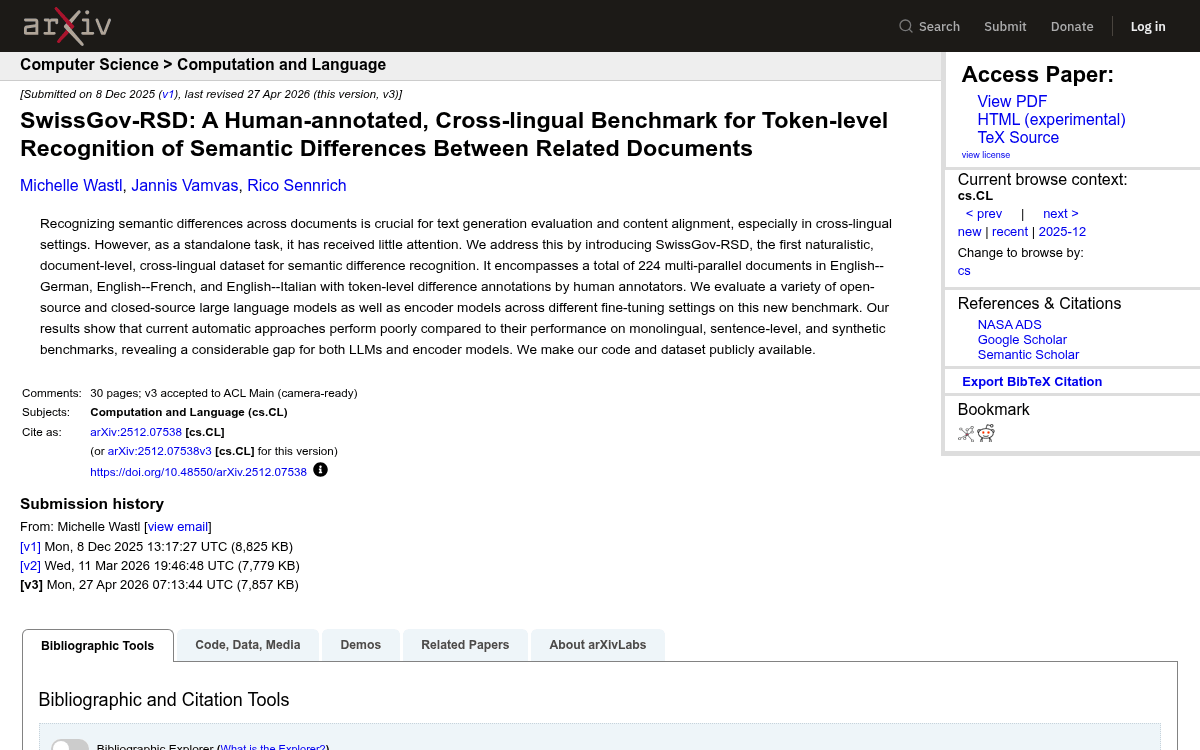
- Zurich NLP released SwissGov-RSD, the first naturalistic cross-lingual benchmark for token-level semantic difference detection.
- 224 human-annotated multi-parallel documents in EN-DE, EN-FR, and EN-IT scraped from Swiss government admin.ch pages.
- Fine-tuned GPT-4o-mini fell from ~80 to ~5 Spearman correlation moving from synthetic iSTS-RSD to real documents.
- Unsupervised DiffAlign with encoders like LaBSE and Qwen3-Embedding proved most robust on naturalistic data.
- LLMs frequently produce misaligned label sequences and underlabel differences near document ends.
- Code and data available at github.com/ZurichNLP/SwissGov-RSD under CC BY.
A team from the University of Zurich just released a benchmark that quietly embarrasses most of the models we assume are good at cross-lingual understanding. SwissGov-RSD is a human-annotated dataset for spotting where two versions of the same document, written in different languages, actually diverge in meaning. And when the authors ran it against GPT-4o, DeepSeek-R1, Llama-3.1 405B, o3-mini, and a dozen encoder models, performance collapsed compared to synthetic benchmarks.
The task nobody has been measuring properly
Recognizing Semantic Differences (RSD) is the task of finding which specific tokens in two related texts carry different meaning, rather than assigning a single similarity score to the whole pair. The paper frames it as a token-level regression problem, where every token gets a score reflecting how much its meaning diverges from its counterpart in the other document.
The catch is that existing benchmarks are synthetic. Prior work built the iSTS-RSD dataset by taking sentence-level similarity annotations and stitching them together with concatenation, reordering, and machine translation to simulate cross-lingual documents. Real multilingual content, like government portals where translations drift out of sync, looks nothing like that.
Scraping admin.ch for naturally occurring drift
Switzerland publishes government content in English, German, French, Italian, and Romansh. Because pages get updated at different times and translations sometimes miss details, the site is a goldmine of naturally misaligned parallel documents. The authors crawled admin.ch and its subdomains, then had computational linguistics students annotate token-level difference spans on a 1-to-5 scale, where 1 is a trivial detail and 5 means complete semantic dissimilarity or an omitted paragraph.
The final dataset contains 224 multi-parallel documents across three language pairs (EN-DE, EN-FR, EN-IT), totaling 886 texts and roughly 550,000 tokens. Around 10 to 17 percent of tokens carry a difference label, which is a much more skewed equivalence-to-difference ratio than the roughly 25 to 30 percent found in synthetic iSTS-RSD.

Three ways to attack the problem
The authors compared three families of approaches:
- DiffAlign (unsupervised): Encode both documents independently, then for each token compute one minus the max cosine similarity against every token in the other document. High scores flag likely differences.
- Few-shot prompting: Feed an LLM a tokenized pair with three in-context examples and ask it to emit a JSON object scoring every token from 0 to 5.
- Fine-tuning: Either supervised fine-tuning of LLMs on the synthetic iSTS-RSD training data, or a token regression head on an encoder like ModernBERT-large.
For cross-lingual fine-tuning, they used a nice trick: they asked GPT-4o-mini to project token-level labels from the English training examples onto their machine-translated German, French, and Italian versions, avoiding the need for new human annotations in each language.
The numbers that should worry you
On synthetic iSTS-RSD, fine-tuned GPT-4o-mini scored around 80 Spearman correlation across the three language pairs. On SwissGov-RSD, the same model scored between 1.1 and 5.3. That is a drop of up to 78 correlation points on what is supposed to be the same task.
A few patterns stood out:
- Unsupervised DiffAlign with encoders like LaBSE, XLM-R+SimCSE, and Qwen3-Embedding turned out to be the most robust approach on naturalistic data, beating every fine-tuned or few-shot LLM.
- Few-shot LLMs frequently produced the wrong number of labels. On SwissGov-RSD, fine-tuned GPT-4o-mini failed to produce a properly aligned label sequence for 7.4 percent of samples, and Llama-3.1 405B failed for 7 percent.
- LLMs systematically underlabel differences, especially toward the end of long documents or in the second input, while Llama-3.1 405B often stopped producing output entirely past 1200 tokens.
- Long-context encoders that can swallow full documents did worse than shorter-context ones that had to segment the input, suggesting that long-context processing weakens token-level alignment signals.
Why this matters beyond one benchmark
The broader lesson is about how much we trust synthetic data. Fine-tuned GPT-4o-mini was the top performer on iSTS-RSD and one of the worst on real documents, which the authors flag as clear overfitting to augmentation patterns. Strong benchmark numbers were masking a total failure to generalize.
Practically, this benchmark is useful if you are building multilingual content alignment tools, evaluating machine translation quality at the document level, or checking whether a translated site actually says the same thing as the original. The code lives at github.com/ZurichNLP/SwissGov-RSD and the dataset is on Hugging Face under a CC BY license for the labels (the underlying text remains copyright of the Swiss federal authorities). The extended EN-IT version of iSTS-RSD and an Italian PAWS-X translation are also published as separate Hugging Face datasets.
If your pipeline relies on LLMs to compare documents across languages, this benchmark is a cheap way to find out how badly it will fail before your users do.