
University of Zurich's LaueRL Teaches a Robot to Align Crystals Like an Expert
A reinforcement learning agent learns to align single crystals from raw diffraction images alone, replacing hours of expert manual work in materials labs.
 Pro
Takeaways
- Zurich team introduces LaueRL, a visual RL agent that aligns single crystals from Laue diffraction patterns
- Model-free actor-critic (DrM algorithm) learns from pixels alone, with no crystallography knowledge or labels
- Trained purely in simulation on monatomic crystals, transfers to real polyatomic samples via domain randomization
- Agent autonomously discovers human-like strategy of following high-symmetry lines through reciprocal space
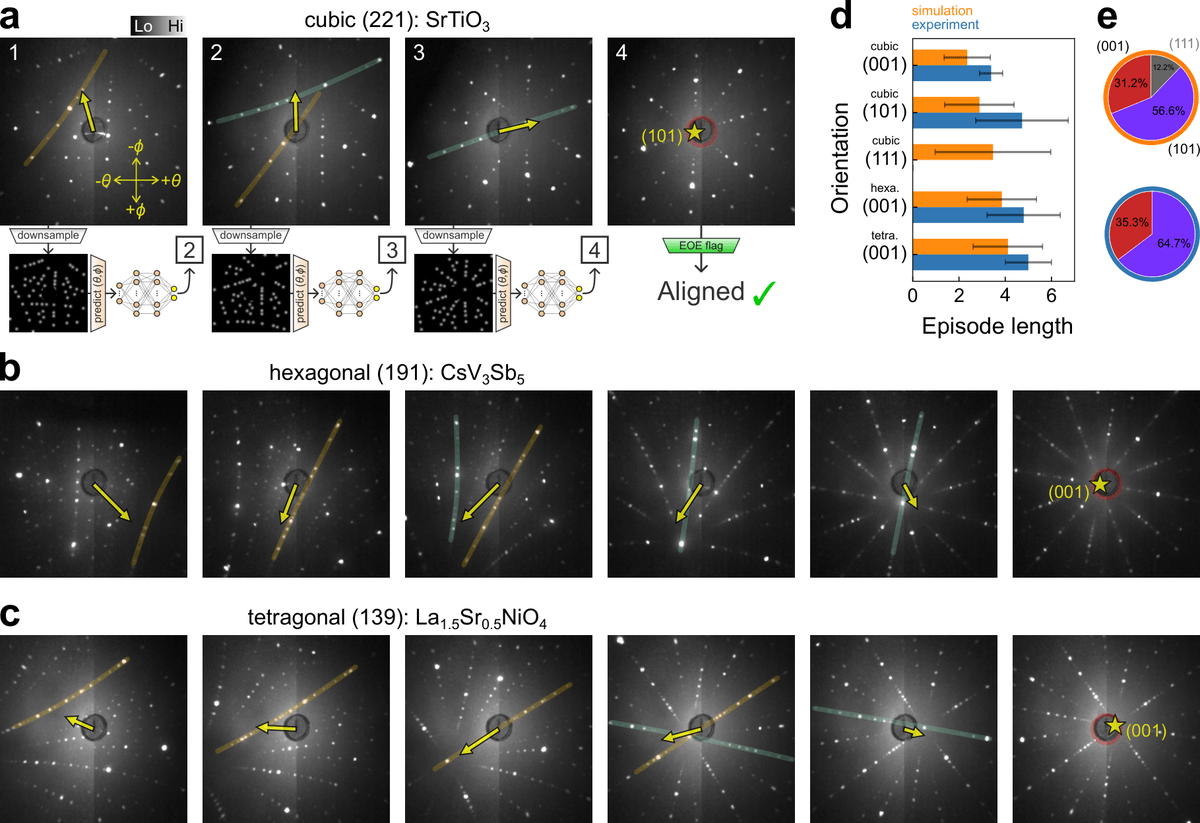
- Validated on SrTiO3, CsV3Sb5, and La1.5Sr0.5NiO4 single crystals with a robotic arm
- Code available at github.com/joppli/laue_rl under an open source license
Crystal alignment is one of those unglamorous but critical steps that gates a huge amount of materials science. Before you can run inelastic neutron scattering or synchrotron diffraction on a single crystal, someone has to physically rotate that crystal until a specific crystallographic axis points at the beam. That someone is usually an expert who spent years learning to read Laue diffraction patterns. A team from the University of Zurich just showed that a reinforcement learning agent can do the same job from pixels, without ever being taught crystallography.
Their system, called LaueRL, learns to interpret Laue patterns and drive a six-axis robot arm toward a target crystal orientation. The agent identifies and navigates toward high-symmetry orientations directly from raw diffraction images using a model-free RL framework. No physics model, no labeled examples, no orientation matrix. Pixels in, rotation angles out.
Why crystal alignment is a bottleneck
Laue diffraction shoots a broadband X-ray beam at a crystal and records the scattered pattern of spots on a 2D detector. The geometry of those spots encodes the crystal's orientation in reciprocal space, but decoding it is not trivial. Traditional software indexes spots by fitting theoretical patterns to observed peaks, which depends strongly on accurate knowledge of system parameters such as lattice constants, unit cell composition, and detector geometry. It also typically requires a human to seed the fit with initial estimates of spot locations.
The bottleneck compounds at scale. Experiments like inelastic neutron scattering often require co-aligning dozens or hundreds of individual crystals into a mosaic, which is notoriously human-intensive. Anything that removes the expert from that loop is a real win for large-scale facilities where beam time is measured in hours.