
University of Würzburg Runs Full Neural Architecture Search on a Single Consumer GPU
A closed-loop pipeline pairs small frozen LLMs with a five-step feedback memory to run neural architecture search on one RTX 4090.
 Pro
Takeaways
- Würzburg researchers run LLM-driven NAS in 18 GPU hours on a single RTX 4090.
- Closed loop pairs a Code Generator LLM with a Prompt Improver LLM and one-epoch training evaluator.
- Historical feedback memory keeps last K=5 attempts as problem, suggestion, outcome triples.
- Code execution failures are treated as first-class learning signals, not discarded noise.
- CIFAR-10 accuracy jumps from 28.2% to 69.2% with DeepSeek-Coder-6.7B over 2000 iterations.
- Frozen 7B models suffice, no fine-tuning; code and logs are public.
Neural Architecture Search has long been a rich lab's game. Early reinforcement-learning approaches burned through up to 22,400 GPU-days, and even modern differentiable variants lean on heavy supernet training. A new paper from the Computer Vision Lab at the University of Würzburg pushes in the opposite direction: it uses small, frozen instruction-tuned LLMs to iteratively invent convolutional architectures on a single 24GB consumer GPU, no fine-tuning, no cloud.
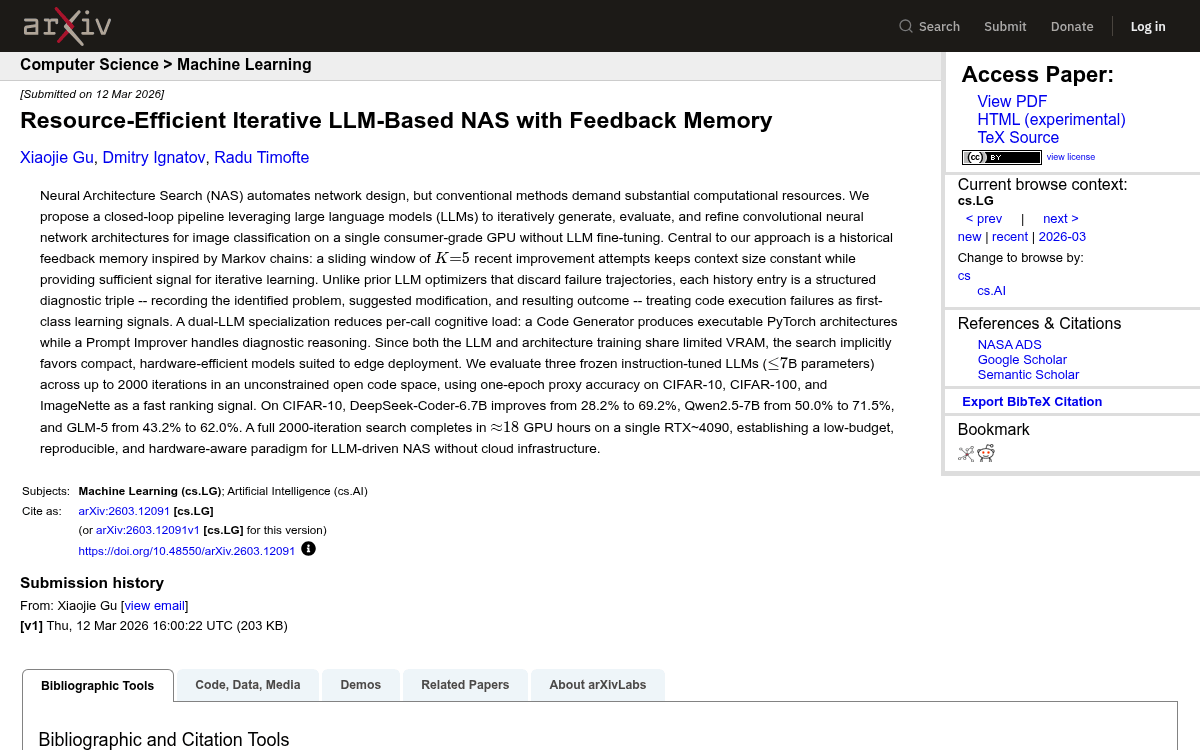
The pipeline, described in Resource-Efficient Iterative LLM-Based NAS with Feedback Memory, runs a full 2000-iteration search in roughly 18 GPU hours on an RTX 4090 and consistently beats what the same LLM can produce in a single shot.
Why single-shot LLM design falls short
Recent work has used LLMs as architecture generators that write executable neural network code directly, but most of that work is one-pass: prompt the model, take whatever it emits, move on. A critical limitation of single-shot LLM generation is that it treats architecture design as a one-pass prediction, discarding the evaluation signal entirely. Human engineers, by contrast, build, test, read the stack trace, and try again.
Prior iterative LLM optimizers like OPRO and FunSearch exist, but they tend to keep only the elite winners in context and throw away failures, or they operate in tightly constrained cell-based search spaces. That is a problem when your generator is a 7B model whose code fails to compile more often than not.
A three-part loop with Markovian memory
The system runs three components in a closed loop:
- Code Generator: an instruction-tuned LLM prompted as a "visionary deep learning architect" that emits a full PyTorch
nn.Moduleclass with__init__andforward. - Evaluator: validates the generated code with a dummy forward pass, then trains it for exactly one epoch with SGD, cosine annealing, and batch size 128. Top-1 test accuracy serves as the proxy metric.
- Prompt Improver: a second LLM call that diagnoses what went wrong and proposes concrete edits.
The core trick is what the paper calls historical feedback memory. Each history entry is a triple recording: the identified problem in the previous iteration, the suggested improvement, and the resulting outcome (accuracy or error). This sliding-window design draws on the Markov property: the improvement decision at step t depends on the current state (best architecture plus recent history window) rather than the complete trajectory.
Only the last K=5 attempts are kept, which caps context size and prevents the overflow that plagues unbounded-history approaches. Crucially, code execution failures are encoded as first-class entries in the history, enabling the LLM to learn from structural mistakes rather than pretending they never happened.
Numbers on a single RTX 4090
The team tested three frozen LLMs, all 7B parameters or smaller: DeepSeek-Coder-6.7B-Instruct, Qwen2.5-7B-Instruct, and GLM-5. On CIFAR-10 the one-epoch proxy accuracy climbed as follows:
| Model | Single-shot | Best after search | Success rate | Spearman ρ |
|---|---|---|---|---|
| DeepSeek-Coder-6.7B | 28.2% | 69.2% | 76.0% | 0.754 |
| Qwen2.5-7B | 50.0% | 71.5% | 18.8% | 0.561 |
| GLM-5 (100 iters) | 43.2% | 62.0% | 91.0% | 0.422 |
The behavior split is interesting. DeepSeek-Coder completed 1519 of 2000 iterations successfully on CIFAR-10 and an even higher 1902 of 2000 on CIFAR-100, giving the largest absolute gain. Qwen2.5 had the worst compile rate but ultimately hit the highest peak, because over thousands of iterations, Qwen2.5 increasingly generates ambitious architectures, many of which fail but occasionally yield superior designs. GLM-5 was the most conservative and reliable within its 100-iteration budget.
An ablation removing either the feedback memory or the reference-architecture prompt caused the search to stagnate, confirming that both components matter. On ImageNette, DeepSeek-Coder collapsed to 0.7% success because 160×160 inputs exposed a context-retention weakness, a sharp reminder that these small models are brittle outside their comfort zone.
The quieter breakthrough
The headline is "NAS on a 4090," but the more interesting shift is the framing of code failures as signal. Prior LLM optimizers treated low scorers as noise to discard. Here, the diagnostic triple (problem, suggestion, outcome) gives the model a causal record of what does not work, which is what makes iterative learning viable when compile-time failure rates run from 5% to 99%.
A second subtle point: because the LLM and the candidate CNN share the same 24GB of VRAM, the search implicitly rewards small models. That is a form of free hardware-aware NAS, useful for anyone targeting edge deployment.
Where it fits, and where it doesn't
This is worth trying if you want to sketch compact vision models for constrained hardware and you already have a small coder LLM sitting on a workstation GPU. It is not a replacement for large-scale NAS on ImageNet, and the one-epoch proxy has not been validated against fully converged performance. The authors flag both as open work, along with extending the memory mechanism with evolutionary selection and testing on tasks beyond image classification.
The full pipeline, prompt templates, training scripts, and per-iteration logs are available in an anonymized repository, so reproducing the CIFAR-10 run on your own 4090 is a weekend exercise rather than a research program.