
University of Twente's DAAM Framework Gives Drones Human-Like Muscle Reflexes
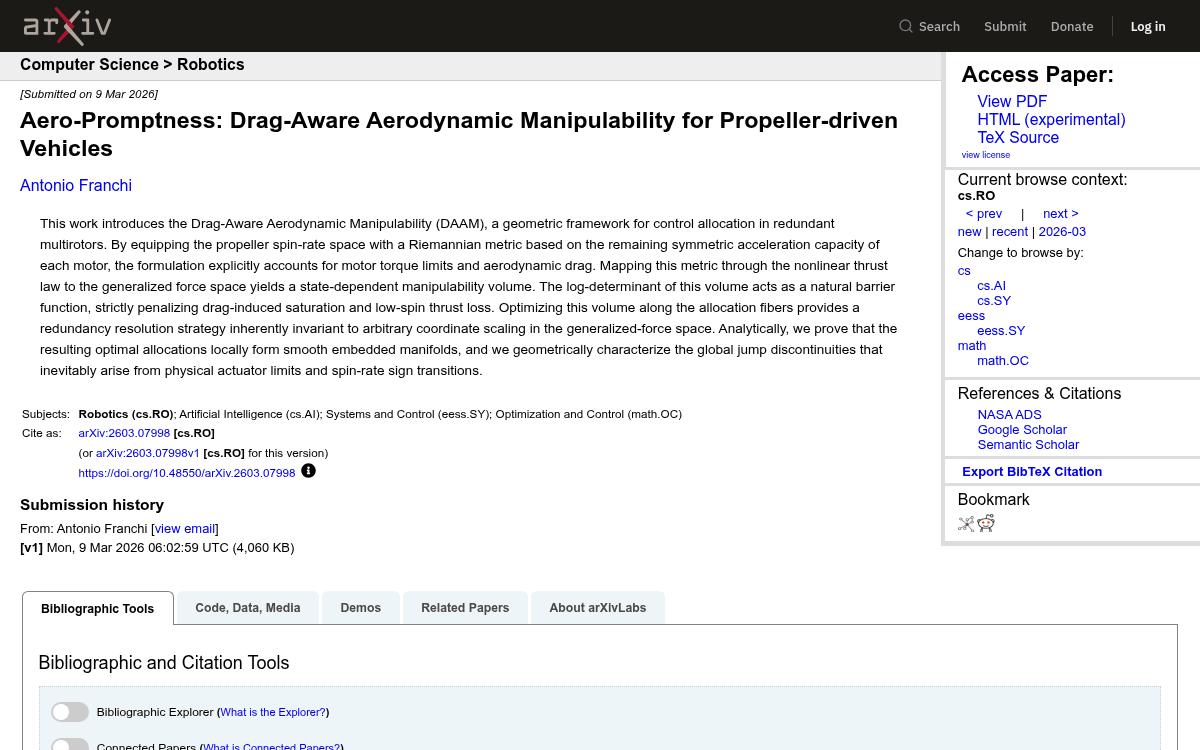
A new geometric framework called DAAM replaces heuristic drone motor allocation with physics-grounded optimization that keeps rotors primed for instant force changes
 Pro
Takeaways
- New framework: DAAM (Drag-Aware Aerodynamic Manipulability) replaces energy minimization in drone motor allocation with a geometry that maximizes instantaneous force-change readiness.
- Core insight: A Riemannian metric built from each motor's remaining acceleration headroom (SAC) is pushed through the nonlinear thrust map to produce a state-dependent manipulability volume.
- Barrier function: The log-determinant of this volume diverges to infinity near drag saturation and zero-spin thrust loss, automatically steering motors away from both failure modes.
- Proven invariance: Optimal allocations are independent of task-space coordinate scaling — a key advantage over classical manipulability indices that change with unit choices.
- Antagonistic tension: The optimizer actively spins motors against each other near zero net force, analogous to biological muscle co-contraction, to preserve reactive authority.
- Theory only: No hardware experiments; preprint on arXiv provides closed-form gradients suitable for embedded NLP solvers but releases no code.
Most drone control stacks treat motor allocation as an energy minimization problem: given a desired force, find the motor speeds that produce it while burning the least power. That works well for steady hover, but it leaves the vehicle poorly prepared for the moments that matter most , a sudden gust, an unexpected impact, or a rapid maneuver. A new paper from the University of Twente proposes a fundamentally different objective: instead of minimizing energy, maximize the drone's instantaneous ability to change what it's doing. The framework is called Drag-Aware Aerodynamic Manipulability (DAAM).
Why existing allocation falls short
Redundant multirotors , hexarotors, octorotors, and fully-actuated tilt-rotor platforms , have more motors than strictly needed to produce any given force. That extra degree of freedom is called actuation redundancy, and how you resolve it has real consequences. Traditional allocators exploit this redundancy to minimize instantaneous power or mechanical manipulability. The problem is that both objectives can park motors at spin rates where they have very little room to accelerate further.
Propeller physics creates two distinct failure modes that energy-minimizing controllers ignore:
- Drag-induced saturation: At high spin rates, aerodynamic drag torque consumes most of the motor's available torque budget, leaving almost no headroom to speed up further.
- Thrust-slope degeneracy: Near zero spin, the thrust curve is nearly flat , a small change in motor speed produces almost no change in force. The drone loses the ability to respond quickly even if the motor can physically accelerate.
Both rotor thrust and aerodynamic drag torque arise from the acceleration of air particles. This shared physics dictates a quadratic dependence on the propeller spin rate, introducing two competing aerodynamic bottlenecks not present in standard robotic joint actuators. No prior work had unified both effects into a single allocation framework.
The DAAM framework, step by step
The core idea is to equip the space of motor spin rates with a geometry that reflects how much acceleration headroom each motor actually has. The paper formalizes this through a quantity called the Symmetric Acceleration Capacity (SAC) , for each motor at its current spin rate, the SAC measures the largest symmetric interval of accelerations that the motor can still execute given its torque limit and the drag it's fighting. Mathematically:
# SAC for motor i at spin rate v_i
# tau_max: peak motor torque
# b: aerodynamic drag coefficient
# m_i: rotor inertia
def sac(v_i, tau_max, b, m_i):
    return max(0, (tau_max - b * v_i**2) / m_i)
# SAC peaks at v=0 and drops to zero at v = sqrt(tau_max / b)
# Beyond that speed, the motor cannot accelerate symmetrically
The SAC values for all motors are assembled into a diagonal weight matrix W(v). This matrix becomes the Riemannian metric on the spin-rate space , a geometry where directions with little remaining headroom are "expensive" to move in. Mapping this metric through the nonlinear thrust law to the generalized force space yields a state-dependent manipulability volume. The result is the DAAM matrix:
# DAAM matrix at spin-rate vector v
# J_f: Jacobian of the thrust allocation map
# W: diagonal SAC-squared weight matrix
D = J_f(v) @ W(v) @ J_f(v).T
# Objective: maximize log-det(D)
# = maximize the "volume" of achievable force-rate directions
# subject to: f(v) == w  (produce the required force)
The log-determinant of this volume acts as a natural barrier function, strictly penalizing drag-induced saturation and low-spin thrust loss. When any motor approaches saturation or zero spin, the log-det cost diverges to infinity, automatically steering the optimizer away from those states.

What the math proves
The paper's theoretical contributions go beyond just defining the objective. Three key results are established analytically:
- Intrinsic invariance: The optimal allocation is independent of how you scale or parameterize the force space. Whether you mix forces in Newtons and torques in Newton-meters, or rescale either axis, the answer doesn't change. This is a significant improvement over classical manipulability indices, which are notoriously sensitive to unit choices.
- Local smoothness: The optimal allocation locally forms a smooth embedded manifold, effectively avoiding thrust loss and actuator saturation while significantly enhancing vehicle controllability in high-drag environments. In practice, this means that for small changes in the desired force, the motor commands change smoothly , no chattering.
- Global jump discontinuities: The smooth manifold breaks down at three physical boundaries: motor reversals (spin rate crossing zero), actuator saturation (hitting maximum spin), and authority loss (the allocation Jacobian losing rank). These jumps are proven to be unavoidable consequences of the underlying physics, not artifacts of the algorithm.
Antagonistic tension as a feature, not a bug
One of the most striking results is what the optimizer does near zero net force. An energy minimizer would spin all motors down toward zero when the required force is small. DAAM does the opposite: it actively maintains antagonistic rotor tension, spinning some motors forward and others backward to keep all of them away from the zero-spin degeneracy zone. A recent preprint initiated this direction by isolating the thrust singularity, demonstrating that antagonistic rotor operation (akin to biological co-contraction) can enlarge dynamic manipulability at the cost of energy. DAAM unifies this insight with drag limits into a single coherent framework.
The analogy to human muscle physiology is intentional. When you hold a cup steady, your arm muscles don't all relax , they co-contract, maintaining tension in opposing muscle groups so that any perturbation can be resisted instantly. DAAM gives drones the same property.

Numerical landscapes across configurations
The paper works through three illustrative cases to show how the theory plays out in practice. For a two-propeller system generating one force, six parameter variations reveal how the optimal allocation path reorganizes itself when motors have different inertias, torque limits, or drag coefficients:
- A motor with very low inertia gets "parked" at its aerodynamic sweet spot while the heavier motor absorbs force variations.
- A motor with very low torque limit gets pushed to its saturation boundary as a constant bias, preserving the stronger motor's dynamic range.
- A motor with very low drag coefficient gets a much wider feasible spin range, and the optimizer exploits this with a more complex path through the landscape.
For three-propeller systems, the allocation fibers become 2D surfaces in 3D spin-rate space, and the optimal section traces a 2D manifold that actively avoids the origin of the actuator cube. For any desired generalized force, the framework performs a fiberwise selection: searching exclusively along the allocation fiber , the set of all redundant motor commands that produce the target generalized force , to find the configuration that maximizes the DAAM volume.
Where this fits and what it can't do yet
As a complementary strategy for flight phases demanding high aerodynamic readiness , such as severe wind gusts or unmodeled interactions , the framework leverages redundancy to maximize the intrinsic aerodynamic capability encoded by the DAAM volume. It is not meant to replace energy-efficient allocation during steady cruise; the authors explicitly frame it as a mode to engage when reactivity matters more than endurance.
There are real limitations to acknowledge. The paper is purely theoretical , no hardware experiments are included, and the authors are explicit that this is intentional. The geometric proofs hold for any n-rotor configuration, so instantiating on specific hardware is left for follow-on work. The framework also assumes standard quadratic thrust and drag models, which break down under blade flapping, ground effect, or rotor-to-rotor aerodynamic interference. And the global jump discontinuities mean that large-signal trajectories crossing physical boundaries will require explicit handling , a continuous, suboptimal path through the allocation space remains an open problem.
The analytical gradient derived in the paper (equation 14 in the full paper) is closed-form and avoids finite differences, which means the optimization can in principle run on embedded flight controllers using standard nonlinear programming solvers. The preprint does not release code, but the mathematical formulation is complete enough to implement directly. The practical use cases are clearest for fully-actuated aerial manipulators, inspection drones operating in turbulent environments, and any platform where the cost of a delayed force response is high.