
University of Toronto's ALLO Beats Every AI Detector for Spotting Space Debris
A new synthetic dataset and CAD-guided detector help the Canadarm3 spot floating hazards near the Lunar Gateway when off-the-shelf methods break down.
 Pro
Takeaways
- Toronto and MDA Space release ALLO, a 51,409-image synthetic benchmark for anomaly detection in lunar orbit.
- MRAD algorithm compares camera feed against CAD-rendered reference images to flag debris and hazards without training data.
- Achieves 62.9% pixel-level AP and 75.0% image-level AUROC, beating nine learning-based baselines including Dinomaly.
- State-of-the-art industrial detectors dropped 21 AUROC points moving from MVTec to space imagery.
- Full dataset, Blender pipeline, and code are open source under utiasSTARS.
- Method relies on known Canadarm3 pose and CAD model; performance limited by reference render fidelity.
Detecting a stray tool floating near a space station sounds like a solved computer vision problem. It is not, especially when the station is orbiting the Moon, the lighting alternates between harsh sunlight and pitch black, and there is no crew on board to notice. Researchers from the University of Toronto and MDA Space have released a paper that pairs a purpose-built synthetic dataset with a statistical detector designed for exactly this scenario, and it beats every learning-based baseline they tested.
Why Earth-trained detectors fail in orbit
NASA's forthcoming Lunar Gateway is central to the Artemis program, and its Canadarm3 robotic arm will need to handle inspection, maintenance, and vehicle capture largely on its own. Anomaly detection in the space domain is particularly challenging because of complex lighting conditions that result from the black background coupled with harsh direct solar illumination. Varied camera viewpoints used during operations near the space station can cause anomalies to fall into shadow regions and blend in with the background, making detection substantially more difficult.
Existing anomaly detection benchmarks like MVTec are built around factory conveyor belts: fixed cameras, controlled lighting, plain backgrounds. That mismatch is why the authors built something new.

Meet ALLO, a rendered lunar orbit
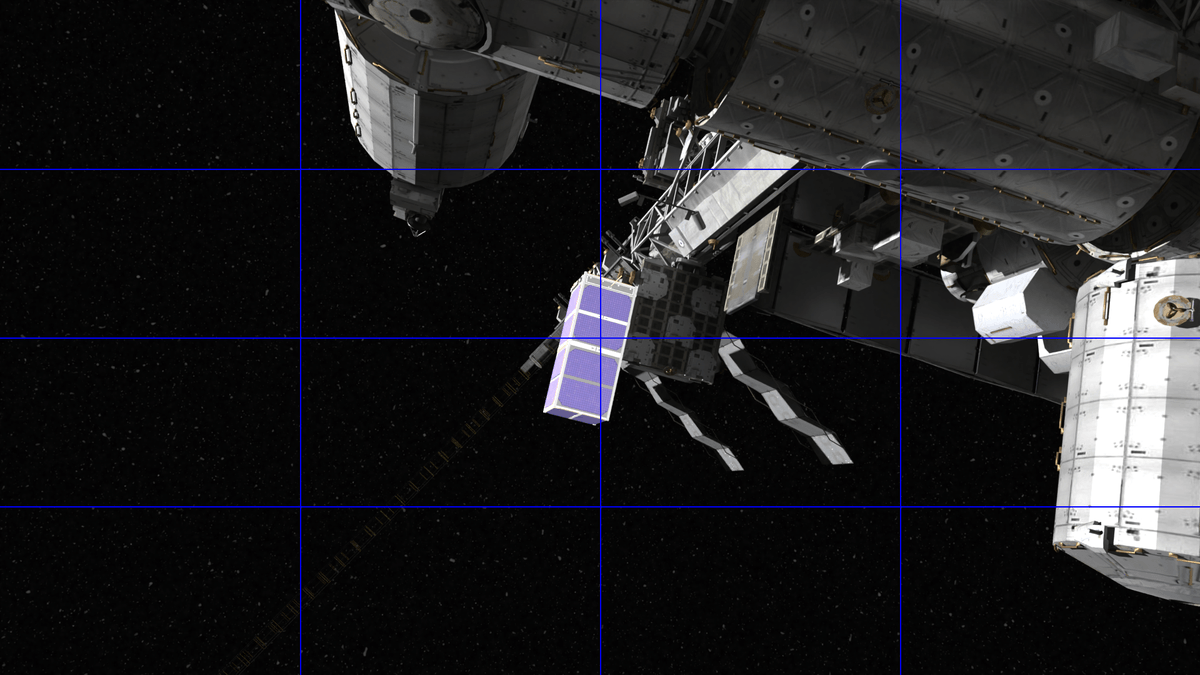
The ALLO dataset (Anomaly Localization in Lunar Orbit) is a photorealistic synthetic benchmark rendered in Blender Cycles. Since a detailed Gateway model does not yet exist publicly, the team used a high-fidelity model of the ISS as a stand-in and placed it on the Gateway's anticipated orbit. Some key numbers:
- 51,409 synthetic images simulating the visual feed from arm-mounted cameras, split into anomaly-free training data and a test set with both normal and anomalous scenes.
- 16 distinct anomalous objects representing potential collision hazards, including dislodged station equipment such as thermal blankets or cables, items lost during extravehicular activities such as tools or astronaut gloves, and objects resembling experimental equipment from prior missions such as Cubesats and small satellites.
- 50 base camera poses derived from possible Canadarm3 trajectories, perturbed with Gaussian noise (1 m position, 0.2 rad orientation) to capture viewpoint diversity.
- Sun, Earth, and Moon positions pulled from 2030 ephemeris data over a 365-day span using the Skyfield library.
To validate realism, the authors compared ALLO renders against real ISS photographs. They obtained an average LPIPS score of 0.58 across ten real-synthetic pairs, comparable to state-of-the-art image synthesis models such as GILL (~0.70 on VIST) and Stable Diffusion XL (0.88 on COCO2017). Their FID score of 3.61 against historical ISS photographs also beats several recent generative models.
The trick: render your own ground truth at inference time
Model Reference Anomaly Detection (MRAD) sidesteps the training data problem entirely. Because the Canadarm3 knows its own pose and a CAD model of the station is available, MRAD can render what the camera should see and compare that reference to the actual query image. Anomalies show up as statistical deviations between the two.
The pipeline runs in three stages:
- Per-pixel anomaly scoring. MRAD extends the Reed-Xiaoli detector, a classical technique that treats background pixels as samples from a multivariate Gaussian and flags low-likelihood outliers. Both query and reference images are divided into a 4x4 grid, and mean and covariance are computed per cell to handle the extreme contrast between the black of space and lit station surfaces. The final score is the difference between the reference-based and query-based Mahalanobis distances.
- Noise removal. A sliding-window kernel measures local standard deviation of anomaly scores. Regions with uniform low variation (typical of background noise amplification) get zeroed out, then a Gaussian blur smooths what remains.
- Region growing. Mean-shift clustering picks seed pixels, and adjacent pixels with similar scores are aggregated into contiguous anomaly regions. An image is flagged as anomalous if the total anomalous area exceeds a threshold.

Numbers that matter
On the ALLO test set, MRAD hits the highest P.AP of 62.9%, best FPR95 of 37.5%, and the second-highest I.AUROC of 75.0%. The best learning-based competitor, Dinomaly, reached 49.4% P.AP. More striking is how much learned methods regressed compared to their MVTec performance: Dinomaly's I.AUROC dropped by 21.0 points (99.6% to 78.6%) and P.AUROC by 7.0 points (98.4% to 91.4%) when moved from factory floors to lunar orbit.
The ablation studies point to grid size as the dominant parameter. Dropping the grid entirely tanks image-level AUROC to 57.9%, while a 6x6 grid actually edges out 4x4 on P.AP. The takeaway is that local statistics matter far more than global scene modeling when illumination is this heterogeneous.
Where this shines and where it does not
MRAD's strengths are exactly what you would want in a space-qualified system:
- No training data required. Acquiring labeled on-orbit imagery is prohibitively expensive, and training purely on synthetic images introduces a sim-to-real gap.
- Interpretable behavior. The handful of tunable parameters (grid size, tolerance, kernel size, noise standard deviation) produce predictable changes rather than black-box surprises.
- Extensible. The authors note the same framework could handle inspection tasks like structural damage or surface degradation, not just free-floating debris.
The catch: MRAD leans hard on the CAD model and pose estimate. If the reference render is wrong, the comparison is wrong. Its pixel-level AUROC (71.8%) also trails several learning-based methods, meaning it is better at localizing anomalies precisely (higher AP) than at ranking every single pixel. And this evaluation is entirely synthetic-on-synthetic, with the domain gap simulated through lighting jitter and small pose perturbations rather than tested against real footage.
Code and data
The ALLO dataset and full MRAD implementation are open source, including the Blender-based generation pipeline so other teams can extend the scenes for semantic segmentation, depth estimation, or their own anomaly detection experiments. The paper has been accepted to IEEE Robotics and Automation Letters.
For anyone working on autonomous inspection, defect detection with known geometry, or robotics in visually extreme environments, the broader lesson lands harder than the specific algorithm: when you have a good geometric prior and cannot get training data, comparing against a rendered expectation can outperform learning a distribution you do not have enough samples to model.