
University of Tokyo Shrinks Surgical Robot's Joint Angles by 20% Inside the Body
A new joint-space path planner reshapes concave abdominal cavities into convex surfaces, cutting joint motion and port stress for autonomous surgical forceps.
 Pro
Takeaways
- University of Tokyo team proposes path planning in joint space for laparoscopic surgical robots using a Riemannian metric.
- Concave abdominal cavities become non-concave in joint space, letting gradient descent replace expensive global search.
- Edge cost combines a kinematic metric with a barrier term that penalizes proximity to organs and joint limits.
- Tested on cholecystectomy and prostatectomy mimic organs with the pneumatic Saroa surgical system.
- Reduces mean forceps insertion angle from 39.5 to 31.8 degrees, easing torsion at the trocar port.
- Full method and derivation in the arXiv preprint; no public code released.
Autonomous surgical robots have a geometry problem. Every laparoscopic tool has to enter the body through a fixed trocar port, which pins the arm at a pivot and squeezes its reachable workspace into an awkward cone. Plan the tool tip's path in ordinary Cartesian space and you end up with trajectories that look reasonable in three dimensions but push the shoulder, elbow, and wrist joints toward their mechanical limits. A team at the University of Tokyo has proposed a fix: plan the path directly in joint space, treated as a Riemannian manifold, so that concave obstacles like the abdominal wall become well-behaved convex shapes.
Why position-space planning breaks inside the body
Classical planners such as PRM and RRT sample the end-effector in 3D, then solve inverse kinematics to get joint commands. That works fine for a factory arm in open air. Inside an abdomen, two things go wrong. First, the body cavity walls are concave, which makes gradient-based collision avoidance methods like signed distance fields expensive to use because they no longer have a single well-defined minimum. Second, a Cartesian trajectory that looks short can force the holder arm to swing across a huge angular range, twisting the trocar port and torquing the patient's abdominal wall.
The surgical platform the authors target is the pneumatically driven Saroa system, a Japanese assist robot that provides real-time haptic feedback to the surgeon and has already been evaluated in robot-assisted laparoscopic radical prostatectomy. Its holder arm has five degrees of freedom with tight per-joint limits, so any planner that ignores those limits will produce paths the robot cannot actually execute smoothly.

Turning the abdomen inside out
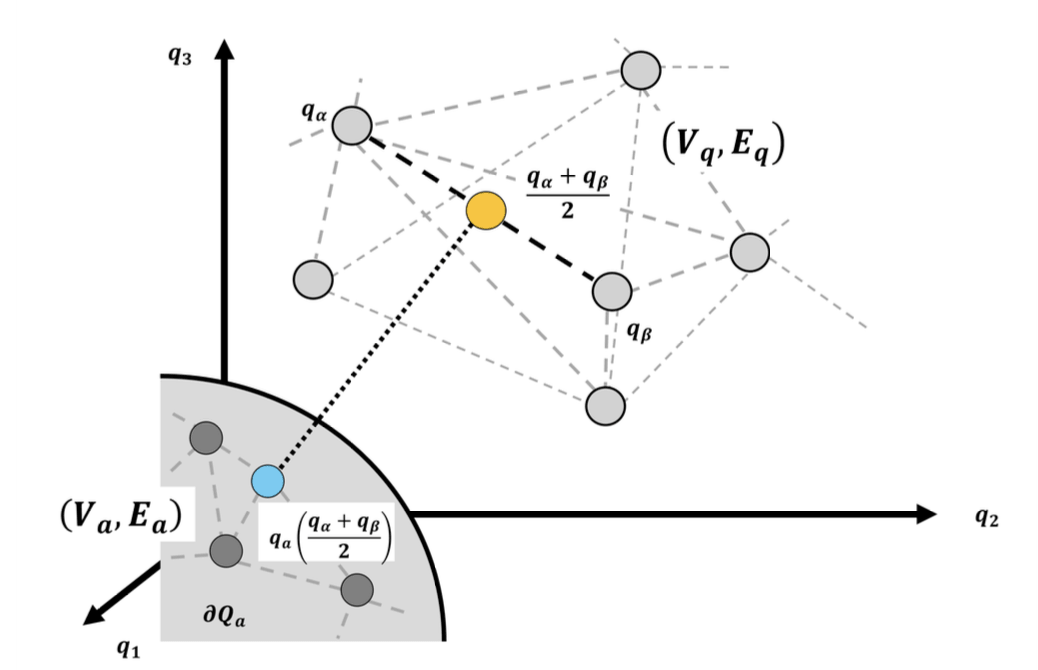
The core trick is a change of coordinates. Instead of measuring distance between two tool positions in millimeters of Cartesian displacement, the planner measures it in the joint-angle space that actually drives the motors, equipped with a Riemannian metric derived from the forward kinematics. The metric bakes in the contribution of the wrist joints q4 and q5 as functions of the shoulder and elbow joints, so a step that looks short in 3D but requires a large wrist swing is correctly penalized.
When the authors push a concave body-cavity surface through this transformation, something useful happens: organs that were concave in position space come out as combinations of non-concave patches in joint space. The paper verifies this with Gaussian and mean curvature calculations on simulated organ meshes. Non-concave surfaces have a single closest point that gradient descent can find quickly, replacing an expensive global search with a local greedy walk.
Building the planner
The pipeline is a fairly clean adaptation of sampling-based planning into the manifold setting:
- Sample the boundary of the forbidden region on a grid of spherical directions from the trocar port, run inverse kinematics on each sample, and build a Delaunay-triangulated mesh of the obstacle in joint space.
- Segment that mesh into convex patches so the nearest forbidden configuration to any query point can be found by greedy descent on each patch, then taking the minimum.
- Sample free configurations, connect them with a Delaunay graph, and weight each edge with the Riemannian arc length plus a barrier term that blows up near the obstacle.
- Run Dijkstra on that graph between the nodes closest to start and goal, then fit a cubic spline through the resulting sequence for a smooth trajectory.
The edge cost has two parts: a metric term that discourages paths approaching joint limits and a penalty term that discourages paths approaching organs. A tuning parameter sets how aggressively the arm keeps its buffer, calibrated so a 5.0 mm Cartesian margin around tissue matches roughly 0.842 degrees in joint space.
What the numbers show
The authors simulated two well-known procedures, cholecystectomy with a gallbladder inside a concave ellipsoid cavity, and prostatectomy with a bladder inside a hemispherical cavity, and then ran a physical experiment on a mimic-organ bladder model with 1000 sampled configurations and 5000 obstacle-boundary points. They compared their joint-space planner against a matched position-space planner using the same barrier structure.
The tracked metric is the forceps insertion angle relative to vertical, which correlates with torsion at the port:
| Metric | Position space | Joint space (proposed) |
|---|---|---|
| Mean insertion angle (deg) | 39.5 | 31.8 |
| Max insertion angle (deg) | 47.7 | 40.3 |
| RMS angle derivative (deg/mm) | 0.256 | 0.214 |
That works out to roughly a 20 percent reduction in mean forceps tilt and a smoother angular profile along the path. In practice, less lever action at the abdominal wall means less risk of the arm slamming into a joint limit halfway through a motion.

Where it fits and where it does not
This is a targeted contribution rather than a general robotics breakthrough. It is aimed at the specific geometry of trocar-constrained laparoscopy, and the convexity claim depends on the particular kinematic chain of a five-joint holder arm. The authors are upfront that clarifying the conditions under which arbitrary organ shapes become non-concave in joint space is future work, and the current experiments use simplified mimic organs rather than real segmented anatomy. Cubic-spline post-processing also does no collision re-checking, so the smoothed trajectory could in principle clip a margin the graph search respected.
No code release is mentioned in the paper. For anyone building semi-autonomous laparoscopic behaviors on top of clinical platforms like Saroa or the da Vinci family, though, the takeaway is architectural: if your kinematics is dominated by a fixed pivot, planning in the space your motors live in, with a metric that remembers the whole arm, is a more honest problem formulation than pretending the tool tip flies freely through 3D.