
University of Tokyo's FSG Generates Robot Grasps 240x Faster Than Rivals
A teleoperation-plus-sampling pipeline turns a handful of human grasp demos into large, diverse datasets for dexterous hands in under a second per pose.
 Pro
Takeaways
- New pipeline combines AutoWS and FSG to augment dexterous grasp datasets from single teleoperated demos.
- Fingertip workspace point clouds embed joint angles directly, removing per-sample inverse kinematics costs.
- Generates valid Shadow Hand grasps in 0.04 to 0.2 seconds, orders of magnitude faster than DexGraspNet and QD-Grasp-6DoF.
- Valid grasp rate on YCB tomato soup can hit 60.8 percent versus 5.9 percent for DexGraspNet.
- Works across Shadow Hand, Robotiq 2F-85, Barrett Hand, and Allegro Hand without algorithm changes.
- Fails on thin edges and tiny objects without demonstrations; no public code released yet.
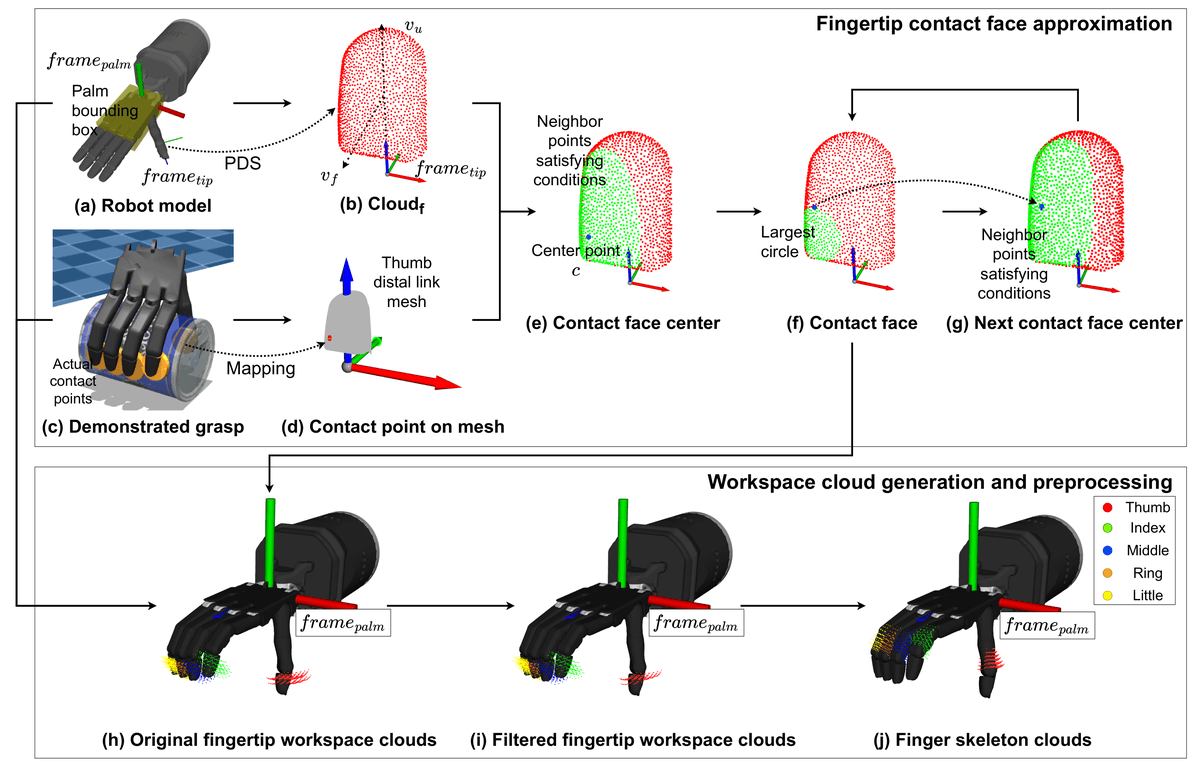
Training neural networks to grasp with multi-fingered robotic hands runs into a stubborn wall: you need thousands of physically valid grasp poses per object, and generating them is slow, hand-specific, and computationally punishing. A team from the University of Tokyo has proposed a pipeline that shortcuts the process by baking hand kinematics directly into point clouds, then bootstrapping large datasets from a single teleoperated demo per object.
The paper, which appears in Advanced Robotics, introduces two components that work together: AutoWS, which builds structured fingertip workspace clouds from a robot hand model, and FSG (Fingertip-contact-aware Sampling-based Grasp generator), which samples valid grasps from those clouds in a fraction of a second.
Why grasp data generation is stuck
Most existing pipelines fall into two camps, and both have serious downsides. Optimization-based approaches produce stable grasp poses but often take a long time to compute, and they tend to minimize hand-object distance, which breaks down for small objects sitting on a table where the palm would collide with the surface. Sampling-based methods offer more flexibility in pose generation but struggle with the vast solution space, driving up compute costs and killing throughput for large-scale data generation.
The core inefficiency is that contact-point sampling and inverse kinematics (finding joint angles that place a fingertip at a target) are usually separate steps, so you pay the IK cost every time you test a candidate. Prior research using contact point sampling often limits the number of fingers to three just to keep the combinatorics manageable.