
University of Tokyo's ELLMob Beats AI Mobility Models by 46.9% During Disasters
ELLMob uses cognitive psychology to make LLMs generate realistic human movement during disasters, pandemics, and major events — and releases the first dataset to prove it works.
 Pro
Takeaways
- ELLMob is a new LLM framework that generates realistic human movement trajectories during major societal events like typhoons, pandemics, and the Olympics.
- It introduces the first event-annotated mobility dataset, covering 1,100 Tokyo users across three real events (2019-2021) with GPS, POI category, and timestamps.
- The core innovation is Fuzzy-Trace Theory (FTT)-based alignment: the model extracts "gists" of user habits and event constraints, then iteratively reconciles conflicts between them.
- ELLMob beats all baselines by an average of 46.9% across events; the cognitive alignment alone accounts for a 69.5% improvement over non-aligned variants.
- It costs $0.0017 per person per day using GPT-4o-mini and works across open-source backends (LLaMA3, Qwen-2.5, DeepSeek-R1).
- Code and dataset are open-source on GitHub; key use cases include emergency response planning, public health simulation, and stress-testing urban infrastructure.
Ask an LLM to simulate where someone goes on a typical Tuesday, and it will do a decent job. Ask it to simulate where that same person goes during a typhoon, and it will almost certainly get it wrong. It will either ignore the storm entirely and generate a normal-looking commute, or it will overcorrect and have the person stay home all day when they might actually venture out for essentials. A new paper from researchers at the University of Tokyo and Institute of Science Tokyo tackles this exact failure mode with a framework called ELLMob.
Why this problem matters more than it sounds
Trajectory generation aims to synthesize realistic mobility traces whose distribution matches key properties of real mobility data, so the outputs can be used for downstream tasks like simulation and policy evaluation. Simulating human mobility data is essential for transportation, urban planning, and epidemic control, since real data are often inaccessible due to expensive costs and privacy issues. The synthetic data that comes out of these systems feeds into emergency response planning, public health modeling, and urban infrastructure decisions.
The problem is that LLM-based methods excel at generating routine trajectories, but struggle to capture deviated mobility during large-scale societal events , a limitation that stems from the absence of event-annotated mobility datasets and the inability of current frameworks to reconcile competition between users' habitual patterns and event-imposed constraints. Without reliable data to benchmark against, nobody even knew how badly existing models were failing at this task.
The dataset that didn't exist
Before building a better model, the team had to build the data to evaluate one. They constructed what they claim is the first event-annotated human mobility dataset, pulling from Foursquare check-ins that users publicly synced to Twitter between 2019 and 2021 in the Tokyo metropolitan area. The final dataset covers 1,100 users across four scenarios:
- Typhoon Hagibis (Oct 2019): A Category 5 storm that brought over 240mm of rain in 24 hours, suspended all major transit, and triggered evacuation orders for 800,000 households.
- COVID-19 Pandemic (Apr 2020): Japan's first State of Emergency, which requested residents to stay home except for essential activities.
- Tokyo 2021 Olympics (Jul 2021): A pandemic-era mega-event with restricted zones, traffic jams, and simultaneous "stay home" advisories.
- Normal Period (Sep 2019): A 30-day baseline of routine urban mobility.
Each check-in record includes GPS coordinates, POI category, timestamp, and a user comment , making it richer than existing public datasets like GeoLife or Gowalla, which lack explicit event annotations. The pre-event data (two months before each event) serves as training context, while the during-event period is what models must predict.

The cognitive trick at the core of ELLMob
The key insight behind ELLMob comes from an unlikely source: a 1995 cognitive psychology theory called Fuzzy-Trace Theory (FTT). FTT posits that humans don't make decisions based on precise facts ("there's a 15% chance of a tsunami") but on the essential meaning, or gist, of information ("the risk is high"). Crucially, FTT says this gist can be expressed in language , which means an LLM can work with it.
The team maps this theory onto trajectory generation by defining three types of gist that the model must extract and reconcile:
- Pattern Gist: The essential summary of a user's habitual mobility , their core behaviors, "points of inertia" (non-negotiable habits like going home at night), and "points of fracture" (dependencies that could break, like relying on a specific train line).
- Event Gist: The core behavioral implication of the event , not the raw facts, but what they mean for movement decisions (e.g., "high outdoor risk, strong incentive to stay home").
- Action Gist: The intent behind the LLM's current draft trajectory , does it reflect habit adherence or event compliance, and to what degree?

How it works, step by step
ELLMob runs as a three-stage loop, using GPT-4o-mini as its backbone (temperature 0.1, 10-minute trajectory resolution):
- Event Schema Construction: Raw event text (news reports, policy documents) is parsed into a structured four-field brief covering event profile, intensity/scale, infrastructure impact, and official directives. This prevents the LLM from losing critical details in long free-form text.
- Initial Trajectory Generation: The LLM generates a candidate trajectory conditioned on the user's long-term history, short-term recent behavior, and the event schema. It also produces a written justification for its choices.
- Gist Extraction and Reflection: The framework extracts all three gists from the candidate trajectory and runs a dual-axis audit: does the action gist conflict with the pattern gist (internal alignment)? Does it conflict with the event gist (external alignment)? If either check fails, the model receives specific corrective feedback and regenerates. This loop runs up to K=3 iterations.
The whole pipeline costs $0.0017 per person per day at GPT-4o-mini pricing, using 9,569 tokens and about 18.7 seconds. That's more expensive than single-pass LLM baselines, but significantly cheaper than generic reflection methods like Reflexion, which consume 26,057 tokens at $0.0042 per run. Since each user is generated independently, city-scale simulations can be parallelized.
The numbers tell the story
Performance is measured using Jensen-Shannon Divergence (JSD) , a measure of how different two probability distributions are, where lower is better , across four metrics: step interval (time between activities), step distance (spatial jump between locations), category distribution (what types of places people visit), and spatial grid distribution (where in the city activity concentrates).
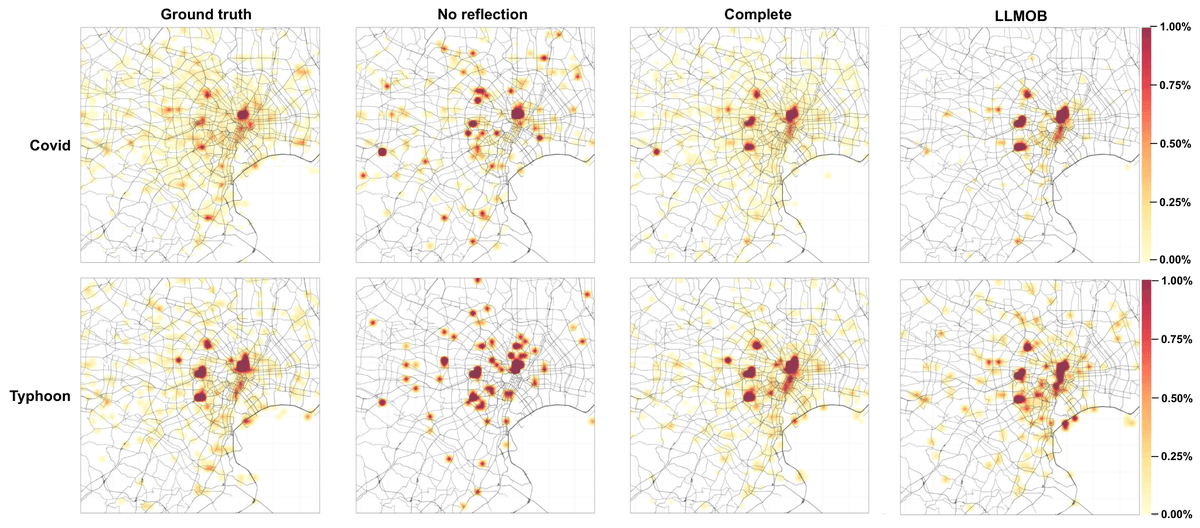
ELLMob surpasses the strongest baselines by an average of 46.9% across all three events. The ablation study is where the real story emerges: incorporating cognitive-based self-alignment improves performance by an average of 69.5% over non-aligned variants. Removing external alignment during COVID-19 causes a 132.4% degradation in step interval score alone , the model reverts to habitual patterns and completely misses the behavioral suppression caused by the emergency declaration.
The framework also holds up across different LLM backends. Tests with Gemini Flash 2.0, LLaMA3-8B, Qwen-2.5-14B, and DeepSeek-R1-Distill-Qwen-7B all show ELLMob maintaining its lead, while baseline methods show significant volatility when the backbone changes. This suggests the gains come from the alignment architecture, not from any particular model's prior knowledge.
What it's actually good for
The most compelling practical application may be emergency response. The paper frames typhoon mobility as a binary classification problem: can you identify which users will still travel during a dangerous storm? Those are the people who need targeted early warnings. ELLMob achieves the highest F1-Score, driven by a recall of 59.3% in identifying this "active" high-risk population during the typhoon. Other use cases include:
- Stress-testing transportation networks under disaster scenarios without waiting for a real disaster
- Generating privacy-preserving synthetic mobility data for public health research during outbreaks
- Urban simulation for event planning (Olympics-scale traffic modeling)
- Training downstream models where real event-period data is scarce or sensitive
The real limits to watch
ELLMob is not a drop-in replacement for routine trajectory generation if cost is a concern , it's roughly 2.5x more expensive per query than the cheapest LLM baselines. More importantly, the dataset itself has a known demographic skew: data from location-based social networks may introduce demographic biases, such as skewing towards younger users, which is a common limitation in LBSN research. The dataset is also currently limited to Tokyo, though the team validated generalization to Osaka during COVID-19 with consistent results. The framework also requires structured event context as input , someone needs to write or generate the event schema before the system can run, which adds a preprocessing step for novel events.
The paper and the full dataset and code are available at the ELLMob GitHub repository. For teams working on urban simulation, emergency planning, or any application that needs synthetic mobility data that doesn't fall apart when something unusual happens, this is worth a close look.