
University of the Basque Country Reveals Multimodal AI Secretly Fails at Combined Tasks
A new study reveals that multimodal LLMs consistently fail to combine their own visual and text skills, even for trivially simple tasks — and the fix is harder than it looks.
 Pro
Takeaways
- Cross-modality skill composition gap: All tested MLLMs perform significantly worse when asked to combine visual and textual skills in a single prompt vs. two separate calls to the same model.
- Three benchmark tasks: Researchers tested OCR + reasoning, object detection + counting, and card recognition + arithmetic — all trivially decomposable for humans.
- Gaps up to 22 points: LLaVA 1.6-Vicuna-13B showed a 22-point accuracy gap; even strong models like Llama 3.2 11B showed ~19 points on rendered-text reasoning.
- Cascaded inference is a free fix: Splitting tasks into two model calls consistently outperforms single-prompt inference with no extra training required.
- CoT and fine-tuning help but don't close the gap: Chain-of-thought prompting is model-sensitive; fine-tuning only fully closes the gap on in-distribution data.
- Code and datasets are open-source: github.com/paulaonta/skillComposition includes COCO-Count and card game benchmarks.
Multimodal large language models (MLLMs) can read text, analyze images, count objects, and solve math problems. But can they do all of those things together, in a single pass? A new paper from researchers at the University of the Basque Country says: not nearly as well as you'd expect. The study, titled "Multimodal LLMs Do Not Compose Skills Optimally Across Modalities", introduces the concept of a cross-modality skill composition gap and shows it exists in virtually every major open-source MLLM tested.
The hidden seam in multimodal models
Most modern MLLMs follow the late-fusion paradigm, where a pretrained visual encoder and LLM are connected and further trained for vision-language instruction following. Think of it like bolting a camera onto a brain that was already trained to think. The camera learns to see; the brain already knows how to reason. But does the combined system know how to see and then reason as a unified whole?
The dominant late-fusion paradigm adds a modality-specific encoder later in training, raising questions of how well the final model is able to combine skills from both modalities. This is the exact question the paper sets out to answer , and the answer is uncomfortable.
Defining the gap
Skill composition is the ability to combine previously learned skills to solve new tasks. As neural networks acquire increasingly complex skills during their pretraining, it is not clear how successfully they can compose them. The researchers make this concrete by defining two types of skills:
- Visual skills: abilities that require processing image content, like OCR (reading text in images) or object detection.
- Textual skills: abilities that operate purely on text, like arithmetic reasoning or counting items in a list.
A model that has both skills should, in theory, be able to chain them. The paper tests whether that chaining actually happens.
Three tasks, one uncomfortable truth
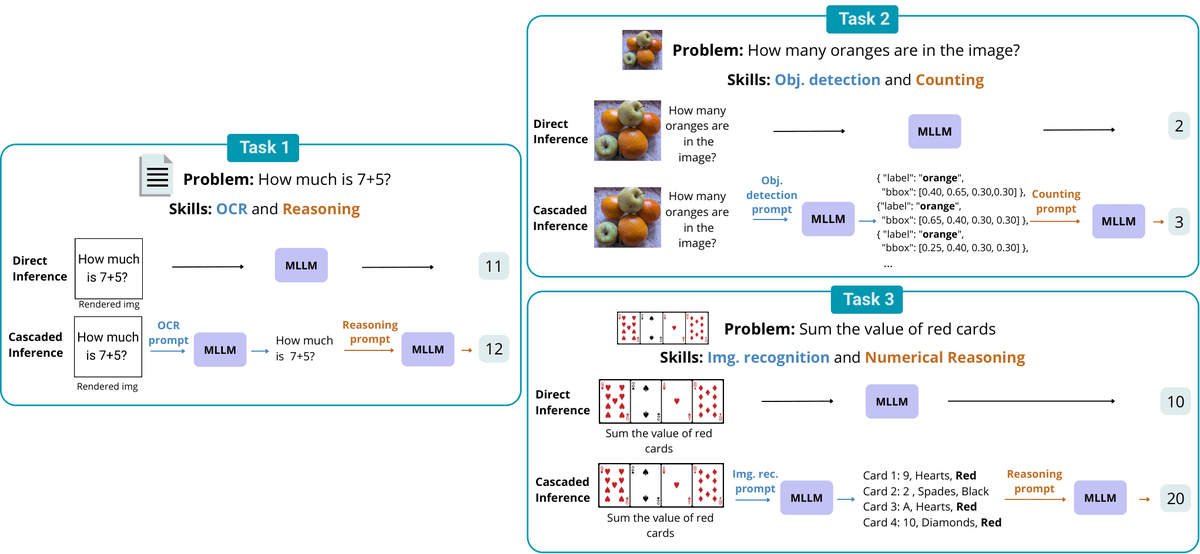
The researchers designed three tasks, each solvable by sequentially applying one visual skill and one textual skill:
- Reasoning over rendered text (Task 1): A math or knowledge question is rendered as an image. The model must read it (OCR) and then solve it (language reasoning). Datasets used: GSM8K, MATH, ARC Easy, ARC Challenge, and MMLU , all rendered as images.
- Object counting (Task 2): Given a photo, count how many of a specific object appear. This requires object detection (visual) followed by counting occurrences in a text list (textual). Datasets: CV-Bench and a new dataset the authors built called COCO-Count, derived from the COCO 2017 validation split with 4,952 annotated instances.
- Card playing (Task 3): Given an image of four poker cards, either sort a new card into the sequence or compute a rule-based sum. This requires card recognition (visual) and numerical reasoning (textual).
For each task, they measured two inference modes. Direct inference: ask the model to solve the task end-to-end with a single prompt. Cascaded inference: make two separate calls to the same model , first asking it to apply the visual skill and produce an intermediate result, then feeding that result back in for the textual reasoning step. The gap between these two scores is the cross-modality skill composition gap.
The numbers don't lie
Even with these straightforward compositions, all evaluated MLLMs exhibit a significant cross-modality skill composition gap. On Task 1, the gap ranged from a staggering 22 accuracy points for LLaVA 1.6-Vicuna-13B all the way down to 2.5 points for Qwen2.5-VL-7B. Even Llama 3.2 11B , a capable modern model , showed a gap of roughly 19 points on average across Task 1 benchmarks. The pattern held across all three tasks and all seven models tested:
- LLaVA 1.6-Vicuna-13B: Direct avg. 18.93% vs. Cascaded 41.12% on Task 1 , a 22-point gap.
- Llama 3.2 11B: Direct avg. 55.40% vs. Cascaded 74.46% on Task 1 , a 19-point gap.
- Qwen2.5-VL-7B: Direct avg. 77.65% vs. Cascaded 80.10% on Task 1 , a 2.5-point gap.
- Qwen2.5-VL-72B: Direct avg. 89.45% vs. Cascaded 89.84% on Task 1 , nearly no gap.
The models also tested include Molmo-7B and Molmo-72B. An interesting edge case emerged: Molmo showed almost no composition gap on Task 2 (object counting) , but not because it was composing well. Individual skill analysis revealed that Molmo-7B's object detection accuracy was below 50% and its string counting accuracy was only 38%, meaning both component skills were too weak to show a meaningful gap. The absence of a gap was a symptom of failure, not success.
Why does this happen?
The paper doesn't fully resolve the root cause, but the training recipe leaves a strong fingerprint. Studying skill composition requires visibility into when and how individual skills are acquired during training. For this reason, the researchers restrict their analysis to open-source MLLMs, whose training stages and objectives are publicly documented. This transparency allowed them to spot something telling: models like Qwen2.5-VL, which showed smaller gaps on Task 1, were explicitly trained on invoices, forms, receipts, and rendered text , meaning what looked like skill composition was actually a directly trained capability. It wasn't novel composition; it was memorized behavior.
Representation and fusion bottlenecks: linear projection adapters and transformer fusion can induce modality imbalance, where text dominates joint representations, undercutting the contribution of visual or audio channels. This structural issue in how most MLLMs are built may be a key contributor to the gap.
Can you fix it with prompting?
The first mitigation strategy the team tried was composition-specific chain-of-thought (CoT) prompting , telling the model explicitly which skills to apply and in what order, all within a single call. For example, instead of just saying "solve the problem in this image," the prompt says "first extract the text from the image, then solve the problem."
This helped, but inconsistently. LLaVA models saw gains of up to 36 points on ARC-Easy with CoT. Qwen2.5-VL models improved modestly. But Llama 3.2 11B showed almost no improvement, and in some cases regressed. The core limitation: CoT prompting is task-specific and model-sensitive. You need to hand-craft a different prompt for every task, and even then it doesn't always work. Across nearly all models and datasets, the ordering held: Cascaded > CoT > Direct.
Can you fix it with fine-tuning?
The second strategy was targeted fine-tuning. The team fine-tuned Llama 3.2 11B using a clever recipe: they rendered training datasets as images, then generated reasoning traces using the text-only version of the same model, and paired those traces with the image inputs as training data. The idea was to teach the model to perform as well on visual inputs as it does on text inputs.
Fine-tuning on a specific dataset did improve direct inference performance on that dataset. It also showed some generalization , gains transferred to other datasets within the same task type. But the skill composition gap was only fully closed when fine-tuning and evaluation happened on the exact same dataset. Cross-task generalization remained partial.
What this means in practice
This matters for anyone building pipelines that rely on MLLMs to handle compound visual-reasoning tasks , think document understanding, visual QA over charts, or automated grading of handwritten work. The practical takeaways are:
- Cascaded inference is a free win. Splitting a task into two model calls , one for the visual step, one for the reasoning step , consistently outperforms asking the model to do both at once. This requires no training and no new model.
- CoT prompting helps, but isn't reliable enough to depend on. It's model-sensitive and requires manual prompt engineering per task.
- Bigger models close the gap, but don't eliminate it. Qwen2.5-VL-72B came closest to zero gap on Task 1, but still showed meaningful gaps on Task 3 (card playing), which was more novel.
- Training data is everything. Models that appear to compose well often just have direct training examples for that specific combination. True novel composition remains rare.
The real finding beneath the headline
The most important insight here isn't just that MLLMs are imperfect , it's that the gap is measurable and structural. By using the same model in cascaded mode as an upper bound, the researchers isolate the composition failure from individual skill failure. The model already has both skills. It just doesn't reliably use them together when asked in a single prompt. That's a training and architecture problem, not a capability problem.
A significant skill composition gap exists across almost all measured models and tasks, meaning that MLLMs are not able to optimally compose their existing multimodal abilities to solve a task, even in this scenario where the required skill composition is almost trivial. The code and datasets for this work are publicly available, including the COCO-Count dataset and the card game benchmarks. For teams building production systems on top of MLLMs, the immediate recommendation is clear: when your task can be decomposed into a visual step and a reasoning step, decompose it explicitly rather than hoping the model does it for you.