
University of Sydney Maps 30 Years of Fake Network Traffic Generation
A new survey maps every major approach to fabricating network traffic, from Poisson processes to diffusion models and GPTs, and ships a scoring rubric.
 Pro
Takeaways
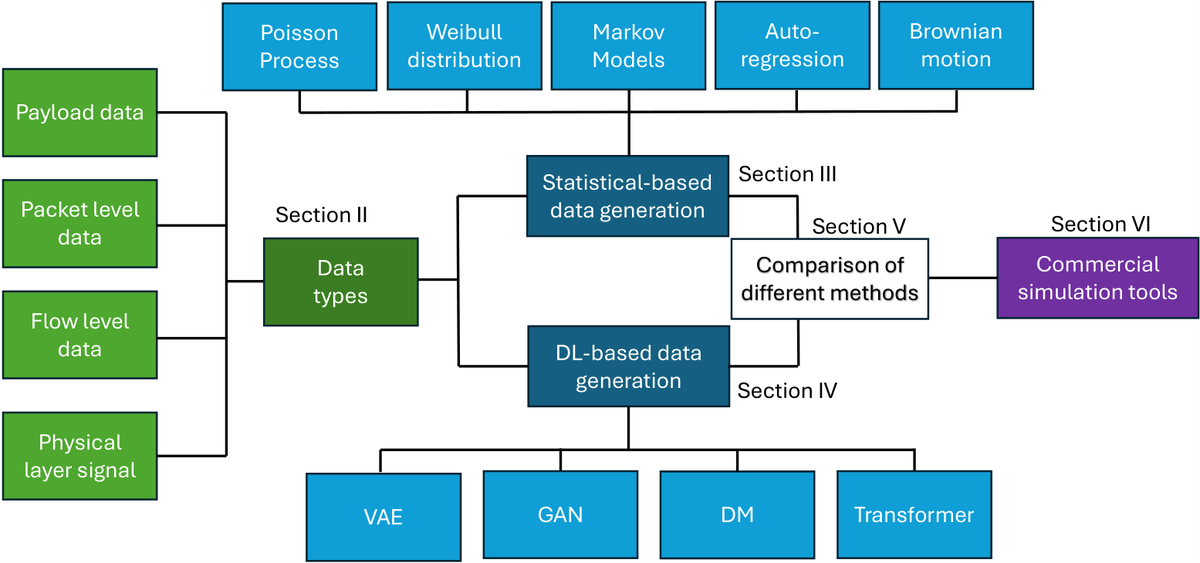
- Survey covers statistical, VAE, GAN, diffusion and transformer approaches to synthetic network traffic generation.
- First review to systematically include diffusion models and GPT-style transformers, not just GANs.
- Data types organized by OSI layer, from L7 payloads through L1 RF and CSI signals.
- Ships a 9-axis, 1-to-5 scoring rubric plus a local GPT-OSS prompt to grade any paper.
- Provides a constraint-driven selection matrix mapping application needs to model families.
- Flags privacy-utility tradeoff, protocol compliance and unseen-scenario synthesis as open problems.
Training a modern network intrusion detector, a 5G digital twin, or a traffic classifier all require the same thing: mountains of packet traces. Getting them is a nightmare. Real captures are noisy, contain private data, take weeks to collect, and rarely include the rare attacks or edge cases you actually want to test against. A new survey out of the University of Sydney, CSIRO and Colorado State takes a hard look at the entire synthetic traffic generation stack, from 1990s statistical models to today's diffusion transformers.
The paper is one of the first to go beyond GAN-only reviews, covering deep learning techniques alongside statistical methods, their extensions, and commercially available tools. More usefully, it ships a 1-to-5 scoring rubric and a prompt you can run locally to grade any traffic-generation paper you come across.
Why fake packets are hard
Network traffic is not a clean time series. It is bursty, self-similar, encrypted, spans multiple OSI layers, and mixes categorical fields (IP addresses, ports, protocol flags) with continuous ones (inter-arrival times, packet sizes). The survey organizes the whole design space around the OSI stack, distinguishing payload bytes at L7, headers at L2 to L4, and raw RF or CSI signals at L1, plus the packet-level versus flow-level split that changes how much granularity a generator has to reproduce.