
University of Saskatchewan's GLMask Trains a 98.5% Crop AI From Just 10 Images
A new semi-self-supervised framework trains wheat head instance segmentation from just 10 annotated images, hitting 98.5% mAP@50 and boosting COCO performance by 12.6%.
 Pro
Takeaways
- Researchers train a wheat head instance segmentation model to 98.5% mAP@50 using only 10 manually annotated images.
- GLMask replaces RGB input with grayscale, LAB lightness, and a semantic mask, forcing the model to learn shape over color.
- A cut-and-paste pipeline generates 30,000 synthetic training/validation images with automatic instance masks from those 10 frames.
- Rotation augmentation on 19 real images (expanded to 6,840 samples) bridges the synthetic-to-real domain gap better than pseudo-labeling.
- The same GLMask approach improves MS COCO mAP@50 by 12.6% over a standard RGB baseline, showing generality beyond agriculture.
- Code and data will be released upon paper acceptance; built on YOLOv9e-Seg and Albumentations.
Pixel-perfect annotation is the hidden tax of agricultural AI. Before you can train a model to count wheat heads, detect disease, or estimate yield, someone has to sit down and draw outlines around hundreds of overlapping, self-similar objects in thousands of images. Researchers from the University of Saskatchewan and University of Calgary just published a framework that nearly eliminates that bottleneck -- training a state-of-the-art instance segmentation model from only 10 manually annotated images.
Why agriculture breaks standard segmentation pipelines
Instance segmentation -- identifying and outlining individual objects with well-defined boundaries -- poses distinct challenges compared to semantic segmentation, as it demands precise identification and separation of individual objects. In general-purpose vision, this is already hard. In agriculture it gets worse: images with densely packed, self-occluded objects are the norm, not the exception. A top-down view of a wheat field is essentially a sea of near-identical heads, all partially hiding each other, changing color as they ripen, and lit differently every hour of the day.
Since the pixel-level annotation required for segmentation tasks is substantially more demanding due to the time and effort invested, most agricultural datasets are focused on classification or object detection tasks and rarely on segmentation tasks. Variability in growth stages and environmental conditions -- weather, lighting, crop diversity -- presents significant challenges to developing deep learning techniques that generalize across different conditions, and the resource-intensive nature of creating extensive annotated datasets further hinders the widespread adoption of these approaches.
The GLMask trick: ditching color on purpose
The core insight of the paper is that color is actually a liability for wheat segmentation. Wheat heads shift from green to gold to brown depending on growth stage and lighting -- a model that leans on color will fail to generalize. The team's solution is GLMask, a custom three-channel image representation that replaces the standard RGB input.
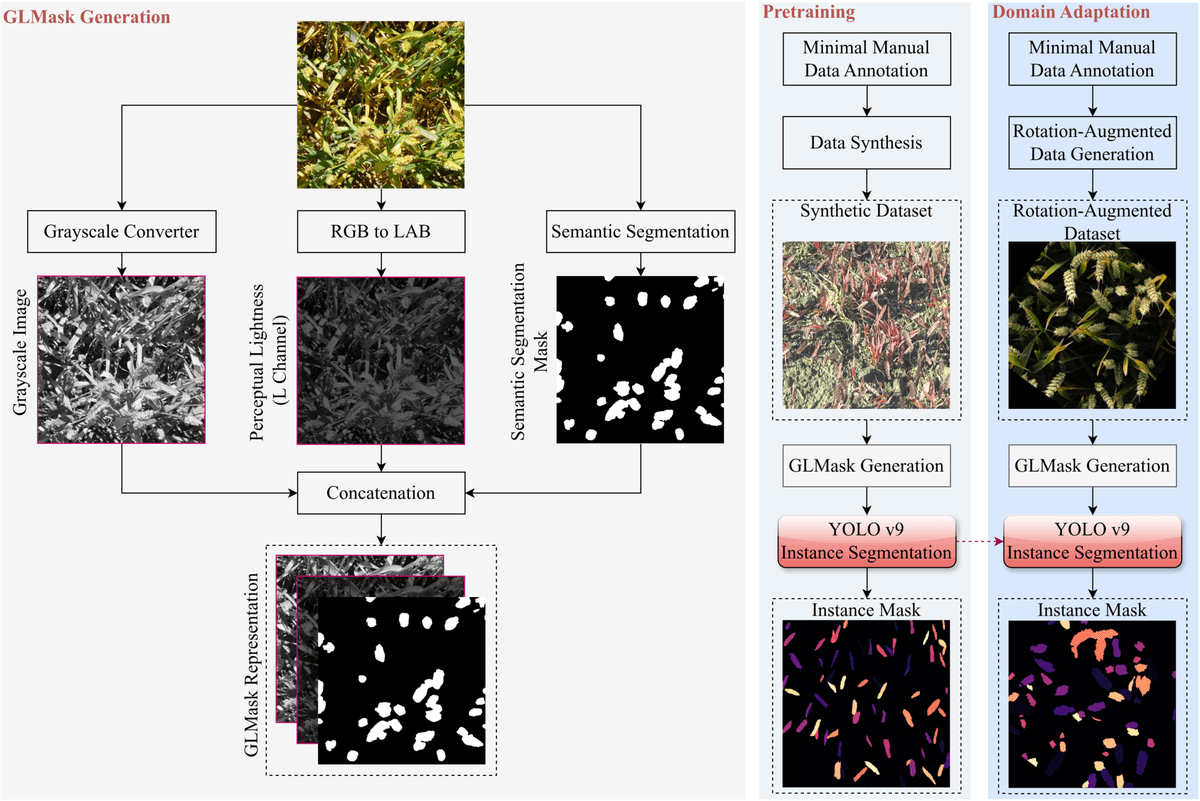
GLMask is constructed by combining the Grayscale (G) channel from RGB, the perceptual lightness L channel of the LAB color space, and a semantic segmentation Mask (M). The result is a three-channel tensor that looks nothing like a normal photograph but contains everything the model needs: brightness, structural edges, and a pre-computed map of where objects are (semantically).
- G (Grayscale): Enhances edge and shape visibility, reduces color-induced noise common in outdoor agricultural images.
- L (LAB lightness): Separates luminance from color, improves shadow identification and structural detail in a perceptually uniform way.
- M (Semantic mask): A binary or class-level segmentation map generated by a pretrained semantic segmentation model -- this is the "prior" that tells the instance model where objects are before it figures out their individual boundaries.
By embedding the semantic mask, the goal is efficient segmentation transfer from semantic to instance masks -- and by incorporating grayscale and the L channel, GLMask intentionally reduces color information, encouraging the model to prioritize shape, texture, and pattern features.

A three-stage pipeline built for minimal labels
The full framework, built on top of YOLOv9e-Seg, proceeds in three logical stages:
- Synthetic data generation: Starting from just 10 manually annotated wheat field frames, the team uses a cut-and-paste pipeline to generate 20,000 synthetic training images and 10,000 validation images. Real and "fake" (augmented) wheat head crops are randomly overlaid on background frames at varying densities to simulate different altitudes. Instance masks are generated computationally in parallel -- no human labeling needed.
- Synthetic pre-training: A YOLOv9e-Seg model (60.5M parameters) is trained from scratch on the synthetic GLMask dataset, producing SynModel. This model never sees a real annotated wheat image during training.
- Domain adaptation via rotation augmentation: To bridge the gap between synthetic and real data, the model is fine-tuned on 19 real annotated images expanded to 6,840 samples through rotation augmentation (0--259 degrees). This simulates aerial views of bending wheat stems and produces the final RoAModel.

The team also tested pseudo-labeling as an alternative domain adaptation strategy -- using the pretrained SynModel to auto-label a large pool of unannotated images, then fine-tuning on those. It underperformed the rotation-augmented approach on both test sets, suggesting that rotation-based augmentation is a more reliable bridge for this kind of structured, repetitive domain.
The numbers: a new state of the art
RoAModel achieved mAP@50 of 95.7% on the single-domain LateStage test set and 98.5% mAP@50 on the 18-domain GHD test set. To put that in context, the RGB baseline (BaseModel) trained under identical conditions but on standard color images scored just 49.7% and 50.4% respectively -- a gap of roughly 48 percentage points.
The per-domain breakdown is striking. The BaseModel exhibits high variance and struggles in several challenging environments (Arvalis_5 and Arvalis_4), while the RoAModel maintains high mAP@50 scores, effectively bridging the domain gap through the combination of GLMask representation and rotation-augmented adaptation. In the hardest domain (Arvalis_4), the baseline scored 8.7% mAP@50 -- RoAModel hit 99.5%.
The gains also hold outside agriculture. Evaluating on the Microsoft COCO 2017 dataset, the GLMask approach achieved improvements of over 12.6% mAP@50 and over 17.8% in mAP@50-95 compared to the RGB baseline trained under identical conditions. Notably, the COCO version used only binary masks (foreground vs. background) rather than full semantic masks -- the authors suggest that using proper semantic masks could push performance even higher.
Where it still struggles
The paper is candid about failure modes. When large objects are occluded by another object and become fragmented, the model misidentifies the separated parts as distinct objects. Additionally, in images captured from high altitudes with numerous small wheat heads, the model may merge overlapping objects into a single label. Both are classic instance segmentation failure modes that get amplified in dense, repetitive scenes.
What this unlocks in practice
The practical implications go well beyond wheat. The GLMask + synthetic pipeline is applicable to any domain where objects are dense, repetitive, and hard to annotate individually:
- Crop yield estimation -- counting individual grain heads at scale from drone footage
- Disease monitoring -- isolating individual infected spikes for severity assessment
- Robotic harvesting -- real-time instance masks on agricultural machinery (YOLOv9 is fast enough for on-device inference)
- General dense-object domains -- cell counting in microscopy, crowd analysis, or any setting where objects cluster and occlude each other
The authors selected YOLOv9 due to its high capacity, speed, and efficiency in image segmentation, making it particularly well-suited for deployment on agricultural machinery performing real-time tasks.
Code and data availability
The data and code supporting the findings of this study will be made available upon acceptance of the paper. The full paper is available on arXiv. The framework builds on the Ultralytics YOLOv9 ecosystem (version 8.2.79) and the Albumentations augmentation library, so integration into existing pipelines should be straightforward once the code drops. The benchmark itself uses the Global Wheat Head Detection (GWHD) dataset for evaluation across 18 diverse acquisition domains worldwide.
The real breakthrough here is not the mAP number -- it is the annotation economics. Getting from 10 labeled images to a 98.5% mAP model changes what is feasible for small research labs, agricultural startups, and anyone working in a domain where expert annotation is the bottleneck. The GLMask idea -- using a semantic prior to guide instance separation, while stripping out the color features that cause generalization failures -- is a transferable design pattern worth watching.