
University of Salerno Trains an AI to Fight Fake News Virality
Researchers pair agent-based simulation with deep Q-learning to test which interventions actually slow fake news spread inside echo chambers.
 Pro
Takeaways
- Salerno researchers integrate agent-based simulation with deep Q-learning to test misinformation containment strategies. Paper
- A Super-Agent picks between Warning, Reiterating, Forcing, or Observing actions inside a NetLogo echo-chamber simulation.
- Intervening every two ticks pushes fake-news virality below the 0.5 critical threshold, even for highly credulous agents.
- Interventions matter most in mid-polarized networks (P_N between 0.4 and 0.8) where echo chambers leak into the wider graph.
- Q-network is tiny: three dense layers (24, 12, 4 units) trained on Global Cascade, Opinion Metric, and top-A centrality signals.
- Extended version published in Neural Computing and Applications as a regulatory sandbox proposal.
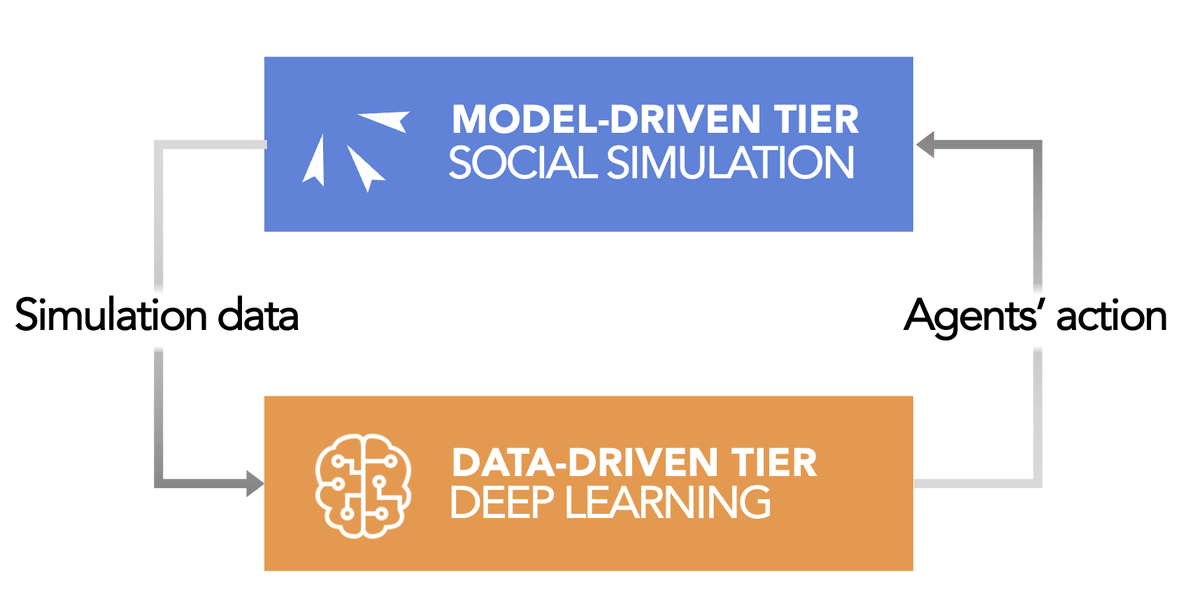
A team from the University of Salerno and Italy's National Institute for Public Policy Analysis has built a hybrid framework that lets a reinforcement learning agent practice fighting misinformation inside a simulated social network. If you cannot ethically run misinformation experiments on real users, you can train an AI policymaker inside an agent-based model instead, then see which interventions actually knock down viral spread. The preliminary paper outlines a two-tier architecture that couples a NetLogo simulation with a deep Q-learning agent, and reports the conditions under which the learned interventions cut fake news virality below the critical threshold.
Where detection stops and intervention should start
Most computational work on fake news falls into one of two camps. Data-driven approaches lean on machine learning, deep learning, and NLP to classify suspect content, using classifiers like SVM, Random Forest, LSTM, and pre-trained transformers such as BERT, RoBERTa, and DistilBERT for embedding and labeling. Model-driven work uses agent-based simulations to study echo chambers and how misinformation propagates through networks.
Both sides have blind spots. Classifiers struggle with breaking news because there is no established knowledge base to check against, and pure simulation studies rarely tell you which containment policy to actually deploy. The authors argue that few prior attempts have integrated the inductive inferences of data-driven methods with the explicit operational descriptions that come out of simulation. Their framework is an attempt to close that loop.
Two tiers, one Super-Agent
The system is split into a Model-Driven Tier (MDT) and a Data-Driven Tier (DDT). The MDT is an agent-based model built on Petter Törnberg's echo chamber formulation, where nodes on an Erdős-Rényi network hold one of three opinions: A (supporting fake news), B (supporting true news), or neutral. Each node has an activation threshold that informally represents its credulity, and users flip opinions when enough neighbors push them past that threshold.
Sitting on top is the DDT, which hosts a single Super-Agent trained with deep Q-learning. Think of the Super-Agent as a governance body, a platform trust-and-safety team, or a public health authority: it observes the state of the network at every simulation tick and picks one of four actions to try to suppress opinion A. The network is initialized around an echo chamber whose nodes have their thresholds lowered, making them more susceptible to internal opinions, which mirrors real-world polarization dynamics.
What the Super-Agent actually does
The action space is small but interpretable, and each action maps onto a real-world lever platforms already reach for:
- Warning: flags nodes so that when they are about to be influenced, an opinion update only fires if a random draw beats a warning-impact threshold. Can be global (all nodes) or local (targeted). Analogous to platform labels on unreliable content.
- Reiterating: repeatedly exposes selected nodes to opinion B over subsequent ticks, up to the number of their neighbors. Analogous to repeatedly surfacing corrections.
- Forcing: locks a small fraction of high-centrality nodes (chosen by degree, betweenness, or PageRank) into opinion B for the whole simulation. Analogous to trusted broadcasters or verified newspapers.
- Observing: do nothing. Used when the network is already in an acceptable state.
The Super-Agent sees three signals: Global Cascade (fraction of active A nodes), Global Opinion Metric (network-wide average opinion), and Most Influential A nodes (the top A spreaders by centrality). The reward function penalizes increases in Global Cascade and rewards drops, with an extra weight term that favors states where both average opinion and top-A influence are low. The Q-network itself is small: a dense layer of 24 units with ReLU, a dense layer of 12 units with ReLU, and a final dense layer of 4 units (one per action) with linear activation, trained with a batch size of 128.
How the pieces talk to each other
The plumbing is worth noting because it is a pattern others can reuse. The simulation runs in NetLogo while the reinforcement learning lives in Python, connected via PyNetLogo, the NetLogo API for Python. At each tick, Python pulls the current network state out of NetLogo, feeds it to the Super-Agent, and pushes the chosen action back into the simulation, which updates and returns a reward. It is a clean way to bolt modern RL onto a mature social-simulation environment without rewriting either side.
Sweeping the parameter space
The baseline runs sweep three parameters: network polarization P_N (edges bridging the echo chamber to the outside), opinion polarization P_O (how much the chamber lowers its members' thresholds), and the activation threshold theta. Virality V is defined as the fraction of simulation runs where more than half the network ends up activated on opinion A, with 0.5 as the critical threshold. Each configuration used 100 nodes on an Erdős-Rényi graph with an average degree of 8, an echo chamber fraction of 0.20, 100 ticks per run, and 300 runs per configuration on an Intel Core i9-11900KF with 32GB of RAM. Each Super-Agent simulation took roughly three hours.
Without the Super-Agent, virality stays high (above 0.8) for credulous agents (theta = 0.27) across most bridging values, only dropping when the echo chamber becomes highly isolated. Adding opinion polarization inside the chamber pushes virality even higher across the board, confirming that lowered internal thresholds are the real accelerant.
With the Super-Agent, the intervention frequency (sa-delay) is the dominant knob. Running the agent every two ticks pulls virality below the 0.5 critical threshold for theta = 0.27, where a less frequent schedule (every five ticks) is not enough. For the middle credulity setting (theta = 0.342), interventions every five ticks are already sufficient to push virality down, and for the least credulous agents (theta = 0.414), supervision barely matters because misinformation does not take off anyway. The clearest win is in the mid-range of network polarization, roughly P_N between 0.4 and 0.8, where echo chambers are connected enough to leak into the wider network but not so isolated that they collapse on their own.
A sandbox, not a shipping product
The framework is best understood as a regulatory sandbox rather than a deployable moderation system. It is useful for stress-testing policies before rolling them out, for comparing intervention timing and targeting strategies, and for studying how echo chamber structure interacts with countermeasures. The follow-up work has been published in Neural Computing and Applications under exactly that framing.
Limitations are honest and worth flagging. The experiments run on 100-node synthetic networks, not scraped social graphs, so absolute virality numbers should not be read as predictions about Twitter or TikTok. The opinion model is coarse (three discrete states), the action space is small, and the authors note that simulations become highly demanding computationally as soon as even minimal changes are made to model complexity, whether in agent count, interaction structure, or per-agent decision mechanisms. There is also no public code repository linked in the paper, and the arXiv version is explicitly marked as a preliminary write-up of the journal version.
The quieter breakthrough
The headline finding, that more frequent interventions cut virality, is intuitive. The more interesting contribution is the architectural pattern: use an agent-based model as a differentiable-ish environment for an RL agent whose actions map onto real policy levers, then read off the learned policy as a hypothesis about what interventions would work in the wild. That template generalizes well beyond misinformation, to content moderation, epidemic response, market regulation, or any domain where you want to learn a policy over a system too messy or ethically fraught to experiment on directly.