
University of Patras' FatigueFusion Makes Animated Characters Actually Get Tired
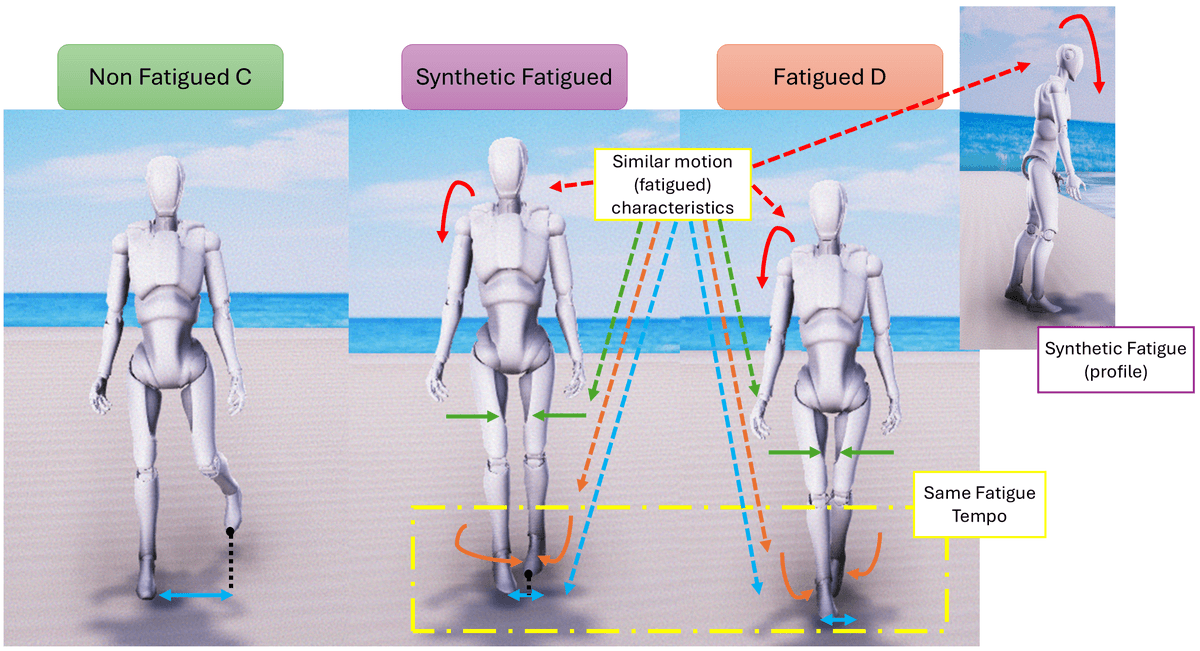
A three-module deep learning framework injects subject-specific fatigue into animated gait sequences without needing fatigued motion data at inference.
 Pro
Takeaways
- FatigueFusion generates fatigued human gait by fusing subject-specific fatigue features in latent space without needing fatigued input data.
- Three modules handle temporal (Fatigue Tempo), spatial (CVAE + FusionAE), and intensity (PINN-based 3CC-λ) dimensions of fatigue independently.
- Trained on the DUO-Gait dataset of 16 subjects with IMU data across fatigued and non-fatigued walking conditions.
- Full framework achieves FID of 0.045 and Diversity of 9.375, close to ground-truth Diversity of 9.670.
- Supports fatigue profile transfer, multi-subject fatigue fusion, and progressive non-fatigued to fatigued transitions.
- Outperforms the authors' prior Fatigue-PINN by encoding personalized fatigue signatures rather than only simulating accumulation.
Most motion synthesis models happily animate a humanoid running at full pace forever, as if humans never get tired. A new framework called FatigueFusion from researchers at the University of Patras tackles that gap, generating physically plausible fatigued gait by fusing subject-specific fatigue signatures inside a latent space, without needing any fatigued motion data as input at inference time.
Fatigue-driven motion generation remains underexplored in animation research. Skipping it means simulators produce a never-ending active state, missing the gradual decline of joint torques and the messy, personal ways people actually stumble, hunch, or drag a leg after exertion. Those details are exactly what ergonomic design tools, sports biomechanics apps, and realistic game characters need.
Why existing fatigue models fall short
Prior work has approached fatigue by imitating the effects of accumulation in motion patterns, essentially scaling down torques over time using a state machine called the Three-Compartment Controller (3CC). The authors' own prior Fatigue-PINN did this deterministically, and a SIGGRAPH Asia 2023 paper combined 3CC with reinforcement learning. Neither approach captures the personalized flavor of fatigue: one person shuffles, another hunches, a third stumbles asymmetrically.
FatigueFusion treats fatigue as three orthogonal dimensions (time, space, and intensity) and builds a dedicated module for each.

Three modules, one latent fusion
The pipeline works on joint angle sequences and control variables, converting them to torques internally via a surrogate inverse-dynamics transformer, then back to angles at the end. Three specialized modules do the actual fatigue work: