
University of Padua's MALINT Teaches LLMs to Spot Disinformation by Reading Intent
A new English corpus tags disinformation with the motive behind it, and priming LLMs with intent analysis lifts zero-shot detection by 9 to 20 percent.
 Pro
Takeaways
- MALINT is the first English corpus labeling both disinformation and the malicious intent behind it, 1,600 articles annotated by IFCN fact-checkers.
- Five intent categories cover institutional distrust, political manipulation, alliance-breaking, social antagonism, and anti-science narratives.
- Fine-tuned RoBERTa and DeBERTa V3 beat zero-shot LLMs on multilabel intent detection, hitting 0.82 weighted F1.
- Intent-Based Inoculation prompts an LLM to analyze intent first, then classify disinformation using that analysis as context.
- IBI improves zero-shot detection by 9 percent on English datasets and up to 25 percent on Estonian across five LLMs.
- Dataset, prompts, and code are released under CC BY 4.0 on the official GitHub.
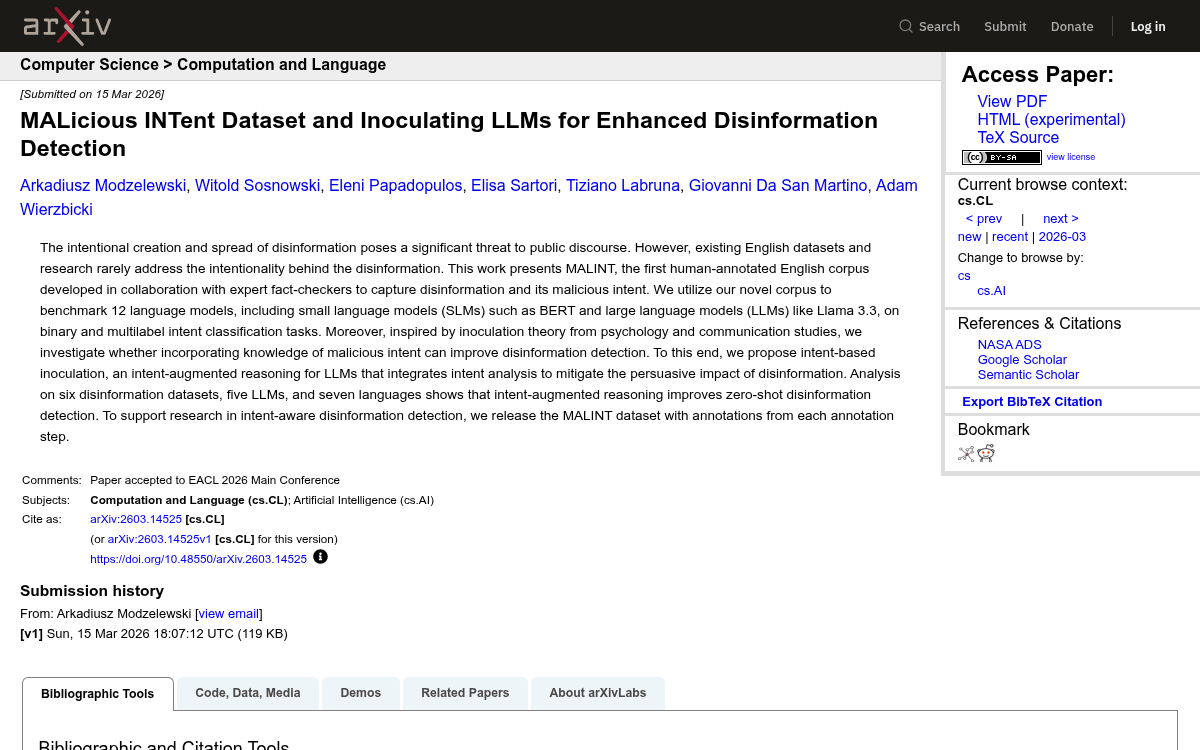
Most fake-news datasets treat disinformation as a simple true-or-false problem. A team from the University of Padua, the Polish-Japanese Academy of Information Technology, and NASK argues that this misses the point of what disinformation actually is: content built with a purpose. Their new work introduces MALINT, an English corpus that labels both the veracity of articles and the malicious motive behind them, and then uses those motive labels to make large language models measurably better at spotting deception.
The High Level Expert Group established by the European Commission defines disinformation as false, inaccurate, or misleading information designed, presented, and promoted to intentionally cause public harm or for profit. Intent is baked into the definition, but existing English resources ignore it. The MALINT paper tries to close that gap and, more interestingly, shows that reasoning about intent first is a useful trick for zero-shot classifiers.
Why motive is the missing signal
Disinformation research has largely modeled the task as binary classification over surface features. That works when a claim is factually checkable, but breaks down on longer articles that mix true facts with a manipulative frame. The authors lean on inoculation theory from psychology, which suggests that, just as people can be protected against viruses through vaccines, they can also be vaccinated to resist persuasive messages, where an inoculation message has two parts: a threat and refutational preemption. The bet is that giving an LLM the same kind of pre-warning about likely manipulation tactics will make it less credulous.
Inside the dataset
MALINT is a novel corpus of online news articles designed to advance research on disinformation and the malicious intents behind it. It contains 1,600 articles averaging roughly 963 words each, pulled from about 50 sources spanning mainstream outlets and known unreliable sites. Sources were reviewed by fact-checking experts and classified by consensus into one of three categories: Reliable, Unreliable, or Mixed/Biased. To prevent annotation bias, source categories were hidden from annotators.
Each article passed through a two-stage annotation pipeline with a primary annotator, a supervisor, and a senior fact-checker for tiebreaks. In the first stage, two annotators achieved an agreement of approximately 85.31% on the credibility task. They reached 65.19% agreement on the more complex multilabel intent task. After consensus, supervisor agreement exceeded 95%.
Articles flagged as disinformation get one or more of five intent labels:
- UCPI - Undermining the Credibility of Public Institutions
- CPV - Changing Political Views
- UIOA - Undermining International Organizations and Alliances
- PSSA - Promoting Social Stereotypes or Antagonisms
- PASV - Promoting Anti-scientific Views
Who wins at spotting intent
The team benchmarked 12 models on binary per-class and multilabel intent classification. The results split cleanly along task lines. On per-class binary detection, closed LLMs are competitive: GPT 4.1 Mini performed best for UCPI and PSSA, while Llama 3.3 70B for PASV and CPV categories. LLMs achieved superior results compared to fine-tuned SLMs across three intent categories.
On multilabel detection the picture flips. DeBERTa V3 and RoBERTa continued to perform best among the SLMs, achieving the highest weighted F1 scores. The best-performing LLM, LlaMA 3.3 70B, lagged noticeably behind the top SLMs. Surprisingly, the logistic regression baseline (using a one-vs-rest strategy) outperformed most LLMs. A fine-tuned RoBERTa Base hit a weighted F1 of 0.821, while the strongest zero-shot LLM landed at 0.570. When you need to identify multiple co-occurring motives at once, supervision still wins.
Intent-Based Inoculation, step by step
The bigger contribution is a prompting recipe the authors call intent-based inoculation, or IBI. It runs in two passes:
- Intent analysis pass. The model receives the article, the taxonomy of five malicious intents with definitions, and formatting guidance. It outputs a Yes or No for each intent along with a rationale.
- Detection pass. The model gets the original text plus a threat warning that the text may contain hidden malicious intent, plus the previously generated intent analysis, plus the detection task instructions. It then makes the final disinformation call.
Formally the paper writes the detection input as Z_T = (T, theta, A_I(T), G_I), where theta is the threat text and A_I(T) is the intent analysis. The threat plays the psychological warning role, and the LLM-generated intent breakdown plays the refutational preemption role. It is essentially a structured chain-of-thought constrained by an expert-authored taxonomy of manipulation goals.
What the numbers look like
The team evaluated IBI on MALINT plus five other corpora: CoAID, ISOT Fake News, EUDisinfo, ECTF, and the multilingual EUvsDisinfo. Across a matrix of 5 LLMs, 3 prompt strategies, and 5 evaluation slices, IBI leads to improved performance in approximately 90% of cases. On average, the overall performance increases by 9%.
Two findings stand out for practitioners:
- The greatest gains are observed in longer-form articles. The extended context in articles offers language models more opportunity to identify and reason about malicious intent.
- IBI improves performance not only on data that may have been present during LLM pretraining, but also on unseen content published after the models' knowledge cutoffs. That matters because temporal leakage is a chronic problem when evaluating LLMs on news detection tasks.
The multilingual results are the most striking. On the EUvsDisinfo dataset split by language, IBI produces average F1 gains of 15 percent for German, 19 percent for Polish and Russian, 21 percent for Spanish, 23 percent for French, and 25 percent for Estonian. IBI demonstrates a clear advantage in cross-lingual disinformation detection, achieving on average a 20% improvement over baseline methods. The taxonomy of intents seems to transfer across languages even when the model itself is weaker in the target language.
Where it breaks down
IBI is not a free lunch. On short social media posts the gains shrink and occasionally reverse. For Gemini 2.0 Flash on the Posts slice, VaN with IBI actually drops 3 percent, and several Gemma configurations show flat or negative deltas on tweets. Short text simply does not give the intent analyzer enough surface to work with.
The multilabel intent classification task itself is also unsolved for LLMs. If you need a production classifier that outputs multiple intent tags, a fine-tuned DeBERTa V3 Large will beat every LLM tested here at a fraction of the inference cost. The interesting use case for LLMs is the composed pipeline: use intent as a reasoning scaffold, not as the final output.
Getting the code and data
The team released the MALINT repository with the dataset, all prompts, and the codebase. The dataset ships under CC BY 4.0 and includes annotations from every step of the workflow, not just the final consensus labels, which is useful for anyone studying annotator disagreement or training calibration models. The intent taxonomy and inoculation prompts are small enough to drop into an existing detection stack without infrastructure changes, which is probably the fastest path to trying this on your own data.