
University of Padova's AdapTS Spots Factory Defects Using 149x Less Memory
A single frozen backbone plays both teacher and student, cutting memory by up to 149x while matching state-of-the-art anomaly detection on MVTec and VisA.
 Pro
Takeaways
- AdapTS unifies teacher and student into one frozen backbone with trainable adapter modules for visual anomaly detection.
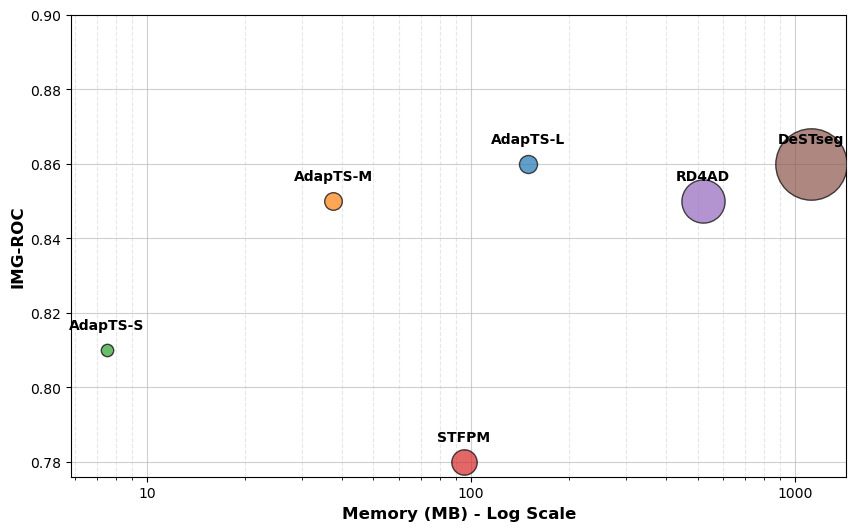
- Lightest variant uses 8 MB extra memory, 149x less than DeSTSeg while matching accuracy on MVTec AD.
- First teacher-student method that natively handles both multi-class and continual learning scenarios.
- Prototype-based task routing picks the right adapter at inference with 99% accuracy across categories.
- Training uses synthetic Perlin-noise anomalies and a tiny segmentation head that is discarded after training.
- Code available on GitHub; still trails MambaAD and DeSTSeg on absolute accuracy.
Factory inspection cameras have a dirty secret: most of the anomaly detection models running behind them can only recognize defects on one product type at a time. Swap the widget on the conveyor belt and you swap the model. A team at the University of Padova wants to fix that with AdapTS, a teacher-student framework that handles many product categories in a single network and can keep learning new ones without ballooning memory usage.
Why single-category models fall apart on real production lines
Visual Anomaly Detection (VAD) is the task of spotting defective images and localizing the bad pixels, typically trained only on clean examples so no one has to hand-label scratches and dents. Most existing methods are limited to single-category scenarios, failing to address the multi-class and continual learning demands of real-world environments. Teacher-Student (TS) architectures are efficient but remain unexplored for the continual setting.
The classic teacher-student setup, popularized by STFPM, trains a randomly initialized student network to mimic the intermediate feature maps of a frozen ImageNet-pretrained teacher. At inference, anywhere the two networks disagree is flagged as anomalous. It works, but it means shipping two full copies of a backbone like WideResNet50 to every edge device, and neither the original STFPM nor its heavier descendants (RD4AD, DeSTSeg) were built to learn a stream of new products over time.