
University of Ottawa's GAR Trains Finance AI to Match Risk, Not Just History
GAR trains generative models directly against financial risk objectives, producing market scenarios that stay accurate even when trading strategies shift unexpectedly.
 Pro
Takeaways
- GAR trains conditional scenario generators directly against financial risk objectives (VaR/ES), not generic distributional similarity.
- Uses elicitability -- the property that lets a risk measure be expressed as a regression loss -- to make risk alignment trainable end-to-end.
- An adversarial policy (GRU network) finds worst-case trading strategies that expose the generator's risk miscalibration during training.
- All three GAR architectures outperform DCC-GARCH, unconditional GANs, and direct linear baselines on joint VaR-ES scoring on S&P 500 data.
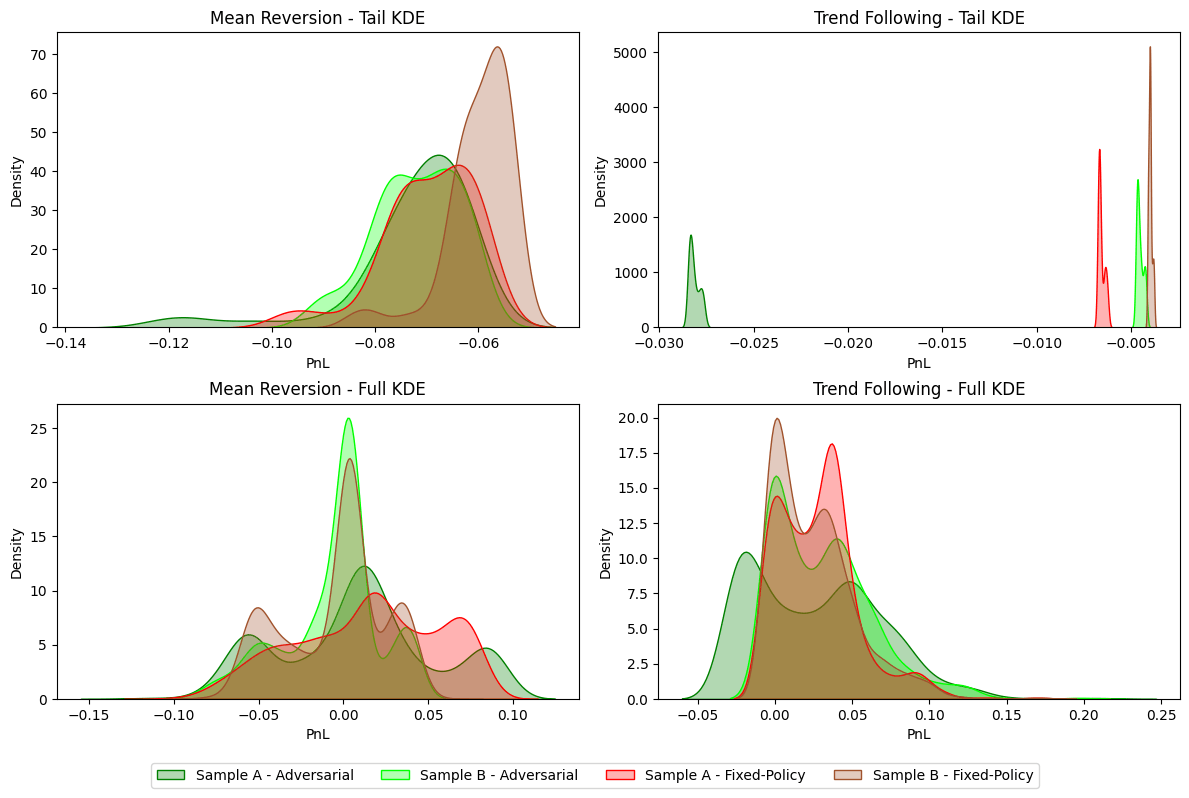
- Adversarial training prevents risk alignment collapse under unseen policies; fixed-policy training degrades sharply on worst-case strategies.
- No public code released; experiments limited to a 9-stock universe with compact architectures -- scalability remains untested.
Most scenario generators used in finance are trained to look like history. They learn to mimic the statistical shape of past market returns, then hand those synthetic trajectories off to a risk engine downstream. The problem: looking realistic and being risk-accurate are not the same thing. A generator can produce trajectories that pass every distributional test and still badly misestimate tail risk once a trading strategy processes them. Researchers at the University of Ottawa have now published a framework called Generative Adversarial Regression (GAR) that attacks this gap directly, training generators not to match distributions but to match risk.
The gap between "realistic" and "risk-accurate"
In a typical risk pipeline, a scenario generator produces plausible future price paths, a trading policy maps those paths into portfolio outcomes (profit-and-loss), and a risk measure like Value-at-Risk (VaR) or Expected Shortfall (ES) is computed on those outcomes. The generator is usually trained on a generic distributional loss -- something like Wasserstein distance or Jensen-Shannon divergence -- that measures how closely synthetic trajectories resemble historical ones overall.
The flaw is that distributional similarity at the trajectory level does not guarantee accuracy at the risk level. Small discrepancies under standard distributional metrics can translate into materially incorrect risk assessments once a downstream policy extracts the relevant signal. This is especially bad for tail risk: the rare, catastrophic events that VaR and ES are specifically designed to capture are exactly the events most likely to be underweighted by generic training objectives.
There is also a second, subtler problem. Even when researchers do try to train generators against a risk objective, they typically fix a small set of benchmark trading strategies and optimize for those. Performance remains guaranteed only for that fixed collection and may not generalize beyond it. If the actual strategy used downstream differs -- because of re-tuning, changing constraints, or evolving objectives -- the generator's risk alignment can collapse entirely.
Elicitability: the mathematical key
To understand what GAR does differently, you need one concept: elicitability. A risk measure is said to be elicitable if it can be uniquely identified as the minimizer of a well-defined expected loss function, also known as a scoring function. Think of it as the property that makes a risk measure "trainable" -- you can write down a loss and gradient-descend toward the right answer.
The practical stakes here are significant. In 2013, Basel III proposed replacing VaR with Expected Shortfall (ES) for capital calculations to capture tail risks better. But ES is not elicitable on its own, because there is no suitable loss function for evaluating ES prediction performance, which leads to challenges in estimating and backtesting ES. The workaround, established by Fissler et al. (2015), is that VaR and ES are jointly elicitable, meaning these two risk measures can be simultaneously estimated and evaluated using a common loss function. GAR exploits exactly this joint elicitability as its training signal.
How GAR works
GAR reframes scenario generation as a regression problem. Instead of asking "do my synthetic trajectories look like real ones?", it asks "does the risk my generator implies match the risk of real data, for any trading strategy that might be applied?"

The framework operates in three steps:
- Conditional risk as regression. For any fixed trading strategy (policy), the conditional risk given current market context can be expressed as the solution to a regression problem under a strictly consistent scoring function. This is a direct consequence of elicitability.
- Generative regression. Rather than regressing to a point estimate, GAR trains a generator whose Monte Carlo-sampled outputs produce the correct conditional risk. The generator's parameters are optimized so that the risk implied by its synthetic scenarios matches the risk of real data, under the same scoring function.
- Adversarial robustification. To handle policy shift, GAR introduces an adversarial policy -- a second neural network trained to find the trading strategy that maximally exposes the generator's risk miscalibration. The generator and the adversarial policy are then trained in a minimax game: the adversary tries to break the generator's risk alignment, and the generator adapts to close every gap the adversary finds.
The minimax objective is:
min_theta max_phi E[ S( rho( Pi_phi(G_theta(Z, C)) | C ), Pi_phi(Y) ) ]Where theta are the generator parameters, phi are the adversarial policy parameters, S is the strictly consistent scoring function for (VaR, ES), rho is the risk functional, and Pi_phi maps a scenario through the policy to a scalar P&L outcome. The generator-implied conditional risk is estimated via Monte Carlo: draw 2,000 latent noise samples, run them through the generator, apply the policy, and compute the empirical VaR and ES of the resulting P&L distribution.
The adversarial policy itself is a GRU (Gated Recurrent Unit) network -- a recurrent architecture that reads price history causally (no look-ahead) and outputs portfolio weights at each time step. Its outputs are normalized to a fixed gross exposure to prevent degenerate leverage-blowup strategies. Training alternates between gradient ascent on the policy (find the worst-case strategy) and gradient descent on the generator (eliminate the worst-case gap).
Three generator architectures, one adversary
The paper tests three conditional generator designs of increasing expressiveness:
- Simple-Linear: A feedforward network applied independently to each asset, using past returns and latent noise as input. No cross-asset interactions.
- Encoder-Linear: A global encoder compresses the full conditioning panel (all assets, all time steps) into a shared representation, which is then decoded with injected noise.
- Encoder-LSTM: An LSTM encoder reads the conditioning window as a time series of cross-sectional return vectors, capturing both temporal dynamics and cross-asset structure before decoding.
All three are conditioned on 5 days of past returns across 9 S&P 500 stocks (AAPL, INTC, T, F, BAC, NEE, MU, AMD, PFE) and generate 10-day forward return trajectories. The dataset spans 1984 to 2025, split 80/10/10 into train, validation, and test.
What the numbers show
GAR is evaluated against four baselines: an unconditional generator (no market context), DCC-GARCH (a classical econometric model for time-varying covariance), a direct linear model (predicts VaR/ES directly from context without generating scenarios), and the fixed-policy variant of GAR itself.
On the joint VaR-ES scoring function (lower is better), the results from Table 1 are clear:
| Model | Test Score | VaR Violation Rate |
|---|---|---|
| Unconditional GAN | -3.765 | 1.2% |
| DCC-GARCH | -3.774 | 14.8% |
| Direct Linear | -3.760 | 1.5% |
| Encoder-LSTM (GAR) | -3.929 | 6.6% |
| Encoder-Linear (GAR) | -3.920 | 2.5% |
| Simple-Linear (GAR) | -3.922 | 2.1% |
All three GAR variants beat every baseline on the risk score. The consistent gap between the conditional generators and the unconditional generator highlights the value of market context for extreme-scenario generation. The VaR violation rate tells a complementary story: a well-calibrated 5% VaR should be violated about 5% of the time. DCC-GARCH records a 14.8% violation rate, indicating substantial tail-risk underestimation. Encoder-LSTM's 6.6% is the closest to the ideal 5% target among all models.
The adversarial training results (Table 2) reveal the core robustness benefit. On standard benchmark strategies (mean reversion and trend following), fixed-policy and adversarially trained generators perform similarly. But on worst-case strategies found by the adversary, adversarially trained models consistently outperform their fixed-policy counterparts in all three architectures, with larger gains for the simpler architectures and a smaller gap for Encoder-LSTM. For the Encoder-Linear and Simple-Linear models, fixed-policy training produces dramatically degraded scores under adversarial evaluation -- the risk alignment breaks down entirely. Adversarial training prevents this collapse.
Where this fits and what it cannot do
GAR is most valuable in settings where the downstream trading or decision policy is not fixed -- stress testing across strategy classes, regulatory scenario generation that must hold across different portfolio mandates, or any pipeline where the generator is shared across multiple consumers with different objectives. It is a natural fit for risk teams that need scenario libraries robust to policy re-tuning.
There are real limitations to keep in mind. The minimax training adds computational overhead: for each minibatch, the framework runs 2,000 Monte Carlo forward passes through the generator for each sample to estimate conditional risk, then alternates gradient updates between the generator and the adversarial policy. The paper also tests only on a 9-stock S&P 500 universe with relatively compact architectures (hidden dimension of 4), so scalability to larger asset universes or longer horizons is an open question. No code repository is currently available alongside the paper.
The deeper contribution is conceptual. Prior work on risk-aligned generation (notably Tail-GAN by Cont et al., 2023) was unconditional and tied to a fixed benchmark policy set. GAR is the first framework to combine conditional generation, elicitability-grounded training, and adversarial policy robustification into a single end-to-end system. It turns the question "does my scenario generator preserve risk?" from a post-hoc evaluation into the training objective itself -- and makes that objective hold not just for the strategies you tested, but for strategies you have not seen yet.