
University of Melbourne Beats Top AI Planners by Judging Intent, Not Distance
A new class of planning heuristics judges whether a trajectory looks intentional toward the goal, beating state-of-the-art classical planners on IPC benchmarks.
 Pro
Takeaways
- New paper reframes classical planning heuristics as goal recognition problems, scoring trajectories by goal-intentionality instead of cost-to-goal.
- Introduces the IRPL model and a divergence-based generalization tied to KL divergence and negative log-likelihood of observations given the goal.
- Derives two efficient heuristics, ol^rp and op^rp, using fact observation probabilities from sampled delete-relaxed plans.
- OL^rp-Dual solves 1,655 of 1,831 IPC problems, beating BFNoS-Dual, Dual-BFWS, LAMA, and Scorpion-Maidu on coverage.
- Main tradeoff: intention-based tie-breaking produces longer, higher-cost plans than the length-based baseline.
- Code released via LAPKT-BFNoS, extending the LAPKT planning toolkit.
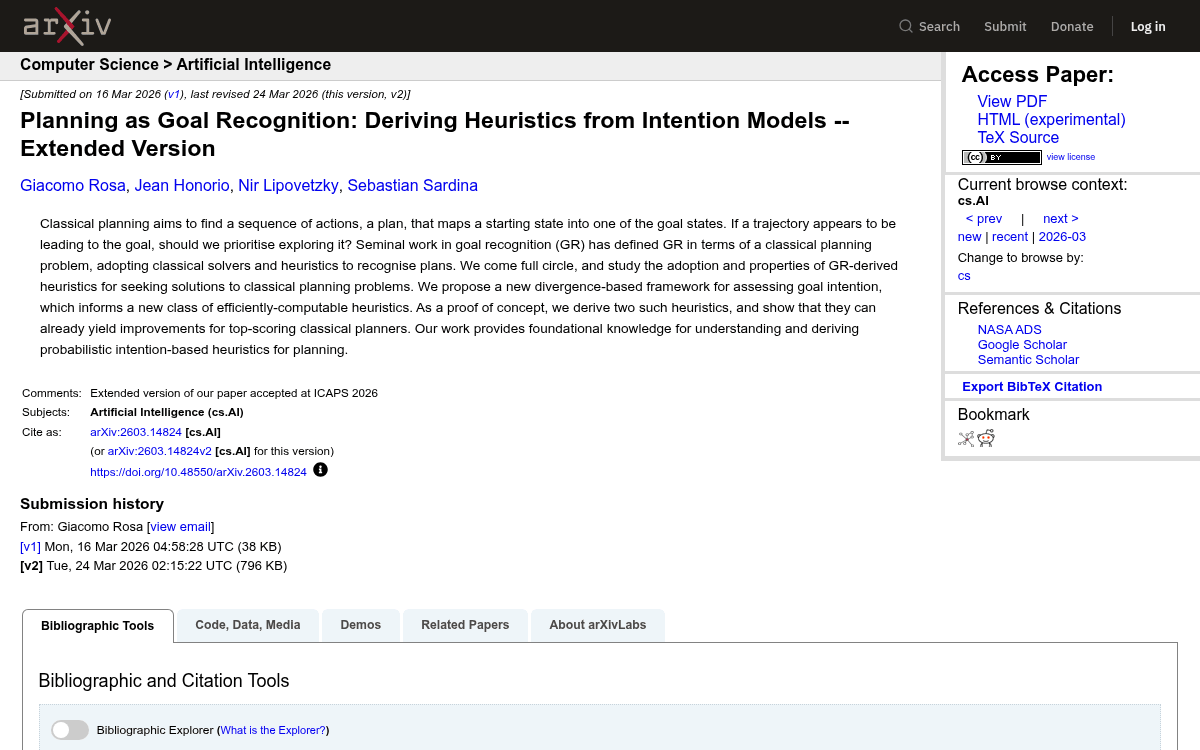
Classical planners have spent decades getting good at one question: how far is this state from the goal? A new paper from the University of Melbourne and RMIT flips the framing entirely. Instead of asking how expensive a partial plan is, it asks how intentional the trajectory looks, borrowing the machinery of goal recognition to score which branches of the search tree seem to be genuinely heading somewhere useful.
The result is a new family of intention-based heuristics that, when bolted onto an existing width-based planner, outperform current state-of-the-art satisficing planners on the International Planning Competition benchmarks, without needing multiple open lists or expensive restarts.
Coming Full Circle on Goal Recognition
Goal recognition (GR) is the flip side of planning. In planning, you have a goal and search for actions that achieve it. In GR, you see a sequence of actions and try to infer which goal an agent is pursuing. Seminal work has defined goal recognition in terms of a classical planning problem, adopting classical solvers and heuristics to recognise plans. This paper reverses that trick: if GR can be cast as planning, can planning be cast as GR?
The intuition is simple. If a trajectory appears to be leading to the goal, should we prioritise exploring it? Treating the planner's search frontier as a stream of observations, and each candidate trajectory as an observation whose goal-intentionality can be scored, turns heuristic evaluation into a probabilistic inference problem rather than a distance estimate.
Why Cost-Based Heuristics Leave Signal on the Table
Most classical planners rely on heuristics like FF or Landmark counts that estimate distance to the goal, plus techniques such as helpful actions, novelty measures, and dominance pruning that guide exploration through alternative mechanisms. These are effective, but they treat trajectories as bags of cost information. They do not directly reason about whether a partial trace looks like the beginning of a plan.
Previous GR-as-planning work by Ramirez and Geffner used cost estimates to compute the likelihood of an observation given a goal, assuming rational agents prefer cheaper plans. The authors argue that reusing that formulation for planning would just loop back to cost heuristics. So they build something new: a divergence-based likelihood that measures how far observed evidence diverges from a distribution over goal-intended trajectories.
The IRPL Model and Its Divergence Generalization
The theoretical backbone is what the authors call the I-Reachable Plan-Library (IRPL) model. It imagines a resource-bounded observer with a sampled subset of possible maximal trajectories from the initial state, some of which reach the goal. Each trajectory carries a weight reflecting the observer's beliefs about agent behavior (uniform, cost-preferring, etc.). From these weights, two probabilities fall out naturally:
- P(O | G): how likely is this observation, given the agent is heading to the goal? Ranking by this quantity behaves like A* with a consistent heuristic, expanding sampled solutions until an optimal one is picked.
- P(G | O): how likely is the agent heading to the goal, given this observation? Ranking by this drives a greedier, hill-climbing style search.
The authors prove several properties. For instance, a planner ranking by max P(G | O) with length-based tie-breaking finds a plan within a number of expansions bounded by the longest sampled plan. And under a Uniform Transition Probability weighting, the number of node generations needed to reach a plan is lower-bounded by the negative log of P(O | G), effectively giving the heuristic an information-theoretic reading.
Because maintaining a real plan library is impractical, the paper generalizes IRPL into a divergence-based likelihood: P(O | G) ~ exp(-KL(d_OG || d_G)). Theorem 4 shows the KL divergence here reduces to the negative log-likelihood of the observation given the goal, and is invariant to the intermediate domain used to align distributions, meaning the framework admits many possible concrete estimators.
Two Practical Heuristics
As a proof of concept, the authors derive two heuristics that plug into a Best-First Width Search (BFWS) planner. Both build on fact-observation probability estimation from Wilken et al. 2024, which samples delete-relaxed plans and estimates, for each fact, the probability it appears in a relaxed plan to the goal.
- ol^rp (relaxed plan observation likelihood): sums log-probabilities of observed facts to approximate P(O | G). Behaves exploratorily, akin to A*.
- op^rp (relaxed plan observation posterior): also computes P(q | not G) by sampling relaxed action sequences that achieve non-goal facts, giving a Bayesian posterior. Behaves greedily.
The fact probability computation runs once, at the initial state. During search each candidate node is scored in time linear in the number of observed facts, so the heuristic is cheap to evaluate. Both variants are integrated as third-level tie-breakers inside BFWS(f5), replacing the usual path-length tie-break with a more informed signal. To prevent a single misleading fact from poisoning entire subtrees, the authors use a "restart" variant that resets the log-probability accumulator whenever the goal-count heuristic improves.
Benchmark Results
Experiments run on the full IPC satisficing benchmark set, 1,831 problems across 60+ domains, with an 1,800-second and 8 GB budget per problem. The baseline BFWS(f5) solves 1,510 problems. Adding the ol^rp tie-breaker pushes coverage to 1,560, and swapping the goal-count heuristic for Landmarks yields OL^rp, which reaches 1,621 problems solved and an 84.6% average domain score.
Compared against multiple state-of-the-art planners including Dual-BFWS, Approximate Novelty Tarski, LAMA, Scorpion-Maidu, and BFNoS-Dual, the enhanced variants come out ahead:
| Planner | Coverage (of 1,831) | % Score | Agile Score |
|---|---|---|---|
| LAMA | 1,535 | 79.1% | 1,192.3 |
| Scorpion-Maidu | 1,591 | 82.9% | 1,206.4 |
| Dual-BFWS | 1,607 | 83.6% | 1,200.8 |
| Approximate Novelty Tarski | 1,611 | 83.8% | 1,233.7 |
| BFNoS-Dual | 1,641 | 86.2% | 1,173.3 |
| OL^rp | 1,621 | 84.6% | 1,229.4 |
| OL^rp-Dual | 1,655 | 87.0% | 1,232.6 |
The dual-strategy variant, which falls back to a backup solver if the intention-based frontend fails within 1,500 seconds, solves more problems than any tested planner while retaining a competitive Agile score. Node expansions drop substantially on most domains, though the extra fact-probability computation trades some raw expansions-per-second for smarter guidance.
Where It Struggles
The main weakness is plan quality. The intention-based tie-breaker biases the search away from the length-based tie-break of the baseline, and both variants tend to produce longer, higher-cost plans than BFWS(f5) on many instances. The restart mechanism, while it fixes accuracy degradation from bad fact observations, also loses the global length bias that keeps solutions short.
Performance is also tied to the quality of relaxed-plan sampling. In domains where delete-relaxed heuristics are known to be weak, the fact-probability estimates lose informativeness. Interestingly, increasing the number of sampled relaxed plans from 100 to 10,000 does not measurably improve coverage. The authors hypothesize that relaxed plans converge to a biased distribution, so more samples do not fix the underlying approximation error.
Availability
The implementation is available as part of the LAPKT-BFNoS planner distribution, extending the Lightweight Automated Planning Toolkit. The extended paper includes proofs, the modified supporter-action sampling algorithm, and per-domain coverage tables.
The bigger contribution is conceptual. Framing heuristics as judges of intentionality rather than distance estimators opens the door to information-theoretic reasoning about search, and gives a probabilistic scaffold that could carry over to learned heuristics and hybrid symbolic-neural planning. The two proposed heuristics are only a proof of concept, and the divergence-based framework admits many other concrete estimators still to be explored.