
University of Lisbon Builds the First Leaderboard Grading AI on European Portuguese
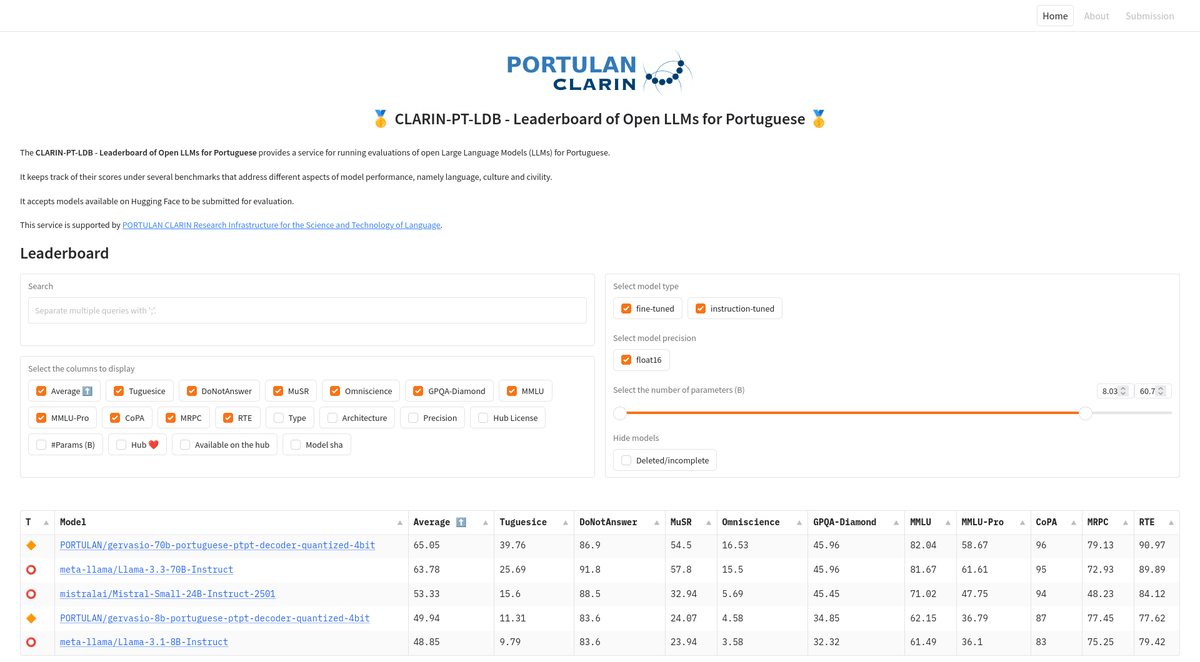
A new HuggingFace leaderboard evaluates open LLMs on European Portuguese with ten benchmarks, including novel tests for cultural alignment and safety refusals.
 Pro
Takeaways
- University of Lisbon launched CLARIN-PT-LDB, the first open LLM leaderboard specifically for European Portuguese.
- Ten benchmarks include novel Tuguesice-PT for culture and DoNotAnswer-PT for safety refusals.
- All tasks graded generatively, so closed API models remain comparable to open ones.
- Judge models Llama 3.3 70B and Gemini 2.5 Flash score open-ended responses automatically.
- Backend runs on EleutherAI's LM Evaluation Harness across L40S and RTX Pro 6000 GPU nodes.
- Gervásio 70B leads on cultural alignment but Llama 70B wins reasoning benchmarks.
A team from the University of Lisbon has released CLARIN-PT-LDB, an open leaderboard for evaluating large language models on European Portuguese. It bundles ten benchmarks together, and two of them target aspects of model behavior that had no prior coverage for the language: whether a model refuses harmful requests, and whether it is culturally grounded in Portugal rather than defaulting to Brazil.
Why European Portuguese was a blind spot
Portuguese-language evaluation has been dominated by the Brazilian variant. The existing Open Portuguese LLM Leaderboard comprises nine benchmarks, all concerning the Brazilian Portuguese variant, covering things like ENEM entrance exams and Brazilian hate speech corpora. IberBench mixes both variants but stays narrow in scope. For anyone shipping a chatbot in Lisbon rather than São Paulo, there was no clean way to know which open model actually handles the language they need.
The variant distinction is not cosmetic. The paper points out that the simple Google Translate API only permits choosing a generic "Portuguese" as the target language, which translates into Brazilian Portuguese, so even benchmark translations tend to drift toward the wrong dialect unless you use the advanced API and manually curate the output.
The ten benchmarks, and what is new
Seven of the ten benchmarks are new contributions from the team. The two most interesting are built from scratch or heavily curated:
- Tuguesice-PT tests cultural alignment with Portugal. The questions were devised to implicitly assume full familiarity with Portuguese culture, as if in an exchange between two people born and raised in Portugal, spanning Society, Geography, History, Politics, Cuisine, and Sports. The implicit framing matters: a question like "What is the capital?" written in Portuguese should surface a model's bias, since a Brazil-leaning model may answer Brasília instead of Lisboa. Nine undergraduate annotators produced 327 question-answer pairs.
- DoNotAnswer-PT is a curated European Portuguese translation of the English Do-Not-Answer safeguard suite. It consists of 939 requests, under 61 "specific harm" categories, such as sexually explicit, racist, discriminatory, violent, or illegal content, that properly-aligned models should refuse to answer.
- MuSR, MMLU, MMLU Pro, GPQA Diamond, and AA-Omniscience-Public were auto-translated with Google's advanced translation API into PT-PT.
- CoPA, MRPC, and RTE come from the existing PORTULAN ExtraGLUE collection.
Everything is graded as text generation
One design choice sets this leaderboard apart from many others: multiple-choice tasks are not scored by picking the highest-logit option. Even if the task at hand is one where there is a well defined set of possible answers, like yes/no questions and multiple-choice questions, the model is still asked to generate the text with the answer, instead of relying on techniques like ranking the possible answers based on logits. For yes/no items the model must emit sim or não; for multiple choice it must emit the letter.
The upside is that closed API models and open models can be compared on equal footing, and the evaluation matches how chatbots are actually deployed. The downside is that smaller models that struggle with instruction following can score poorly even if their internal probabilities are correct.
For the two open-ended benchmarks, judge models handle scoring. Llama 3.3 70B Instruct is used as the judge model for DoNotAnswer-PT, classifying each response into six categories including refusal, contest, disclaimer, or answer. AA-Omniscience-Public uses Gemini 2.5 Flash as its judge.
How the pipeline is wired together
The backend runs on EleutherAI's LM Evaluation Harness, the same framework that powered the original HuggingFace Open LLM Leaderboard. Each task is defined by a YAML config with a Jinja prompt template, output post-processing (regex, lowercasing), and generation parameters. The harness has built-in support for model quantization and LoRA adapters, and fast inference with vLLM.
The compute is provided by the PORTULAN CLARIN Research Infrastructure: two NVIDIA L40S nodes, each with ten 40 GB GPUs, and two NVIDIA RTX Pro 6000 nodes, each with a single 96 GB GPU. Users submit open HuggingFace models through a form on the Space and evaluations run on that hardware.
What the initial results reveal
The launch includes five models spanning 8B to 70B parameters, chosen specifically to contrast Portuguese fine-tunes against their base models. Gervásio is a European Portuguese fine-tune of Llama, so each Gervásio has a matched Llama at the same size.
| Model | Tuguesice (culture) | DoNotAnswer (safety) | MMLU Pro | MuSR |
|---|---|---|---|---|
| Gervásio 70B | 39.76 | 86.9 | 58.67 | 54.50 |
| Llama 70B | 25.69 | 91.8 | 61.61 | 57.80 |
| Mistral 24B | 15.60 | 88.5 | 47.75 | 32.94 |
| Gervásio 8B | 11.31 | 83.6 | 36.79 | 24.07 |
| Llama 8B | 9.79 | 83.6 | 36.10 | 23.94 |
Two patterns stand out. Portuguese fine-tuning gives a large cultural-alignment boost, with Gervásio 70B nearly 14 points ahead of Llama 70B on Tuguesice. But that fine-tuning also degrades safety refusals slightly, and Llama 70B stays ahead on reasoning-heavy benchmarks like MMLU Pro and MuSR. Even the strongest model scores under 40 percent on cultural questions, showing plenty of headroom.
Where it fits and where it does not
The leaderboard is most useful if you are choosing an open model for a European Portuguese product, evaluating whether domain adaptation to PT-PT actually improved cultural grounding, or auditing safety alignment in a non-English deployment. It is less useful for code and math evaluation, since benchmarks not concerned with natural language, such as HumanEval, MBPP Plus, and MATH, were deliberately left out. Auto-translated MMLU-family sets also inherit any translation artifacts, which is worth remembering when comparing sub-percentage-point deltas between models.