
University of Liège's Spike2Pop Decodes Brain Cell Wiring From Firing Patterns in Milliseconds
A deep learning pipeline converts raw spike recordings into diverse, biologically realistic neuron model populations in milliseconds, cracking a long-standing inverse problem in computational neuroscience.
 Pro
Takeaways
- Core result: A two-stage pipeline converts raw spike times into populations of biophysically realistic neuron models in milliseconds, running on standard hardware.
- Key innovation: Dynamic Input Conductances (DICs) compress high-dimensional conductance spaces into 3 interpretable scalars, making the inverse problem tractable.
- Architecture: A ~150K-parameter transformer encoder + RealNVP normalizing flow predicts DIC densities; an iterative compensation algorithm then generates diverse conductance populations.
- Performance: 99.83% accuracy classifying spiking vs. bursting neurons; activity descriptors reconstructed with MAE well below dataset variability across both STG and DA neuron models.
- Transfer learning: LoRA fine-tuning adapts the model to new neuron types using ~40% of full-retraining parameters and a smaller dataset.
- Open source: Full pipeline released as Spike2Pop with a GUI; 1.2M-neuron training dataset on Zenodo.
Every time a neuron fires, it leaves a timestamp. Spike times are the most abundant data in neuroscience, captured by everything from patch-clamp electrodes to modern high-density probes. But knowing when a neuron fires tells you almost nothing about why it fires the way it does at the molecular level. The ion channel conductances that actually drive spiking behavior are hidden behind an infamously hard inverse problem, and a new paper from the University of Liège takes a serious swing at solving it.
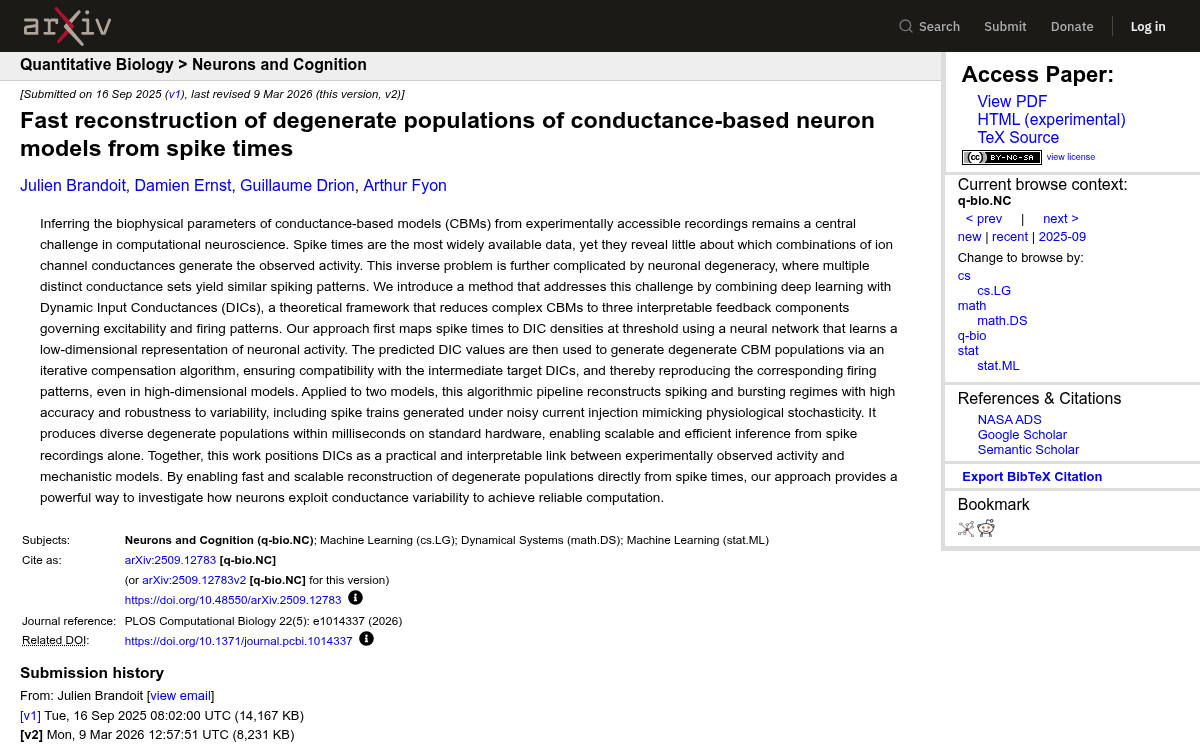
Researchers Julien Brandoit, Damien Ernst, Guillaume Drion, and Arthur Fyon published a method that combines a transformer-based neural network with a classical dynamical systems framework to reconstruct entire populations of biophysically realistic neuron models directly from spike times, running in milliseconds on standard hardware.
The problem that has stumped the field
Spike times are the most widely available data, yet they reveal little about which combinations of ion channel conductances generate the observed activity. This inverse problem is further complicated by neuronal degeneracy, where multiple distinct conductance sets yield similar spiking patterns. Think of it like trying to reverse-engineer a recipe from a photograph of the finished dish. The dish looks the same whether you used butter or olive oil, so the photo alone can not tell you which one was used.
Neuronal degeneracy is the well-established fact that multiple distinct parameter sets, particularly effective ion channel densities, can produce similar spiking behaviors. This functional flexibility enhances robustness but complicates interpretation, as neurons exhibit inherently nonlinear, high-dimensional dynamics. When different parameter combinations produce indistinguishable activity, identifying which configurations underlie recorded behavior becomes an underdetermined problem. Realistic conductance-based models (CBMs) can have dozens of free parameters, and the solution is not a single point but an entire subspace of valid configurations.
Prior approaches either required full intracellular voltage traces (not just spike times), were too slow for practical use, or produced a single best-fit model rather than the diverse population of equivalent models that biology actually demands. The new method sidesteps all three limitations.
The key insight: three numbers to rule them all
The core trick is a theoretical framework called Dynamic Input Conductances (DICs). Rather than working in the full high-dimensional conductance space, DICs compress any conductance-based model into just three scalar values at a critical voltage called the threshold potential. Each value captures the net effect of all ion channels operating at a specific timescale:
- Fast DIC (g_f): governs the rapid voltage changes underlying the spike upstroke
- Slow DIC (g_s): regulates membrane repolarization and the interval between spikes
- Ultra-slow DIC (g_u): accounts for adaptation and shapes bursting envelopes
The sign of the slow DIC at threshold turns out to be a clean dividing line between spiking and bursting neurons. Negative slow DIC values produce bursting; positive values produce regular spiking. This structured, low-dimensional space is exactly what makes the inverse problem tractable.

How the pipeline works, step by step
The full pipeline chains two components together:
- Transformer encoder + normalizing flow: A lightweight attention-based network (roughly 150,000 parameters) takes raw spike times as input. It extracts inter-spike intervals (ISIs), applies a log transform for numerical stability, and processes them through transformer blocks with multi-head self-attention. A self-attention pooling layer collapses the variable-length sequence into a fixed-size latent vector. A RealNVP-style normalizing flow then outputs a full probability density over DIC values, not just a point estimate, which is critical for capturing degeneracy.
- Iterative compensation algorithm: Given a sampled DIC target, the algorithm generates valid conductance vectors by partitioning the conductance space into a randomly sampled subset and a compensated subset. The compensated values are solved analytically to match the DIC target. Different random draws yield different valid conductance sets, naturally producing a diverse degenerate population. An iterative version refines the sensitivity matrix at each step, reducing residual errors by approximately a factor of 15 in just five iterations.
The training dataset was built by uniformly sampling the slow and ultra-slow DIC space, generating 1.2 million simulated neurons spanning spiking, bursting, and irregular regimes, each simulated under noisy current injection to mimic physiological stochasticity.

What the results actually show
The deep learning encoder achieved 99.83% classification accuracy distinguishing spiking from bursting neurons. Regression of key activity descriptors was well within the natural variability of the dataset, with mean absolute errors far below the dataset standard deviation across all metrics (spike frequency, intra-burst frequency, inter-burst frequency, burst duration, and spikes per burst).
End-to-end validation on both the stomatogastric ganglion (STG) neuron model (7 ion channels, complex calcium dynamics) and a dopaminergic (DA) neuron model (6 ion channels) showed close agreement between input and generated spike statistics across spiking and bursting regimes. Generated populations of 500 neurons showed broad conductance distributions while reproducing equivalent firing dynamics, confirming that the pipeline correctly samples the degenerate solution space rather than collapsing to a single answer.

Transfer to the DA model used LoRA (Low-Rank Adaptation), the same parameter-efficient fine-tuning technique popularized in large language models. By freezing the STG-trained backbone and updating only a small set of adapter parameters, the team achieved accurate transfer using only about 40% of the parameters required for full retraining, and with a reduced dataset of roughly 40% the size of the original training set.
What this unlocks in practice
The practical implications span several areas of neuroscience and medicine:
- Neuromodulation studies: Comparing inferred conductance distributions before and after applying a neuromodulator could reveal how it reshapes the conductance landscape and steers neurons between activity regimes
- Drug discovery: Tracking how DIC values shift under a pharmacological compound could identify which ion channel types are most affected
- Clinical neuroscience: Rapidly generating mechanistic models from extracellular recordings could support patient-specific modeling for deep brain stimulation or epilepsy monitoring
- Neuromorphic hardware: The DIC framework applies to analog electronic circuits implementing neuromorphic dynamics, opening a path to real-time tuning of silicon neurons
The method is also honest about what it cannot do. Because it operates only on spike times, it is blind to subthreshold dynamics such as after-depolarizations that shape interspike interval fine structure. The spiking regime is also inherently harder to resolve than bursting, because multiple DIC configurations produce functionally indistinguishable firing rates, creating a one-dimensional manifold of valid solutions rather than a single point. Adding responses to controlled stimuli could help constrain this ambiguity in future work.
Open source, no coding required
The team released the entire pipeline as Spike2Pop, an open-source software package with a graphical interface designed for experimentalists without programming expertise. A companion dataset on Zenodo containing 1.2 million simulated neurons is also publicly available. The paper itself is published in PLOS Computational Biology.
The deeper contribution here is conceptual. By showing that DICs act as a mechanistically interpretable bottleneck between spike recordings and full biophysical models, the work provides a principled answer to a question that has lingered in computational neuroscience for decades: not just which conductance sets are compatible with observed activity, but why they are equivalent, and how to enumerate them efficiently.