
University of Liège's NcAE Keeps Physics AI Stable Across Regime Changes
A new autoencoder architecture keeps its geometric projection guarantee intact when physical parameters shift, matching or beating six baselines on dynamical systems.
 Pro
Takeaways
- The Neuromodulated Constrained Autoencoder extends cAEs so their projection guarantee survives context changes.
- A hypernetwork modulates only activation slope and bias, leaving biorthogonal weights fixed, mirroring biological neuromodulation.
- Three theorems guarantee idempotency, diffeomorphic invariance, and Lipschitz stability across all contexts, including unseen ones.
- On a 16-DoF pendulum, position RMSE drops roughly 75% versus the base cAE with far lower variance than FiLM.
- On Lorenz96 across a bifurcation, NcAE beats unconstrained baselines by an order of magnitude on velocity RMSE.
- FiLM+AE diverges numerically by step 10 on iterative projection, while NcAE stays at ~10^-5 idempotency error.
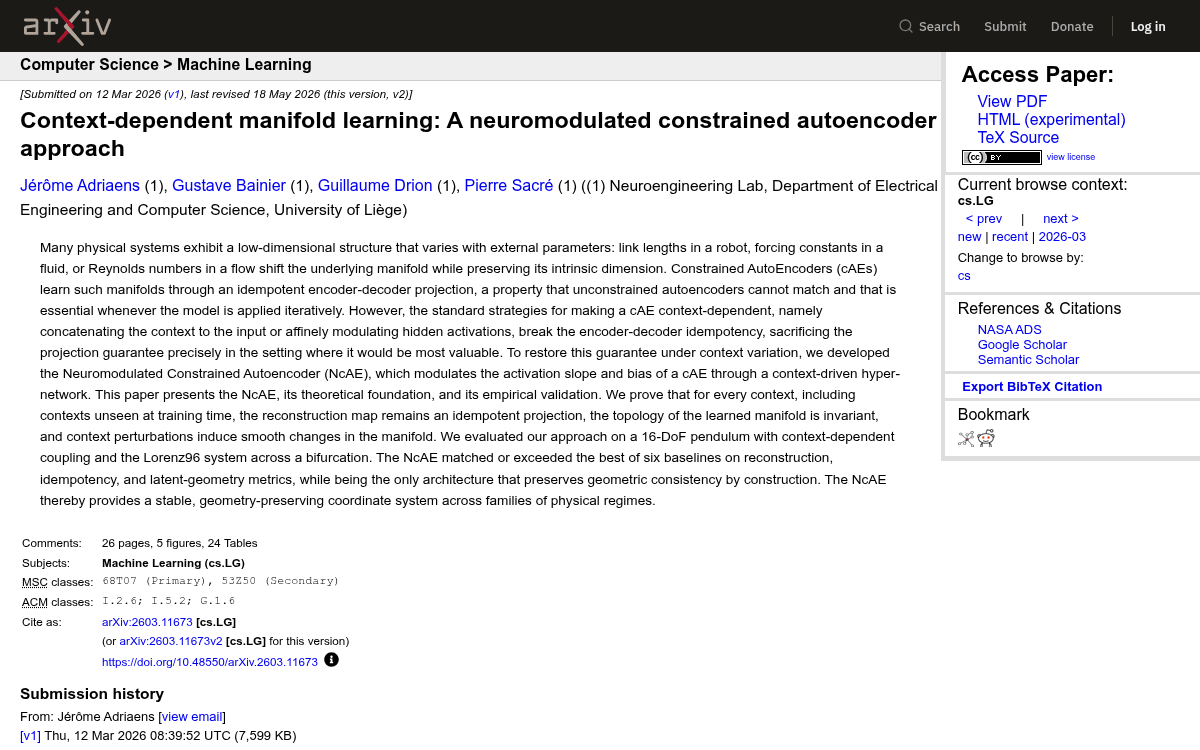
Autoencoders that reduce high-dimensional physics data to a handful of latent coordinates have a nagging problem: the moment you change a physical parameter, like a link length in a robot or a forcing constant in a fluid, the underlying manifold moves and the model has to relearn it. A team from the University of Liège has proposed a fix that borrows a trick from neuroscience, and they can prove it works for every context, even ones the network never saw during training.
Their Neuromodulated Constrained Autoencoder (NcAE) extends the Constrained Autoencoder (cAE) framework so that its projection guarantee survives context changes. The paper shows it matches or beats six baselines on a 16-degree-of-freedom pendulum and on the Lorenz96 system across a bifurcation, while being the only architecture that keeps its geometric structure by construction.
The idempotency problem
A standard autoencoder trains an encoder and decoder to minimize reconstruction error, but nothing forces their composition to be a projection. Constrained Autoencoders enforce biorthogonality between encoder and decoder weights together with mutually inverse activations, making the reconstruction map an idempotent projection onto a smooth embedded submanifold of the data space. In plain terms: once a state lies on the learned manifold, applying the autoencoder again leaves it unchanged. That property matters whenever you iterate the model, for example when integrating a dynamical system in latent space, because otherwise tiny per-step errors accumulate into large drift.
The catch is that the standard remedies for making the model context-dependent, namely concatenating the context to the input or affinely modulating hidden activations as in FiLM, both break the encoder-decoder inverse relationship that makes a cAE a projection. The geometric guarantee is lost precisely where it would be most valuable.
Borrowing from neuroscience
The authors identify which parts of a cAE can be safely modulated without breaking its projection property. In the nervous system, neuromodulation is the process by which diffuse signals adjust the response properties of neurons (gain, threshold, time constant) without altering the underlying connectivity. Mapping that idea onto the cAE: leave the biorthogonal weight matrices alone, but let the activation slope and bias adapt to context.
Concretely, a small hypernetwork consumes a context vector c and produces per-layer activation slopes and biases through two stages. A shared MLP maps c to a low-dimensional signal s, and layer-specific linear projections turn s into the α and β parameters for each biorthogonal layer pair. A saturating sigmoid keeps α inside the admissible range so the inverse-activation property never breaks.
From this construction the authors prove three properties that hold for every context, including unseen ones:
- Idempotency: the reconstruction map is a true projection at every
c. - Diffeomorphic invariance: manifolds learned at different contexts are the same up to smooth deformation, so topology and intrinsic dimension are preserved.
- Lipschitz stability: small perturbations to
conly produce proportionally small changes in the ambient position of the manifold.
What the experiments show
The team tests on two systems that stress different failure modes. The 16-DoF pendulum imposes context-dependent coupling through the first four link lengths. The Lorenz96 system with dimension 36 has an intrinsic bifurcation at forcing constant F approximately 3.163, within the range F in [3.133, 3.193], where the attractor topology fundamentally changes. The bifurcation is dramatic: the system shifts from a traveling wave with spatial frequency 8 to frequency 7.

Against six baselines spanning context-free cAE and AE, input-concatenation variants, FiLM-style modulation, and a soft-constraint version, NcAE wins on both reconstruction and geometry. On the pendulum, NcAE reduces position RMSE by approximately 75% relative to the cAE and Context-cAE and achieves the lowest velocity RMSE. FiLM+AE produces a marginally lower mean position RMSE (0.008), but its variance is five times larger. On Lorenz96 the velocity RMSE gap is an order of magnitude over every unconstrained baseline.
The idempotency numbers are where the theoretical guarantee shows up most starkly. cAE and NcAE maintain near-zero error (~10^-5) on both systems. Meanwhile Context-cAE breaks idempotency despite its constrained backbone: concatenating the context to the input modifies the effective input at each application, so the encoder receives [x,c] on the first pass but [x-hat,c] on every subsequent pass. FiLM+AE actually blows up numerically by step 10 on Lorenz96.
Robustness beyond training
Because the geometric guarantees hold for every c, out-of-distribution contexts only degrade reconstruction fidelity, not structural validity. NcAE retains the best velocity RMSE at every OOD level on both systems (Lorenz96: 0.33 to 0.545 at +50%; pendulum: 0.152 to 0.42), with monotone degradation. FiLM+AE, by contrast, catastrophically fails at +50% out of distribution on Lorenz96, with velocity RMSE ballooning to 273.9. Under Gaussian noise on states, context, or both, across all 72 comparable conditions, NcAE achieves the best RMSE in 47, making it the most consistent architecture overall.
When to actually use it
The authors are refreshingly clear about scope. Idempotency matters when the autoencoder is applied iteratively or chained with other operators, not for a single-shot denoising pass. The natural home for NcAE is projection-based reduced-order modeling of dynamical systems, latent-space integration, and pipelines where the reconstruction map composes with an external dynamics model. The team explicitly points at dynamics-discovery methods like SINDy, Hamiltonian Neural Networks, and Neural ODEs as natural downstream targets, since those methods identify governing equations at a single operating point and could benefit from a stable coordinate system that spans regimes.
Three limitations bound the current framework:
- The context
cis assumed static and directly observable at inference; time-varying or latent contexts are out of scope. - Riemannian optimization on the biorthogonal manifold adds per-step overhead that may hurt scaling to very large networks.
- The Lipschitz constant in the OOD stability bound is not tightened during training, so the guarantee is qualitative rather than a numerical certificate.
The paper does not appear to ship a public code release yet, though the training relies on the open-source geoopt library for Riemannian optimization, which handles the biorthogonal constraint. For anyone building surrogates of parameterized physical systems, this is a principled way to get a single latent coordinate system that survives regime changes without sacrificing the projection property that made cAEs useful in the first place.