
University of Geneva Maps Wikidata's 2,240 Qualifier Properties Into Four Buckets
A study of 1.6 billion Wikidata statements produces a four-category taxonomy for the qualifier soup, aiding query design and knowledge graph modeling.
 Pro
Takeaways
- New taxonomy organizes Wikidata's 2,240 qualifier properties into four categories covering 99.6% of usage in the graph.
- Importance ranked by frequency times Hill-number diversity using proportional frequencies to handle long-tail distortion.
- Four top categories: Contextual, Epistemic/Uncertainty, Structural, and Additional, refined from Patel-Schneider's earlier scheme.
- Contextualization is under 10% of qualifications, refuting prior claims that most qualifiers add context.
- Enables qualifier abstraction so queries and inference rules operate on category-level data types, not raw qualifier names.
- Full scripts, dictionaries, and classification data on GitHub against the 2025-01-01 dump.
Wikidata's statements are more than simple subject-property-value triples. Each one can carry a tail of qualifier snaks that pin down when a fact holds, where it holds, how sure we are, or who says so. The problem is that this expressive freedom has produced a sprawl of thousands of qualifier properties with no clear organizing principle, and picking the right one, or writing a query that respects them, has become genuinely hard.
A new arXiv paper from researchers at the University of Geneva tackles this head-on. They mined a full Wikidata dump, ranked qualifiers by both frequency and diversity, and used the top 300 to build a four-branch taxonomy that they argue covers 99.6 percent of actual qualification usage in the graph.
Why qualifiers are a mess
A Wikidata statement can look like (George C. Scott, spouse, Colleen Dewhurst)[start time: 1960, end time: 1965, end cause: divorce]. Those bracketed pairs are qualifiers, and they let Wikidata avoid the reification gymnastics that plain RDF would require to express the same idea.
The scale is significant. As of the first of January 2025, 2240 properties were used as qualifiers, appearing in approximately 20% of the statements (331,631,397 statements out of 1,624,567,397 are qualified). That abundance creates three concrete pain points:
- Contributors face an overwhelming menu when deciding which qualifier to attach
- Query authors must know which qualifiers restrict a statement's validity (temporal, spatial, jurisdictional) versus those that merely decorate it
- Anyone writing inference rules has to figure out how qualifier values propagate from premises to conclusions
Measuring what actually matters
Ranking by raw frequency alone is misleading. The authors point out that the qualifier astronomical filter (P1227) is extremely frequent with 33,145,290 statements qualified, but it is used almost exclusively to qualify statements about the apparent magnitude (P1215) of stars. Meanwhile, a less common qualifier like valid in place touches hundreds of distinct properties and shapes the meaning of far more of the graph.
So the team defined importance as frequency times diversity, where diversity is measured with Hill numbers of order 1, the exponential of Shannon entropy. If a qualifier's diversity index is d, it behaves like a qualifier that spreads evenly across d different properties.

A subtle but important refinement: raw property counts get distorted by long-tail effects. To fix this, they replaced absolute counts with the proportional frequency, defined as the share of statements with property p that are qualified by q. This prevents one massive property from drowning out the signal. For the series ordinal qualifier, the naive Shannon index gave 2.03, badly underselling its reach. With proportional frequencies, the diversity jumped to 57.64, correctly reflecting that it qualifies 99% of statements with the property expressed in and 94% of statements with the property author.
Four buckets that hold everything
Starting from Patel-Schneider's earlier split between contextual and additional qualifiers, the authors found that a two-category scheme leaves important cases homeless. Their refined taxonomy has four top-level classes:
- Context (Validity) restricts when, where, or for which sub-part of the subject a statement holds. Temporal, spatial, and subject-modifier qualifiers live here.
- Epistemic / Uncertainty captures how sure we are. Qualifiers like
sourcing circumstances(with values such as circa, hypothesis, disputed) and interval-styleearliest date/latest datepairs quantify imprecision without defining validity. - Structural qualifiers build data structures. They either metamodel (defining categories, list types, or property constraints) or act as fields of a compound value, like the pressure that must accompany a boiling point.
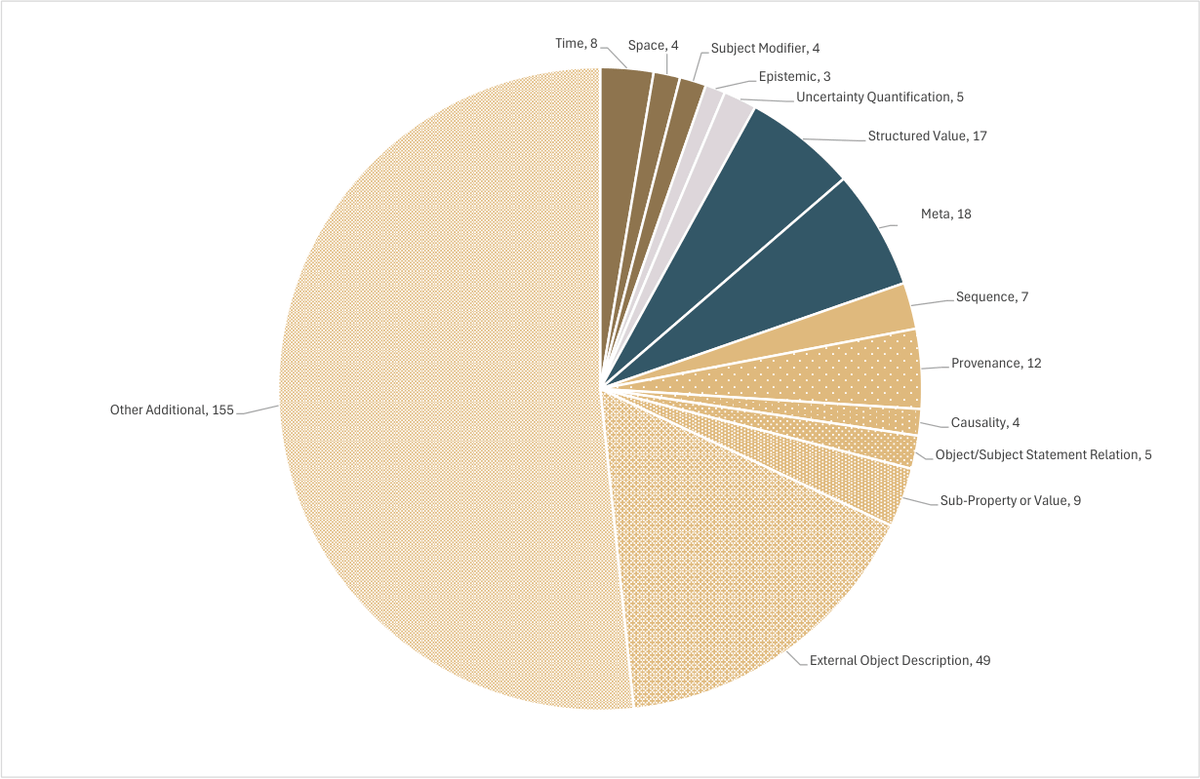
- Additional qualifiers decorate without changing meaning, split into sequence, provenance, causality, object/subject-statement relation, sub-property refinement, and external object description.
One clarifying insight: the study pushes back on a common assumption. Figure 7 shows that contextualization represents less than 10% of the qualifications, contradicting earlier claims that most Wikidata qualifiers are about context.
Why this is useful in practice
The taxonomy is not just a filing system. The authors show it enables qualifier abstraction for querying and reasoning. Instead of writing rules that name specific qualifiers, you can associate each statement with a value per category (a temporal context value, a causality value, etc.) and write rules against those abstract types.
For example, an inference rule combining two statements with temporal validity intervals T1 and T2 can be corrected by inserting an intersects(T1, T2) predicate and an intersection(T1, T2) operation in the conclusion. All the messy work of handling different qualifier combinations (start time plus end time versus start time plus duration, open-ended intervals meaning plus or minus infinity) gets encapsulated inside the data-type operations rather than smeared across every rule.
Other practical payoffs include:
- Better UIs that group qualifier menus by category rather than listing them alphabetically
- Improved recommendation systems that today, like the SchemaTree-based recommender, ignore qualifier semantics entirely
- Cleaner property descriptions, since only 148 of the top 300 qualifiers currently document their role as qualifiers
- A design template for new knowledge graphs that need to represent context, uncertainty, causality, and provenance from day one
What it does not solve
The taxonomy inherits Wikidata's ambiguity problems. The country qualifier sometimes marks spatial validity and sometimes redundantly annotates a place of birth. The publisher qualifier means provenance on population statements but external-entity description on described at URL statements. The taxonomy exposes these misuses cleanly, but does not automatically fix them. The Other Additional bucket also swallows more than half of the top 300 qualifiers because they are domain-specific and low-diversity, so further refinement is possible but would mostly touch minor qualifiers.
All the frequency dictionaries, diversity scores, extraction scripts, and classification spreadsheets are available in the cui-ke/wikidata-qualifiers GitHub repository, computed against the 2025-01-01 Wikidata JSON dump. For anyone building tooling on Wikidata, or designing a new property-qualified knowledge graph, it is a rare piece of empirical grounding in a corner of KG modeling that usually runs on intuition.