
University of Augsburg's DSFlash Runs Full Scene Graphs at 56 FPS
A new two-stage panoptic scene graph generator hits 56 FPS on an RTX 3090 while matching state-of-the-art accuracy on PSG.
 Pro
Takeaways
- DSFlash generates full panoptic scene graphs at 56 FPS on an RTX 3090, matching DSFormer accuracy at ~9x lower latency.
- Accepted at CVPR 2026; code and checkpoints promised on release.
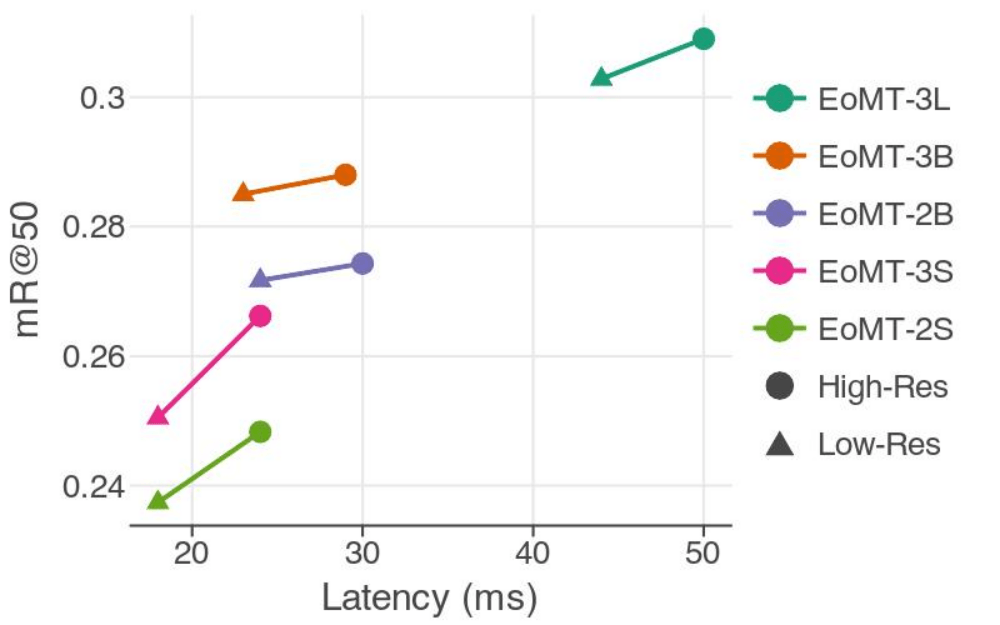
- DSFlash-L reaches 30.9 mR@50 in 50 ms; DSFlash-S runs in 18 ms with 40M parameters.
- Uses a frozen EoMT segmentation backbone plus a bidirectional gated relation head to halve forward passes.
- Mask-based dynamic patch pruning and ToMe-SD token merging cut GTX 1080 latency from 230 ms to 173 ms.
- Trainable end-to-end in under 24 hours on a single nine-year-old GTX 1080 GPU.
Scene graph generation has been stuck in an awkward spot for years: the models that produce the best graphs are far too slow for a live video feed, and the models that are fast enough tend to skip most relationships in the scene. A team from the University of Augsburg is trying to close that gap with DSFlash, a panoptic scene graph model that runs at up to 56 frames per second on a single RTX 3090 while still generating a comprehensive graph over every pair of objects in the image.
The paper was accepted at CVPR 2026, and the authors say code and checkpoints will be released once the paper is out. What makes it interesting is not a new architectural trick so much as a careful engineering pass over an existing state-of-the-art design, trading almost none of the accuracy for roughly a 20x speedup.
The problem with scene graphs today
A scene graph represents an image as nodes (object instances) and edges labeled with predicates like sitting on or behind. Panoptic scene graph generation (PSGG) is the harder variant where each instance is localized with a segmentation mask instead of a bounding box, giving downstream tasks like embodied reasoning or surgical assistance much more precise spatial grounding.
The authors point out that almost all PSGG research has optimized for graph quality, ignoring latency. The current accuracy leader, DSFormer, runs at 458 ms per image, essentially two frames per second, and requires two full backbones stacked back to back. The one real attempt at a fast SGG model, REACT, gets down to 19 ms but only classifies a small subset of salient relationships and lags well behind on the mean recall metric.
How DSFlash is put together
DSFlash inherits DSFormer's two-stage layout but rebuilds nearly every component. Stage one runs an Encoder-only Mask Transformer (EoMT) once per image to produce panoptic masks and patch features. Stage two, executed for every pair of masks, injects the subject and object locations into the patch tokens via a mask embedding and predicts the relation.

The key structural changes that get it from 445 ms to under 20 ms are:
- Unified backbone. DSFormer used a separate segmentation model plus its own ResNet backbone. DSFlash pulls features directly out of the EoMT segmentation model at blocks 2/5/8/11 (or 5/11/17/23 for the large variant) and concatenates them, so a single forward pass produces both masks and the feature tensor fed to the relation head. This alone cuts latency by 91%.
- Bidirectional relation predictor. Instead of running the relation head twice per pair (once for A-to-B, once for B-to-A), DSFlash splits the shared feature vector via a learned gate inspired by GRUs and predicts both directions from one forward pass. A consistency loss during training forces the two halves of the gate to behave symmetrically when the mask order is flipped.
- Raw-resolution masks. The mask embedding only needs a 13x13 grid of overlap ratios. Skipping the bilinear upsampling from 160x160 to full image resolution shaves another 21% off latency.
- Dynamic patch pruning. Patches that overlap with neither the subject nor the object mask carry almost no useful signal, and because the overlap ratios are already computed for the mask embedding, dropping those patches costs nothing extra.
- Token merging. ToMe-SD is applied inside the backbone's attention layers with unmerging afterwards, preserving segmentation quality while cutting attention cost.
A subtle detail: during initial experiments the model learned that in the PSG training data a positive relation is three times more likely to appear in the forward direction than the backward direction. The gate started exploiting that shortcut, which would collapse at deployment time. The added consistency loss between the flipped forward passes is what forces it to treat the two directions on equal footing.
The numbers
Evaluation is on the PSG dataset (49k images, 56 predicate classes) using mean Recall@50 under the Scene Graph Detection protocol, which requires the model to predict masks, labels, and relations from raw pixels. All latency numbers are batch size 1 on an RTX 3090, simulating a real video stream.
| Model | mR@50 | Latency | Params |
|---|---|---|---|
| MotifNet-MD | 16.32 | 504 ms | 332M |
| HiLo-L | 19.08 | 427 ms | 230M |
| REACT | 19.00 | 19 ms | 43M |
| DSFormer | 30.70 | 458 ms | 330M |
| DSFlash-L | 30.90 | 50 ms | 340M |
| DSFlash-B* | 28.50 | 23 ms | 116M |
| DSFlash-S* | 25.05 | 18 ms | 40M |
The large variant slightly beats DSFormer's mR@50 while running roughly 9x faster. The small variant, at 40M parameters and 18 ms per frame, still tops every published baseline except DSFormer itself. Perhaps the most useful practical result: the whole model can be trained in under 24 hours on a nine-year-old GTX 1080.
What the backbone actually determines
Because the segmentation stage is frozen, its capability sets a hard ceiling on how well DSFlash can perform. The authors report a correlation of 0.99 between the segmentation backbone's panoptic quality and mR@inf, the theoretical upper bound on scene graph performance given the produced masks.

The practical implication is that DSFlash gets better essentially for free as segmentation research improves. Swap in a stronger EoMT variant and the scene graph quality follows.
Where pruning helps and where it does not
Dynamic patch pruning and token merging show a clear hardware-dependent pattern. On an H100 or RTX 3090 at batch size 1, the GPU is already underutilized, so pruning barely moves latency. On a GTX 1080, latency drops from 230 ms to 173 ms when combining both techniques, with mR@50 dropping only from 28.80 to 26.51. When batches are large enough to saturate the GPU, both techniques improve throughput on all hardware.
Limitations worth knowing about
The authors are candid about failure modes. DSFlash sometimes confuses which mask is the subject and which is the object, particularly for symmetric-looking relations, and they suggest contrastive losses as a future fix. Performance also drops noticeably with the small backbone plus low-resolution masks, since a weaker segmenter misses instances that then never make it into the graph. And because the backbone is frozen, DSFlash cannot easily adapt to domains where general-purpose panoptic segmentation is a poor fit unless you separately fine-tune EoMT.
Why this matters
Scene graphs have been marketed for years as a lightweight, interpretable alternative to vision-language models for tasks like robotic reasoning, sports analysis, or surgical scene understanding, but the latency gap made that pitch mostly theoretical. A comprehensive graph at 56 FPS on a mid-range consumer GPU, trainable overnight on hardware from 2016, changes what is realistic to deploy on an edge device or a robot. The bidirectional prediction trick and the mask-driven patch pruning are also generic enough that they should port to other two-stage scene-graph architectures without much surgery.