
University Clermont Auvergne's uSAST Reads Telescope Error Bars to Classify Supernovae
A new interpretable model classifies astronomical transients from noisy light curves while revealing which signal shapes drive each prediction
 Pro
Takeaways
- uSAST is a new interpretable classifier for uncertain time series, applied to classifying 15 types of astronomical transients in the PLAsTiCC dataset.
- It achieves 70% F1 score, matching black-box methods like MUSE while outperforming the explainable baseline XEM.
- Unlike standard shapelet methods, it uses all subsequences from reference examples rather than pruning aggressively -- the step that caused prior interpretable methods to fail entirely on this data.
- The Uncertain Euclidean Distance (UED) propagates measurement error bars through the distance calculation, giving the model a 6% F1 boost over ignoring uncertainty.
- Predictions are explainable at both local (per-instance) and global (per-class) levels, and the model correctly recovers known astrophysical signatures like supernova plateau phases and the Doppler shift.
- Code and preprocessed data are publicly available; main limitation is runtime (~43 hours to train vs. ~3 minutes for ROCKET).
Cosmologists studying the universe's expansion rely on a surprisingly fragile pipeline: they need to identify and classify fleeting astronomical events -- supernovae, kilonovae, active galactic nuclei -- from telescopes that produce noisy, incomplete brightness measurements. Every measurement comes with an error bar. Most machine learning models simply ignore those error bars. A new paper from researchers at the University Clermont Auvergne argues that is a costly mistake, and proposes a method that treats uncertainty as a first-class input rather than noise to be discarded.
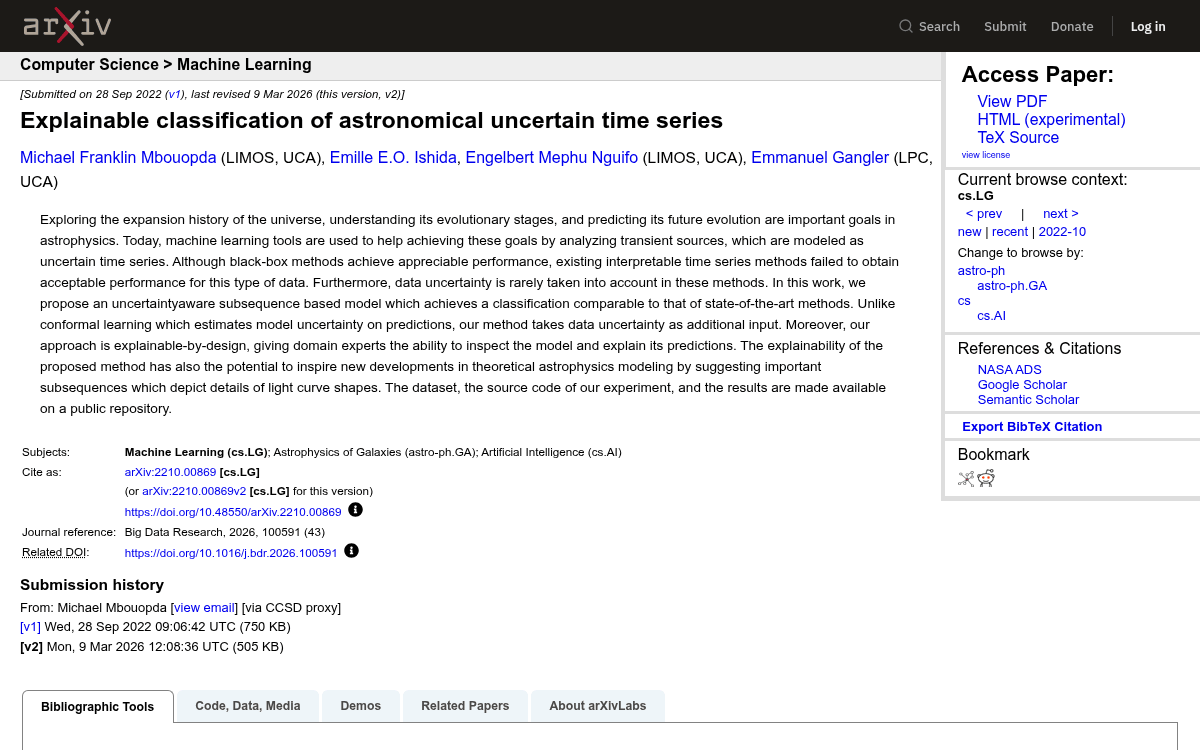
The work, published in Big Data Research, introduces uSAST (Uncertain Scalable and Accurate Subsequence Transform), an explainable-by-design classifier for uncertain time series. It achieves classification performance on par with black-box state-of-the-art methods, while letting domain experts directly inspect which segments of a light curve drove each decision.
The telescope data problem
The backdrop here is the Photometric LSST Astronomical Time-Series Classification Challenge (PLAsTiCC), a Kaggle competition that ran in 2018 to prepare the community for the Vera C. Rubin Observatory. Next-generation surveys like the Legacy Survey of Space and Time (LSST) on the Vera C. Rubin Observatory will generate orders of magnitude more discoveries of transients and variable stars than previous surveys. Over 1,000 teams participated in PLAsTiCC, hosted on the Kaggle platform, ultimately identifying three winners in February 2019.
The challenge exposed a core tension in astrophysics ML: the methods that win competitions are black boxes. The historic presentation of machine learning methods as "black boxes" has generated pushback from some in the physics and astronomy communities regarding how useful they are. Astrophysicists need to trust their classifiers -- not just because of scientific rigor, but because misclassifying a Type Ia supernova (the standard candle used to measure cosmic distances) has direct consequences for cosmological models.
The data itself makes this hard. Brightness measurements (called photometry) are cheaper to collect than spectroscopic data, but they come with significant noise from moonlight, clouds, and atmospheric effects. Each observation is therefore an uncertain value: a best estimate plus an error bar. The resulting sequences are called uncertain time series (uTS) -- and almost no existing time series classifier is designed to handle them natively.
Why existing interpretable methods failed
The standard go-to for interpretable time series classification is the Shapelet Transform. A shapelet is a short subsequence of a time series that is maximally discriminative between classes -- think of it as a "signature shape" that distinguishes one type of event from another. The idea is elegant: find the most informative snippets, measure how similar each full time series is to those snippets, and train a classifier on those distances.
The problem is that PLAsTiCC breaks this approach. The dataset contains 15 classes of transients, is heavily imbalanced (the most populated class holds 29% of objects, the rarest just 0.3%), and many classes look nearly identical in shape. Both the standard Shapelet Transform (STC) and its uncertain extension (UST) completely failed on PLAsTiCC -- neither method could find a single valid shapelet in the dataset, regardless of hyperparameter tuning. The issue is that shapelet methods prune candidates aggressively using information gain thresholds, and on a dataset where class boundaries are this subtle, nothing clears the bar.

How uSAST works
The key insight behind uSAST is to skip the aggressive pruning step entirely. Instead of searching for shapelets (the best possible discriminative subsequences), it uses all subsequences from a small set of reference examples -- one randomly selected instance per class -- and lets a downstream classifier figure out which ones matter.
The pipeline follows four steps:
- Sample reference series: Randomly pick one time series per class from the training set.
- Extract all subsequences: Generate every contiguous subsequence of configurable lengths (e.g., lengths 20 to 60, stepping by 10) from those reference series. Optionally remove near-duplicates using an epsilon-similarity threshold.
- Transform the dataset: Replace each time series in the full dataset with a vector of its distances to every reference subsequence, plus the count of how many times each subsequence appears in it.
- Train a classifier: Feed that transformed feature matrix into a standard supervised classifier (XGBoost, Random Forest, or Ridge regression).
The uncertainty-aware version, uSAST, swaps the standard Euclidean distance for the Uncertain Euclidean Distance (UED). UED propagates measurement error through the distance calculation: when two subsequences are compared, the uncertainty in each measurement contributes to the uncertainty of the distance itself. That uncertainty is then passed to the classifier as an additional feature, giving the model information about how reliable each match is.
Here is a minimal sketch of the core transform logic:
# Pseudocode for the uSAST transform step
for each time_series T in dataset:
    features = []
    for each reference_subsequence S:
        dist, count = distAndCount(T, S, epsilon, use_UED=True)
        # dist: uncertain distance (value + uncertainty)
        # count: how many times S appears in T
        features.extend([dist.value, dist.uncertainty, count])
    transformed_dataset.append(features)
# Train XGBoost on transformed_dataset
Benchmarks and what the numbers mean
The team evaluated on the PLAsTiCC training set (7,848 transients across 15 classes, 6 photometric wavelength bands each), using an 80/20 train-test split and averaging results over 3 runs. The comparison against state-of-the-art methods tells a clear story:
| Method | Precision | Recall | F1 Score | Explainable? |
|---|---|---|---|---|
| uSASTd (proposed) | 0.72 | 0.73 | 0.70 | Yes |
| MUSE | 0.71 | 0.73 | 0.71 | No |
| ROCKET | 0.77 | 0.77 | 0.75 | No |
| XEM | 0.69 | 0.71 | 0.69 | Yes |
uSAST matches MUSE and beats XEM while being fully interpretable. ROCKET is the accuracy leader, but it works by applying thousands of random convolutional filters -- the features it produces have no physical meaning to an astrophysicist. The ablation study is also telling: switching from uncertainty-unaware SAST to uncertainty-aware uSAST yields a 6% gain in both precision and F1 score, at the cost of roughly four times more computation time.
Performance varies significantly by object type. The model achieves an F1 score of 94% for galactic objects observed with Deep Drilling Fields (DDF) strategy, but drops to 67% for extra-galactic objects observed with the Wide Fast Deep (WFD) strategy. This makes physical sense: galactic objects are variable stars that repeat their brightness cycles many times within the observation window, giving the model lots of pattern repetitions to work with. Extra-galactic transients like supernovae produce a single burst that never repeats, encoding far less information.
The explainability payoff
This is where the paper makes its most interesting contribution. Because the classifier is tree-based (XGBoost), feature importances directly correspond to specific subsequences at specific wavelength bands. The model can explain individual predictions by highlighting which segment of which light curve channel was most decisive.
One striking example: for a Core-Collapse Supernova Type II, the model correctly identifies the "plateau phase" -- a characteristic flat region in the brightness curve that occurs just after peak luminosity. This is a known astrophysical signature, and the model learned it without being told to look for it. The model also correctly captures the Doppler effect: closer galactic objects have higher signals in lower wavelengths, while further extragalactic objects show signals shifted to higher wavelengths, and uSAST automatically identifies the relevant wavelength dimensions for each prediction.
The global explanation -- the top 20 most discriminative subsequences across the whole dataset -- reads like a textbook of transient astrophysics. Eclipsing binary signatures show the expected dip in brightness as one star passes in front of the other. Supernova-like subsequences capture the characteristic single-burst shape. Some subsequences are discriminative not because of their value, but because of their uncertainty pattern: a faint, distant object will have large error bars even at its peak, and the model learns that this uncertainty profile itself is informative.
Limitations and what comes next
The main practical limitation is runtime. uSAST takes roughly 43 hours to train on PLAsTiCC, compared to 3 hours for MUSE and just 3 minutes for ROCKET. The computational cost scales with time series length, and the authors note that reducing the subsequence search space is an important direction for future work.
The method is also currently limited to the PLAsTiCC training set rather than the full challenge dataset, and uses a single reference time series per class -- a deliberate design choice that keeps things scalable, but may miss class diversity.
The source code is publicly available on GitHub, along with the preprocessed PLAsTiCC dataset. For teams working on scientific time series with measurement uncertainty -- whether in astrophysics, climate science, or medical monitoring -- uSAST offers a rare combination: competitive accuracy, built-in uncertainty handling, and predictions you can actually explain to a domain expert.