
Université de Lorraine Bridges MRI Lab Speech to Real-World Microphones
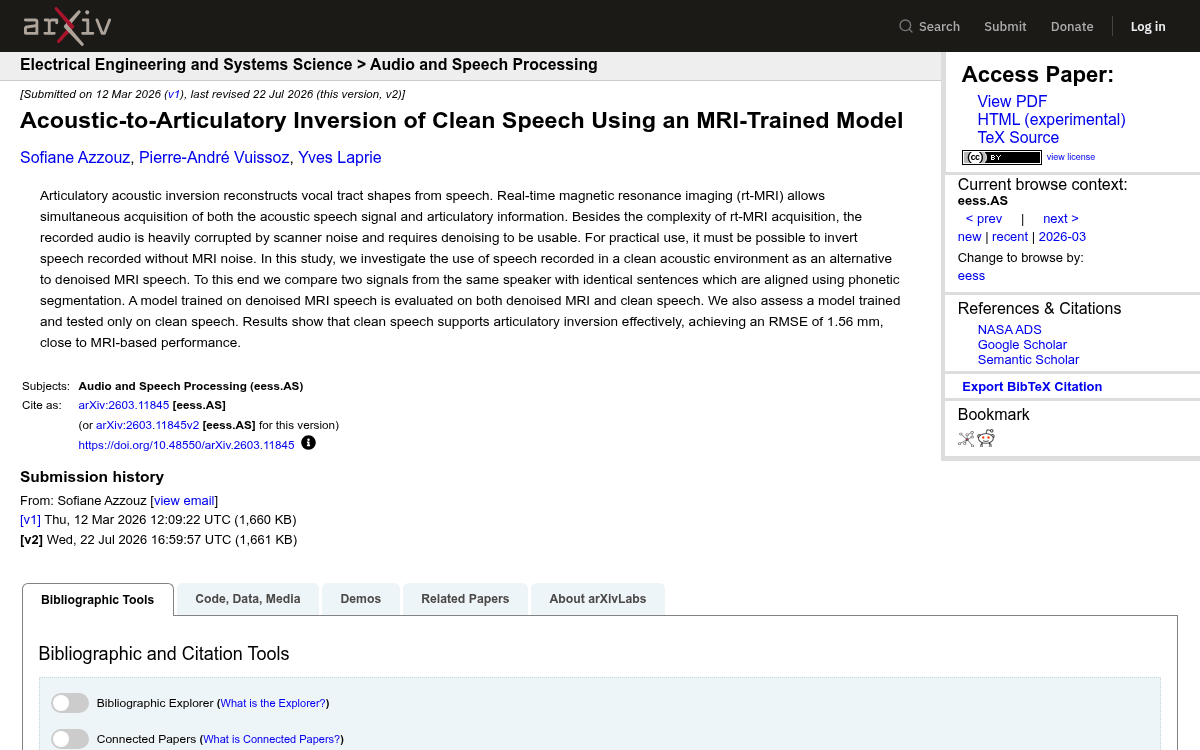
A model that maps speech to vocal tract shapes can now work on studio-quality audio, hitting 1.56 mm error without MRI noise.
 Pro
Takeaways
- MRI-trained articulatory inversion now works on clean speech at 1.56 mm RMSE, near the 1.51 mm MRI baseline.
- Approach uses HuBERT-Base embeddings feeding a two-layer Bi-LSTM predicting 8 vocal-tract articulator contours.
- Phonetic segmentation alignment beats dynamic time warping, cutting error by roughly 0.1 mm on average.
- Training data comes from real-time MRI at 136x136 pixels, 20 fps, 2.5 hours of French speech.
- Naive transfer from MRI-trained model to clean speech degrades RMSE from 1.51 mm to 1.64 mm without adaptation.
- Study is single-speaker French only; Lombard effect and supine posture remain unaddressed confounders.
Reconstructing the shape of the vocal tract from an audio signal alone sounds like a party trick, but it is a real research goal called acoustic-to-articulatory inversion. A new study from researchers at Université de Lorraine shows that a model trained on real-time MRI recordings of a speaker can be transferred to work on clean, studio-quality speech, closing the gap between lab data and anything you would realistically record in the wild.
Why MRI-trained models struggle outside the scanner
The way you get ground-truth articulatory data is to stick a speaker inside a real-time MRI machine and film their vocal tract while they talk. The paper explains that real-time MRI enables visualization of the entire vocal tract from the glottis to the lips, which is a big upgrade over older sensor-based methods like electromagnetic articulography. The catch is that the microphone inside the scanner picks up a huge amount of gradient noise, so the audio needs heavy denoising before anything usable comes out.
Even after denoising, the signal is not the same thing you would record on a laptop mic. The denoised signal is still quite different from normal speech, with the energy lower in the high frequencies in particular. There is also the Lombard effect, where people unconsciously talk louder in noisy environments, and the fact that MRI subjects lie flat on their back. The result is a domain gap that has kept articulatory inversion locked inside the lab.

The setup: same speaker, same sentences, two microphones
To measure the gap honestly, the authors recorded the same native French female speaker twice. The first corpus contains approximately 2.5 hours of data, with 105 acquisitions of 80 seconds and 4000 MRI frames each. The rt-MRI images have a spatial resolution of 136 x 136 pixels at 20 fps, with an in-plane pixel size of 1.62 mm. The audio was recorded using an optical microphone at 16 kHz and then denoised. The second corpus captured the same sentences outside the scanner in a quiet room.
Because the two recordings are not time-synchronized, the team built a hierarchical alignment pipeline that walks sentence, word, and phoneme boundaries. Each MRI frame gets mapped to a target time in the clean recording using its relative position inside the phoneme it belongs to. This preserves phonetic structure while stretching each phoneme independently to match durations across the two corpora.
Inside the model
The architecture is deliberately simple. Audio goes through HuBERT-Base to produce 768-dimensional embeddings at 50 Hz. The network then has two dense layers with 300 units each, two bidirectional LSTM layers with 300 units each, and a final dense layer that outputs a tensor of size 8 x 100. That output covers eight articulators, with 50 X and 50 Y coordinates per articulator. The eight tracked structures include the tongue, lips, velum, epiglottis, pharyngeal wall, arytenoid cartilage, and vocal folds.

What the numbers say
Three configurations were compared, all predicting the MRI-derived contours as ground truth:
- M2M: train and test on denoised MRI speech (the baseline).
- M2C: train on MRI speech, test on clean speech (zero adaptation).
- C2C: train and test on clean speech after phonetic alignment.
M2M scored the best with an average RMSE of 1.51 mm and a median of 1.33 mm. C2C followed at 1.56 mm RMSE and 1.33 mm median. The naive M2C transfer degraded to 1.64 mm RMSE and 1.39 mm median. For reference, the MRI pixel size is 1.62 mm, so the clean-speech model is landing errors below one pixel.
The alignment method matters more than you might expect. Using dynamic time warping instead of phonetic alignment produced significantly worse numbers in both configurations. This confirms that using phonetic segmentation to align articulatory data with acoustic data offers a real advantage. Phoneme boundaries give the model something DTW cannot: a hard guarantee that a given frame is being matched to the right speech sound rather than an acoustically similar neighbor.
What this unlocks, and what it does not
Articulatory inversion has a growing list of downstream uses: speech therapy visualizations, silent-speech interfaces, phonetics research, articulatory-controlled TTS, and low-bitrate speech coding. Until now, models trained on MRI corpora effectively required MRI-quality input at test time, which nobody has in production. Being able to feed in a normal microphone recording and get back plausible vocal tract contours changes the deployment story.
Limitations are worth flagging. The whole study is a single-speaker experiment in French, so speaker-independent generalization is untested here. The Lombard effect and supine posture are acknowledged confounders that the authors could not control for because you cannot currently run an MRI subject standing up. And the code and dataset are not publicly released with the paper, so reproducing the pipeline will take work.
Still, the headline result is that the domain gap between MRI-denoised speech and clean speech is small enough to bridge with careful phonetic alignment and a modest Bi-LSTM head on top of self-supervised embeddings. For anyone building on articulatory data, that is a meaningful signal that the MRI corpora being collected today can power real-world applications tomorrow.