
Universidade da Coruña Proves Fewer Genes Beat More in Anti-Aging AI
A new pipeline uses Fast-mRMR feature selection to trim genomic noise, boosting predictive accuracy while cutting compute costs for dietary restriction gene discovery.
Takeaways
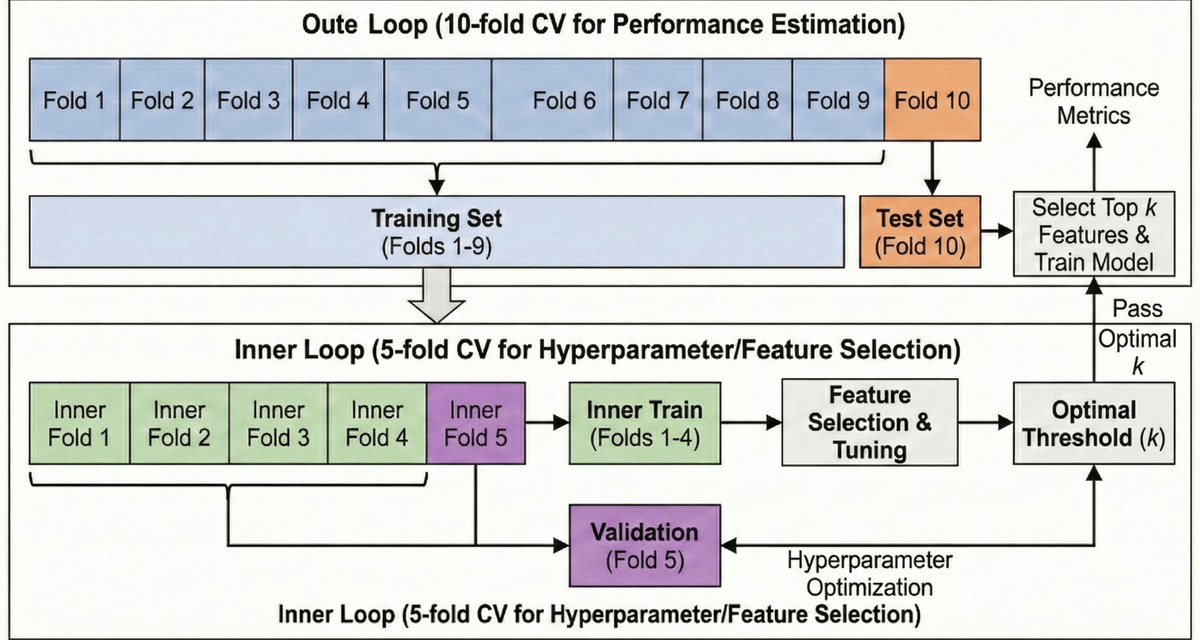
- Fast-mRMR feature selection added to gene prioritization pipeline for Dietary Restriction, dramatically reducing dimensionality without accuracy loss.
- Combined GO+PathDIP with CatBoost hits AUC-ROC 0.873, beating prior PU Learning baselines.
- Feature Bagging strategy handles 45,000-feature coexpression data by splitting into blocks before mRMR selection.
- Optimal retention is just 5-25% of features; more data hurts due to noise accumulation.
- Novel DR candidate genes include RRAGD, linked to the mTORC1 nutrient-sensing pathway central to ageing.
- Code and reproducible pipeline available on GitHub under Green AI principles.
Gene prioritization, the task of ranking which genes are most likely tied to a biological process, has become a proving ground for machine learning in biomedicine. A team from Universidade da Coruña and the University of Kent just showed that the standard approach of throwing every available biological feature at a classifier actively hurts results, and that a classic feature selection algorithm can fix it.
Their new paper targets Dietary Restriction (DR), the anti-aging intervention of reducing nutrient intake without malnutrition. The broader contribution is a domain-agnostic pipeline that could reshape how omics data gets fed into tabular classifiers.
The curse of too many genes
Gene prioritization has two nasty properties that break most ML workflows. First, the data is Positive-Unlabelled (PU): you have a small set of confirmed positives (genes known to relate to DR) and a huge unlabelled pool, but no verified negatives. Second, feature spaces are enormous relative to sample size. The GO feature set has 8,640 features for 1,124 genes, and the coexpression set balloons to nearly 45,000 features across roughly 1,000 genes.
Previous baselines assumed every curated biological feature was relevant, ignoring redundancy and uncertainty in the underlying data. That assumption turns out to be expensive in both accuracy and compute.