
UniFusion Handles Four Vision Tasks With One Frozen DINOv3 Backbone
A single model handles infrared, medical, exposure, and focus fusion by pairing frozen DINOv3 features with a reconstruction-alignment loss and bilevel training.
 Pro
Takeaways
- UniFusion unifies infrared-visible, medical, multi-exposure, and multi-focus image fusion under one architecture.
- Uses frozen DINOv3 backbones with lightweight adapters for modality-consistent feature extraction.
- Reconstruction-alignment loss forces encoded features to retain enough info to rebuild source images.
- Bilevel optimization decouples reconstruction and fusion objectives, updated with different learning rates.
- Beats TC-MoA, CDDFuse, SwinFusion across M3FD, TNO, RoadScene, MEFB, MFIF benchmarks.
- Code available on GitHub; full paper on arXiv.
Image fusion is one of those quiet, unglamorous computer vision tasks that everything else depends on. Autonomous driving stacks fuse thermal and RGB. Radiology pipelines fuse MRI with PET. Consumer cameras bracket exposures and combine focus stacks. The problem is that each of these has historically demanded its own model, its own loss functions, and its own tricks, and none of them generalize well when the input distribution shifts.
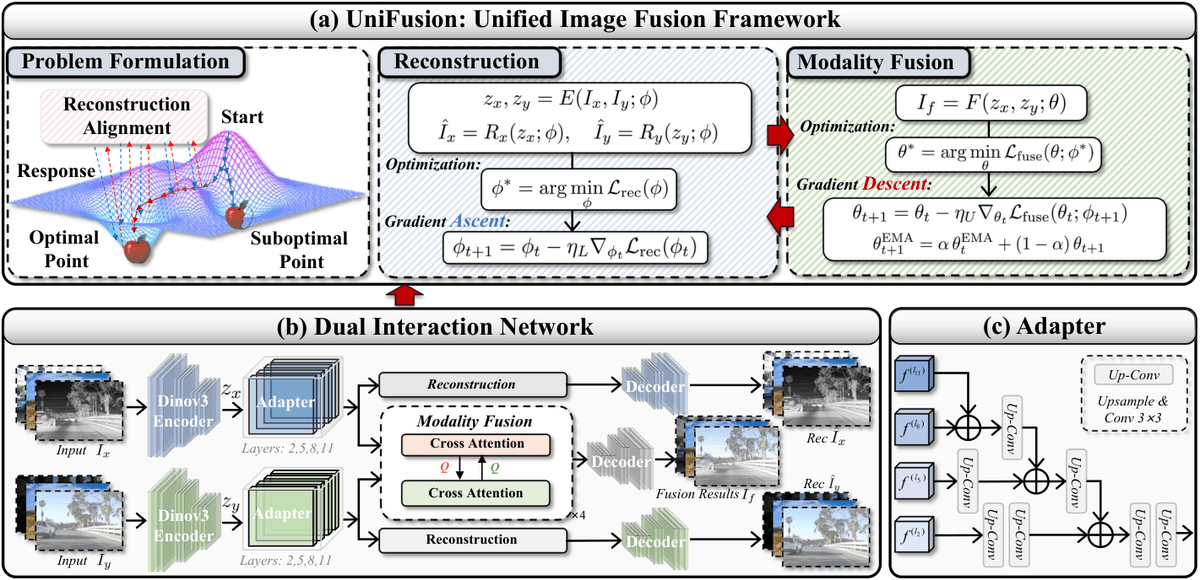
A new paper called UniFusion proposes a single architecture that handles all four of the main fusion tasks: infrared and visible (IVIF), medical (MIF), multi-exposure (MEF), and multi-focus (MFF). It leans on a frozen DINOv3 backbone for feature extraction, adds a self-reconstruction pathway to stop source detail from leaking away in deep layers, and trains everything through a bilevel optimization scheme. Code is on GitHub.
Why task-specific fusion keeps breaking
Most fusion methods are designed for specific fusion scenarios, and use customized designs with CNNs, autoencoders, or GANs to extract features. That specialization hurts twice. First, a network tuned for infrared-visible pairs cannot be dropped into a PET-MRI workflow without retraining. Second, and more subtly, existing general fusion systems are constrained by the lack of a modality-consistent feature extraction mechanism and by information degradation during deep feature propagation.
In plain terms: the deeper you push heterogeneous inputs through a shared encoder, the more the distinctive cues (thermal contrast from infrared, soft-tissue texture from MRI, sharp edges from a focused region) get blurred into a common blob. The fused output ends up looking generic.
Three pieces stitched together
UniFusion attacks the problem from three angles at once:
- DINOv3 as a universal encoder. Two frozen DINOv3 backbones extract semantically rich features from each modality, while lightweight adapters modulate domain-specific characteristics and reduce distributional discrepancies. DINOv3 is Meta's self-supervised Vision Transformer, and its object-centric priors happen to generalize surprisingly well across image types it was never explicitly trained on.
- Reconstruction-alignment. Each adapter is paired with a reconstruction branch that decodes its adapted embedding back to the original input and is supervised independently. If a feature map can still reconstruct the source, it hasn't lost the source's fingerprint.
- Bilevel optimization. Reconstruction and fusion pull in different directions, so the authors solve them as nested problems. An inner loop rapidly updates reconstruction-oriented representations to capture modality-specific semantics, while an outer loop gradually adjusts the fusion strategy based on the evolving feature space.
In practice they avoid the full nested-gradient horror show with a first-order alternating update, where the inner (reconstruction) parameters get a larger learning rate than the outer (fusion) parameters, and an exponential moving average smooths the outer updates.
Numbers that actually move
The team benchmarked against ten recent fusion methods including CDDFuse, SwinFusion, U2Fusion, and TC-MoA across M3FD, TNO, RoadScene, MEFB, MFIF, and the Harvard medical dataset. On infrared-visible fusion at M3FD, UniFusion pushes Mutual Information from TC-MoA's 3.466 to 4.268, a jump much larger than the usual fractional gains you see in this literature. VIF, Q_abf, and Q_y all move in the same direction.

Multi-exposure fusion on MEFB shows similar behavior: MI climbs from 4.889 to 6.861, and PSNR from 59.152 to 59.219. Multi-focus results on MFIF are competitive without any task-specific fine-tuning, which is the real test of whether the unified framing works.

What the ablations actually tell you
The ablation table is where the design choices earn their keep. Removing each component and rerunning training across three datasets gives a clean picture of contribution:
| Variant | M3FD MI | MEFB VIF | MFIF Q_abf |
|---|---|---|---|
| Full model | 4.268 | 1.484 | 0.685 |
| No adapter | 3.646 | 1.232 | 0.532 |
| No DINOv3 encoder | 3.681 | 1.334 | 0.491 |
| No reconstruction | 3.846 | 1.396 | 0.579 |
| No bilevel optimization | 3.924 | 1.424 | 0.583 |
Swapping DINOv3 for a vanilla four-layer transformer hurts most on semantic-heavy metrics, which fits the intuition that the pretraining is doing real work. Dropping the reconstruction branch causes features to lose modality-specific cues, visible in the encoder feature maps the authors publish.
Where it fits, and where it doesn't
UniFusion is useful if you are building a perception stack that has to handle multiple sensor combinations without maintaining a zoo of specialist models. Downstream tasks the paper flags include object detection, medical diagnosis, autonomous navigation, and low-light surveillance. The reconstruction-alignment idea is also portable: if you're building any encoder that needs to hold onto source-specific structure, forcing it to reconstruct is cheap regularization.
The caveats are worth naming. Two frozen DINOv3 backbones plus adapters and reconstruction heads is not lightweight, and training was done on an RTX 5090 with 128x128 patches and 10,000 iterations per task. It is not a real-time model out of the box, and the paper does not report latency numbers. The fusion loss is inherited directly from SwinFusion, so any pathologies of that formulation carry over. And while cross-task generalization is the headline, each task still gets its own training run rather than a single set of weights serving all four scenarios.