
UNIFIER Stops AI from Forgetting How to See Across Shifting Environments
A new benchmark and continual learning framework tackles visual forgetting when multimodal models jump between drone, underwater, and indoor scenes.
 Pro
Takeaways
- New paper introduces UNIFIER, a continual learning framework for multimodal LLMs facing scenario shifts.
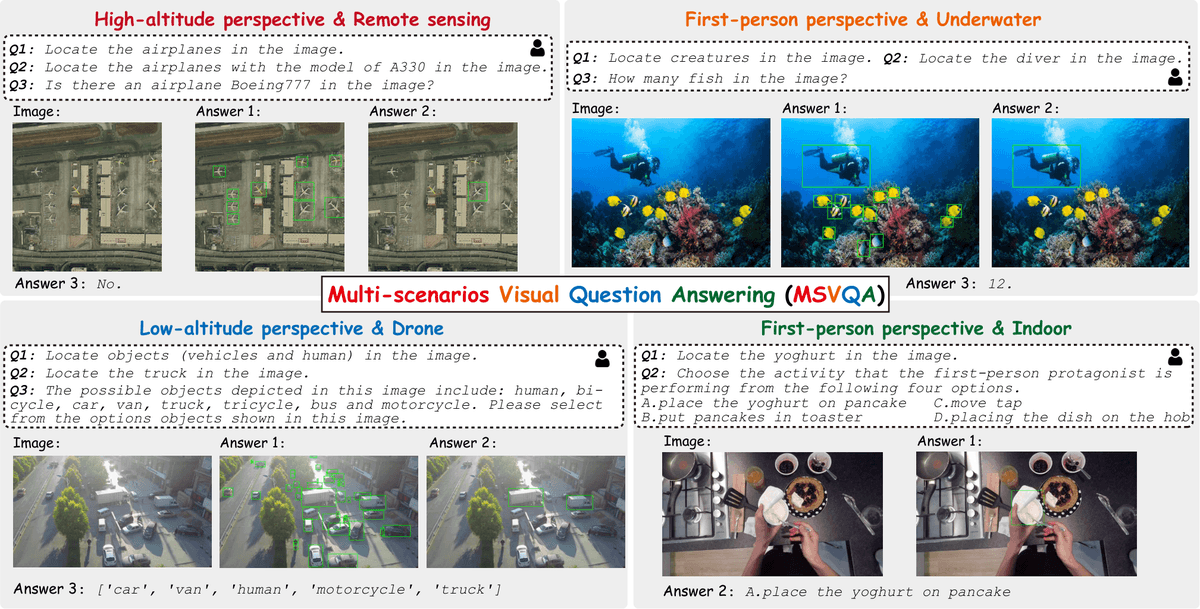
- The MSVQA dataset covers four domains: high-altitude, underwater, low-altitude drone, and indoor egocentric views.
- Beats prior state-of-the-art QUAD by up to 10.62% VQA and 7.69% F1 in 20-step tasks.
- Vision Representation Expansion adds per-scenario branches in the vision encoder without changing inference cost.
- Vision Consistency Constraint uses soft KL alignment instead of strict L2 to preserve model plasticity.
- Parameter overhead is roughly 6.4% for Qwen2.5VL-3B after four scenarios; paper on arXiv.
Deploying a multimodal language model on a device that moves between environments (a drone flying over an airport one minute, a camera scanning an underwater scene the next) exposes a stubborn problem: the model keeps forgetting how to see. A team from Northwestern Polytechnical University, HKU, and TeleAI has released a paper that quantifies this visual forgetting and proposes a framework called UNIFIER to fix it, alongside a new benchmark dataset called MSVQA hosted on Hugging Face.
The forgetting nobody was measuring
Continual learning research on multimodal LLMs has focused heavily on the text side. Existing VQA datasets are constructed under fixed scenarios and similar perspectives, where the questions are simple, such as querying the color or quantity of an object, so the hard part becomes parsing user intent from language. That framing misses what actually breaks on-device models in production.
Images captured by real-world devices typically contain a large number of objects, task-relevant vision information occupies only a small region within the complex backgrounds, and visual tasks usually involve complex requirements, such as identifying the coordinates or categories of a particular target. When the scenery flips (say from a high-altitude satellite view to a first-person indoor kitchen), the visual features the model learned for the previous domain get overwritten. The result is severe false positives and missed detections on scenes the model used to handle.

MSVQA: a benchmark built for scenario shift
To make this measurable, the authors built MSVQA, a multi-scenario visual QA dataset covering four visually distinct domains:
- High altitude - remote sensing imagery sourced from the FAIR1M optical remote sensing benchmark, cropped so airplanes appear intact in slices.
- Underwater - marine creatures with light attenuation, scattering, and camouflage coloring.
- Low altitude - drone footage of vehicles and pedestrians, with heavy occlusion.
- Indoor - egocentric first-person frames from EPIC-Kitchens with lens distortion.
Each scenario mixes easy tasks (counting up to 80 objects, classification, yes/no) with harder ones like visual grounding, where the model must emit bounding box coordinates, and fine-grained grounding, where it must locate a specific subclass. Evaluation combines VQA score with an F1 score computed at IoU=0.5 for the detection outputs.
How UNIFIER works
The naive fix for catastrophic forgetting in a fine-tuned model is to give each new scenario its own LoRA adapter. That works for isolation but breaks down at inference: you have to route to the correct branch, and a router itself catastrophically forgets when you cannot store old data. UNIFIER sidesteps routing entirely with two components.
Vision Representation Expansion (VRE) inserts a Cross-Scenario Representation (CSR) module in parallel with each FFN layer of the vision encoder. The CSR contains one down-projection/up-projection branch per scenario (only the current one is trainable, the rest are frozen), plus a shared projector that fuses all branch outputs into a single unified representation. The text decoder still sees one set of visual tokens, so there is no routing decision and no repeated inference.

Vision Consistency Constraint (VCC) handles the drift problem. Instead of strictly matching intermediate features across the old and new model (which the authors show kills the model's ability to learn new scenes), VCC computes a scenario prototype as the mean of all branch outputs, then uses a softer KL-divergence constraint on mean vectors along feature and embedding channels. This penalizes global representation changes while still allowing local reorganization.
The numbers
Experiments use Qwen2.5VL-3B as the base model, trained on 8 NVIDIA H200 GPUs with AdamW and a learning rate of 1e-5. Splits of 5, 10, and 20 sequential tasks were tested, with each task containing images from only one scenario.
Compared against the previous state-of-the-art QUAD (a question-only replay method), in the 20-step setting UNIFIER improved last-step VQA scores by 10.62% on high altitude and 3.79% on underwater, and last-step F1 scores by 7.69% on underwater, 3.40% on low altitude, and 3.00% on indoor. In the 5-step setting the gaps are smaller but still consistent, roughly 1.3 to 6.5 points across scenarios.
The ablation is arguably more informative than the headline numbers. Removing VRE collapses the model to near-zero last-step F1 on some scenarios. Swapping VCC's KL divergence for a strict L2 distance costs several points. Removing the projector but keeping branches degrades performance too, confirming that both parameter isolation and soft alignment matter.
What it costs
Because MLLMs spend most inference time in the autoregressive text decoder rather than the vision encoder, adding branches to the vision encoder is nearly free at inference. After adding four scene branches, the Qwen2.5VL-3B model only increased by 6.4% in parameters, the Qwen2.5VL-7B model only increased by 2.8%, and the Qwen3VL-4B model only increased by 2.2%. Time-per-output-token was essentially unchanged; only time-to-first-token grew by around 10-20 ms.
Where it fits and where it does not
This work is aimed at a specific deployment pattern: an MLLM running on a device that operates in a handful of visually distinct environments and needs to keep improving in each one over time without a full retraining pipeline. The framework scales roughly linearly in parameters with the number of scenarios, so it is not a fit for open-ended continual learning across hundreds of unknown domains. It also does not address text-side forgetting, which QUAD and similar replay approaches handle better.
The main practical takeaway is that visual forgetting in MLLMs is a distinct problem from text forgetting, and it responds well to lightweight per-scenario branches in the vision encoder combined with a soft consistency loss. The MSVQA dataset is open on Hugging Face for anyone who wants to test their own continual learning method against these four scenarios.