
UNC Chapel Hill's VisionCoach Teaches Video AI to Actually Look Before Answering
A new UNC framework uses visual prompts as a training-time coach so video models learn to look at the right pixels, then drops the crutches at inference.
 Pro
Takeaways
- UNC's VisionCoach uses visual prompts during RL training only, then self-distills the behavior away for tool-free inference.
- A selector flags roughly 58% of samples as hard and chooses among attention overlays, red circles, or darkened backgrounds.
- Object identity consistency and multi-region bounding-box IoU rewards force the model to justify answers with actual visual evidence.
- Reports SOTA on V-STAR, VideoMME, World-Sense, VideoMMMU, PerceptionTest, and Charades-STA under comparable settings.
- 7B checkpoint available on Hugging Face; training code on GitHub with selector training still TODO.
- Accepted to ECCV 2026; built on Qwen-style VLM backbone with GRPO for RL optimization.
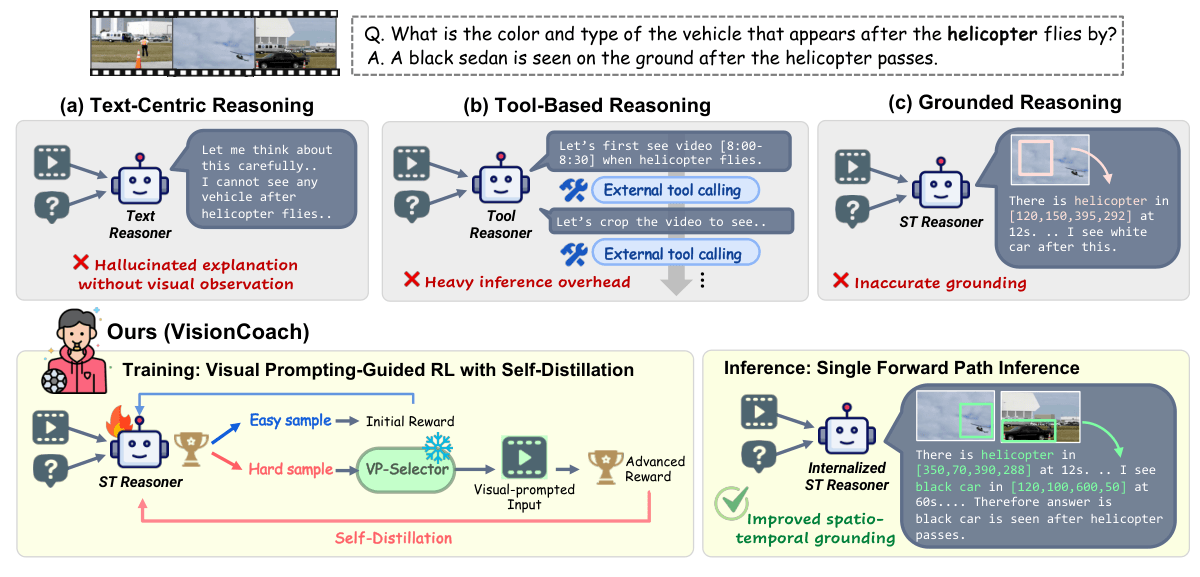
Video question-answering models have a habit of getting the right answer for the wrong reason. They latch onto language priors, guess based on plausibility, and skip the actual visual evidence. A new framework from UNC Chapel Hill called VisionCoach tries to break that habit by acting like a coach during training: it highlights the important pixels for the model, teaches it to attend there, and then removes the highlights so the model has to do it on its own at inference.
The grounding problem nobody solved with RL alone
Video reasoning requires models to locate and track question-relevant evidence across frames. While reinforcement learning with verifiable rewards improves accuracy, it still struggles to achieve reliable spatio-temporal grounding during the reasoning process. In other words, a model can score well on a benchmark while still pointing to the wrong frame or the wrong region when asked to justify itself.
The authors quantify this gap on PerceptionTest. Correct answers align with the right temporal window only 77% of the time, name the correct object 40% of the time, and produce a usable bounding box just 30% of the time. Wrong answers show similarly weak grounding, which suggests the model is often guessing rather than looking.

The usual fixes are expensive. Either you scale up annotated data with bounding boxes and temporal spans, or you bolt on inference-time perception tools like external detectors and trackers. Both increase annotation cost or computational cost. VisionCoach argues there is a cheaper path: use visual prompts only during training, and distill the behavior into the base model.
How the coaching loop works
The system has two parts. A Visual Prompt Selector predicts appropriate prompt types conditioned on the video and question, and a Spatio-Temporal Reasoner is optimized with RL under visual prompt guidance and object-aware grounding rewards that enforce object identity consistency and multi-region bounding-box IoU.
The selector is the interesting piece. It first decides whether a sample is easy or hard. Roughly 58% of training samples get flagged as hard, and only those receive visual prompts. For the hard ones, the selector picks among three prompt styles:
- Attention overlay - a heatmap that biases the model toward relevant regions
- Red circle - a classic visual cue drawn around the target object
- Darker background - dimming everything outside the region of interest to suppress distractors
Applying these prompts on hard samples produced reward gains between 56% and 66% depending on prompt type, which is how the authors argue that adaptive prompting is doing real work rather than just easing the task.

The rewards that force honest reasoning
RL is only as good as its reward. VisionCoach uses GRPO and layers on two grounding-specific signals beyond the standard answer-correctness reward:
- Object identity consistency - the model has to name and track the same object across the frames it cites, not swap identities mid-reasoning
- Multi-region bounding-box IoU - predicted boxes have to overlap ground-truth boxes across multiple regions, not just hit one lucky frame
These rewards are what make the coach useful. Without them, the model could ignore the visual prompt and still get answer-level credit. With them, correct grounding is directly incentivized.
Self-distillation removes the training wheels
The clever move is that the visual prompts never appear at inference. The model internalizes these improvements through self-distillation, enabling grounded reasoning directly on raw videos without visual prompting at inference. Effectively, the coached policy teaches the uncoached policy how to attend, so the deployed model sees only raw video frames and still produces better temporal and spatial attention.

Results across six benchmarks
The team reports state-of-the-art performance across V-STAR, VideoMME, World-Sense, VideoMMMU, PerceptionTest, and Charades-STA, while maintaining a single efficient inference pathway without external tools. The benchmark spread matters: V-STAR and Charades-STA test spatio-temporal grounding directly, while VideoMME and VideoMMMU are broader reasoning suites. Winning on both suggests the grounding gains do not come at the cost of general video understanding.
The efficiency angle is worth flagging. Tool-calling video agents that stitch together detectors, trackers, and captioners tend to be slow. VisionCoach keeps a single forward pass at inference and, according to the authors, outperforms both text-centric and tool-calling baselines at lower latency.
What to actually do with it
The code and a 7B checkpoint are public. You can grab the VisionCoach-7B model from Hugging Face or clone the repository to reproduce training. Two caveats are worth knowing before you commit. First, the VP-Selector training code and visual prompt generation code are still listed as TODO in the repo, so the training pipeline is not fully reproducible yet. Second, the dataset stack is inherited from Open-o3-Video and spans multiple video corpora, so setting up the data is non-trivial.
Reasonable use cases are the ones where you already care about explainable answers over videos: content moderation, sports analytics, robotics evaluation, and any pipeline where a wrong answer with a confident-looking bounding box is worse than an honest miss. If you have been considering wiring an external detector into a VLM to fix grounding, this is the argument for spending that effort on training rewards instead.