
UNC Chapel Hill's ULFS-KDPE Beats TMLE Without Deriving Influence Functions
ULFS-KDPE achieves semiparametric efficiency for any causal parameter simultaneously, without ever deriving or evaluating an influence function
 Pro
Takeaways
- ULFS-KDPE achieves semiparametric efficiency for any causal parameter simultaneously, with no influence function derivation required.
- The method constructs a kernel-restricted universal least favorable flow — a nonlinear ODE on densities — that monotonically increases the empirical log-likelihood until bias vanishes.
- Each iteration reduces to matrix-vector products on the n×n centered Gram matrix; the full algorithm is in the paper's appendix.
- In simulations with n=300, ULFS-KDPE beats TMLE on RMSE for ATE, RR, and OR, with the gap widening substantially under positivity violations.
- A single run simultaneously debiases multiple target parameters; TMLE requires a separate targeting step per estimand.
- No public code is available yet; the method currently scales as O(n²) in memory, limiting it to moderate sample sizes.
Getting the most statistically efficient estimate of a causal quantity , say, the average treatment effect or the odds ratio , typically demands that you first derive the efficient influence function (EIF) for that specific quantity. The EIF is a mathematical object that encodes exactly how sensitive your target parameter is to small perturbations of the underlying data distribution; it provides both a characterization of the semiparametric efficiency bound and a constructive framework for building estimators that achieve optimal statistical efficiency in models where the data-generating law is only partially specified. Deriving it is often analytically demanding, and it must be done separately for every new target. A new paper from UNC Chapel Hill proposes a way to skip that derivation entirely.
The problem with the current toolkit
The dominant workhorse for efficient causal estimation is Targeted Maximum Likelihood Estimation (TMLE). TMLE is a general template for de-biasing estimators through an updating procedure called "targeting," which recognizes that the bias incurred is proportional to how well an estimating equation based on the EIF is solved. In practice, TMLE proceeds by obtaining initial data-adaptive estimates of the relevant components of the data-generating distribution, then "targeting" these estimates to solve the EIF estimating equation for the estimand. The catch: you need the EIF in closed form before you can do any of this, and that derivation is specific to each parameter you care about.
A more recent approach called Kernel Debiased Plug-in Estimation (KDPE) sidesteps EIF derivation by embedding the debiasing problem in a reproducing kernel Hilbert space (RKHS) , a function space defined by a kernel function, where inner products correspond to expectations. KDPE constructs data-adaptive fluctuations that approximately solve empirical score equations without explicit EIF expressions. But KDPE still relies on locally defined updates: each step is only optimal at the current distribution, not globally along the entire path.
What is a universal least favorable submodel?
To understand the new method, it helps to understand the concept of a least favorable submodel. When TMLE "targets" an estimator, it moves the estimated distribution along a one-dimensional path whose score at the starting point equals the EIF. This is a locally least favorable submodel (LLFS) , it is optimal only infinitesimally at the current distribution.
A universal least favorable submodel (ULFS) goes further: it defines a distributional path whose score coincides with the EIF at every point along the path, not just at the origin. Geometrically, this path always moves in the direction of maximal change in the target parameter per unit of statistical information. Targeting along a ULFS can therefore solve the EIF estimating equation in a single step, with minimal unnecessary likelihood fluctuation. The downside of existing ULFS methods: you still need to know the EIF explicitly.
ULFS-KDPE: the best of both worlds
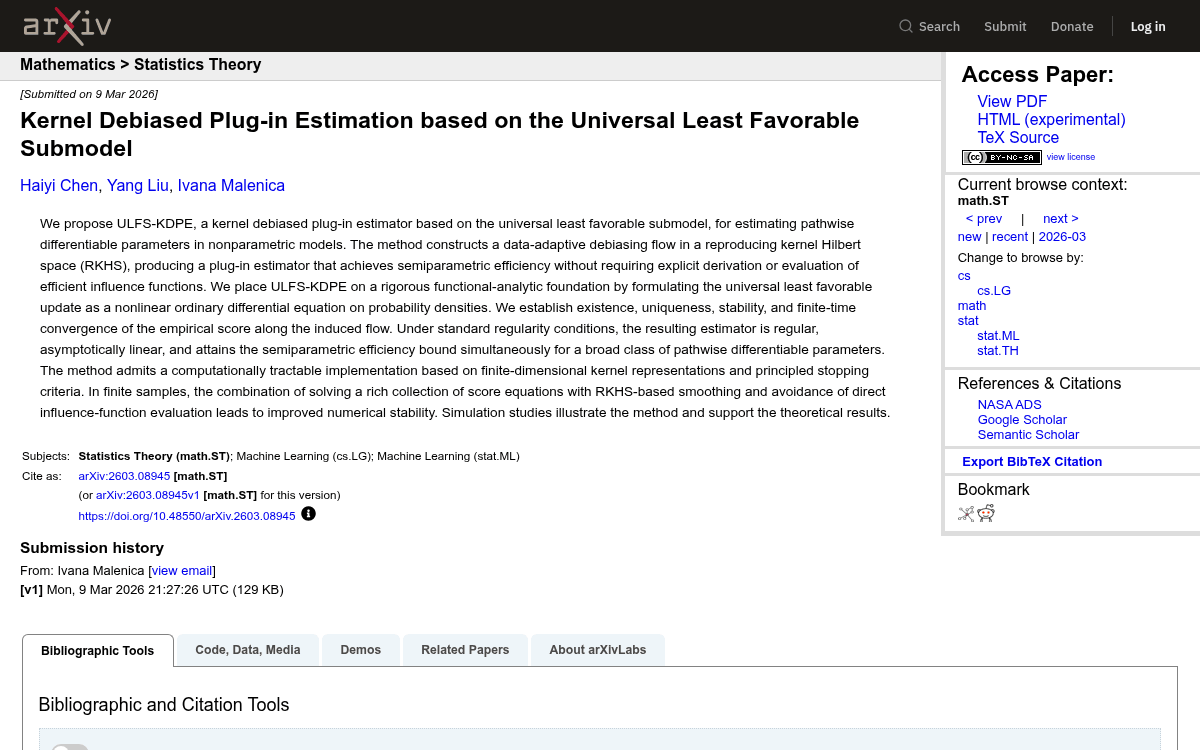
The paper introduces ULFS-KDPE (Universal Least Favorable Submodel Kernel Debiased Plug-in Estimator), which combines global optimality from ULFS with the EIF-free computation of KDPE. The core idea is to construct a kernel-restricted surrogate of the universal least favorable path , defined as the solution to a nonlinear ordinary differential equation (ODE) on probability densities , whose velocity field is given by an RKHS-valued Riesz representer of empirical moment deviations.
In plain terms: instead of asking "what is the EIF for this parameter?", the method asks "what direction in RKHS space most reduces the empirical bias across all possible score equations simultaneously?" That direction is computed purely from kernel evaluations at the observed data points, with no analytical derivation required.
How it works, step by step
The algorithm starts from an initial density estimate (e.g., from a Super Learner ensemble) and iteratively refines it:
- Center the kernel. At each iteration, project the base kernel onto the mean-zero subspace with respect to the current distribution. This ensures the update direction has zero mean under the current density, preserving normalization.
- Compute the empirical mean embedding. Form the vector
αof coefficients by averaging the centered kernel evaluated at each pair of observed data points. This is a simple matrix-vector product:α = (1/n) G · 1, whereGis the centered Gram matrix. - Form the update direction. The direction
D(p_t)is a weighted sum of centered kernel sections,D = (1/n) Σ α_j k_{O_j}. This is a kernel natural gradient , the steepest descent direction in the empirical moment geometry. - Apply an exponential tilt. Update the density via
p_{t+Δ}(o) = p_t(o) · exp(Δ · D(p_t)(o)), then renormalize. This multiplicative form preserves positivity. - Check stopping criteria. Five principled stopping rules are available, all tied to the geometry of the flow: density plateau, score plateau, vanishing RKHS update direction, variance-dominated updates, and (optionally) EIF approximately solved.
Each iteration reduces to matrix-vector operations on the n × n Gram matrix , no influence function evaluation, no parameter-specific derivation.
The theoretical foundation
The authors place ULFS-KDPE on a rigorous functional-analytic foundation by formulating the universal least favorable update as a nonlinear ODE on probability densities in Hölder spaces. They prove:
- Existence and uniqueness of the ODE solution on a finite interval
[0, T], using the Picard-Lindelöf theorem in Banach spaces. - Positivity and normalization preservation along the entire flow , the density never goes negative and always integrates to one.
- Monotone increase of the empirical log-likelihood along the flow, with a clean Lyapunov structure: the derivative equals the sum of squared coefficients, which is always non-negative.
- Finite-time convergence: the empirical RKHS score reaches any target tolerance
δ_nwithin a provably finite timeT. - Asymptotic linearity and semiparametric efficiency: under standard regularity conditions, the resulting plug-in estimator is regular, asymptotically linear, and attains the semiparametric efficiency bound simultaneously for all pathwise differentiable parameters whose canonical gradients lie in the closure of the RKHS.
The key technical insight for efficiency is elegant: when the empirical score P_n D(p_t) ≤ δ_n = o(n⁻²), the RKHS norm of the empirical mean embedding satisfies ‖m_n‖ ≤ δ_n^{1/4} = o(n^{-1/2}). This means the plug-in bias term in the von Mises expansion is negligible, and the estimator inherits the efficiency of the EIF-based approach , without ever computing the EIF.
What the simulations show
Simulations use 500 Monte Carlo replications at sample size n = 300, with a Gaussian kernel, step size Δ = 0.01, and nuisance estimation via Super Learner (GLM, random forests, XGBoost). Two data-generating processes are studied: a standard observational study with binary outcome (DGP1) and a positivity-violated setting where propensity scores approach 0 or 1 (DGP2). Three target parameters are estimated: average treatment effect (ATE), risk ratio (RR), and odds ratio (OR).
Key findings:
- In DGP1, ULFS-KDPE achieves smaller RMSE than TMLE and one-step TMLE across all three parameters, despite TMLE requiring separate targeting steps per parameter.
- In DGP2 (positivity violations), ULFS-KDPE outperforms TMLE and one-step TMLE substantially on RR and OR, exhibiting markedly lower variance , the RKHS smoothing stabilizes the flow where EIF-based methods suffer from variance inflation.
- A single ULFS-KDPE distribution simultaneously debiases all three parameters; TMLE must be re-run for each.
- ULFS-KDPE converges within the iteration limit in all 500 simulations when the limit is set to 150, compared to substantially more failures for iterative KDPE.
- The density stabilization stopping criterion is the most reliable across all settings.
The real breakthrough
The headline result is not just that ULFS-KDPE matches TMLE's efficiency , it's that it does so simultaneously for every pathwise differentiable parameter whose EIF lies in the RKHS closure, without modifying the algorithm or specifying any parameter-specific information. This is a qualitative shift: instead of a separate estimation pipeline per estimand, a single distributional flow produces efficient estimates of the ATE, RR, OR, and any other smooth functional at once.
This matters especially in settings where researchers want to report multiple effect measures (as is common in epidemiology and clinical trials), or where the EIF is analytically intractable. The method is also more numerically stable than iterative TMLE in low-overlap regimes, because the global least favorability of the ULFS path avoids the overshooting behavior that can destabilize locally-targeted updates.
Limitations and what's next
The current implementation scales as O(n²) in memory and O(n³) per iteration due to the Gram matrix, which limits applicability to moderate sample sizes. The authors flag random feature approximations and low-rank kernel methods as promising directions for scaling. The theory also currently requires fixed dimension d (not growing with n), and the stopping criteria, while principled, lack formal guarantees on their impact on asymptotic linearity. No code repository is publicly available at the time of writing, though the algorithm is fully specified in the paper's appendix.