
UNBOX Cracks Open Black-Box Vision AI Using Only Output Probabilities
UNBOX audits black-box vision classifiers using only output probabilities, LLMs, and diffusion models — no weights, gradients, or training data required
 Pro
Takeaways
- UNBOX audits black-box vision classifiers using only output probabilities — no weights, gradients, or training data needed.
- It reformulates activation maximization as an LLM-driven text optimization loop, using a diffusion model to generate probe images.
- On semantic fidelity benchmarks, UNBOX scores 0.64 (ResNet50) and 0.49 (ViT), outperforming several white-box methods that require full model access.
- On bias discovery, it achieves 88.6% worst-group accuracy on Waterbirds and 90.01% on CelebA — matching Oracle DRO which uses ground-truth group labels.
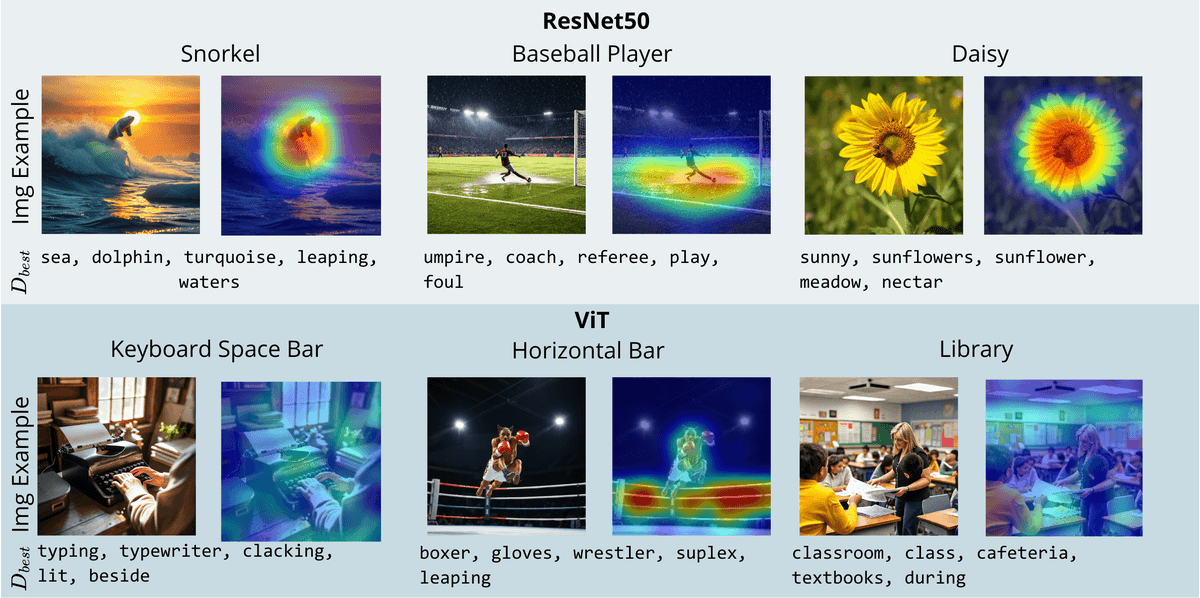
- The method naturally surfaces spurious correlations: e.g., ResNet50's snorkel class fires on water/marine animals, not the snorkel itself.
- Key limitation: ~15 seconds per optimization step on two H100 GPUs; struggles with low-level texture-based features that resist linguistic description.
Every time you call a commercial vision API, the model returns a confidence score and nothing else. No gradients, no activations, no architecture details. For years, that opacity has made meaningful auditing nearly impossible. You couldn't tell whether a classifier learned the right features or latched onto a spurious shortcut. You couldn't detect bias, diagnose failures, or understand what the model actually "thinks" a tiger looks like. A new paper from researchers at the University of Catania and the Technical University of Munich introduces UNBOX, a framework that cracks open black-box vision classifiers using only their output probabilities.
The core idea is deceptively simple: if you can't backpropagate through a model, turn the optimization problem into a conversation. UNBOX uses an LLM-driven loop to iteratively refine natural-language descriptions of a target class, generates images from those descriptions using a diffusion model, feeds those images to the black-box classifier, and uses the resulting probability score as the only feedback signal. No weights. No gradients. No training data.
Why this problem is harder than it sounds
The standard toolkit for model interpretability , GradCAM, SHAP, LIME, CLIPDissect, DEXTER , all assume some level of internal access. Modern vision systems are increasingly deployed as proprietary black-box APIs, exposing only output probabilities and hiding architecture, parameters, gradients, and training data. This opacity prevents meaningful auditing, bias detection, and failure analysis. Existing explanation methods assume white- or gray-box access or knowledge of the training distribution, making them unusable in these real-world settings.
This isn't a niche edge case. It's the default deployment mode for most production vision systems today. In 2026, explainability is better understood as a control architecture for enterprise AI systems , one that spans model behavior, internal mechanisms, user trust, provenance, and end-to-end auditability. Regulators are catching up too: the black-box defense is explicitly losing credibility with regulators. The FDA requires interpretability for AI/ML Software as a Medical Device.
The technical challenge is that classic activation maximization , the technique of finding inputs that maximally fire a given neuron , requires backpropagating gradients through the model. Without access to internals, you're left with a single scalar per query: the model's confidence that your generated image belongs to the target class. Turning that into a useful optimization signal is the core problem UNBOX solves.
How the optimization loop works
UNBOX reformulates activation maximization as a semantic search problem. Instead of optimizing pixels or latent vectors, it optimizes natural-language text prompts. Here's the pipeline at a high level:
- Start with a generic prompt like
"a picture of a random object" - Generate an image from that prompt using FLUX.1-schnell (one diffusion step)
- Pass the image to the black-box classifier and record the target-class probability
s_t - Compute two signals from the score history: trend (is the score going up or down?) and intensity (how far are we from a high-confidence activation?)
- Map those signals to natural-language instructions via lookup tables
- Feed the instructions to a Feedback Agent (LLM) that critiques the current prompt
- Feed the critique to an Updater Agent (LLM) that produces the next prompt
- Repeat until convergence or a 1000-step budget is exhausted

The trend and intensity signals act like a surrogate learning rate. A strong negative trend with high intensity tells the agents to make bold, exploratory changes , switch the scene, try a different subject. A flat trend with low intensity means the prompt is close; apply micro-adjustments. This is the key insight: UNBOX addresses this by interpreting the temporal evolution of the score through two continuous quantities, trend and intensity, which summarize the direction and magnitude of progress, respectively.
To prevent the optimization from oscillating or forgetting useful discoveries, UNBOX maintains two memory structures. The Global Optimization Context accumulates all prompts that exceed a high-confidence threshold, plus the individual words extracted from those prompts that independently score well. The Local Optimization Context stores the last 10 prompt-feedback pairs to prevent the agents from re-introducing recently rejected ideas. Together, they give the LLM agents both long-range semantic memory and short-range trajectory awareness.

What it finds , and what it exposes
The most practically valuable output of UNBOX isn't just a label , it's a ranked list of lexical concepts that maximally activate a target class. For a dog sled class, the method might surface huskies, snow, sled, and winter clothing as the top activating concepts. But it also surfaces the unintended ones. For ResNet50's snorkel class, UNBOX reveals that the classifier fires primarily on water and marine animals rather than the snorkel itself. For ViT's space bar class, the model responds to generic typing scenarios regardless of whether the key is actually visible.
This is spurious feature attribution , the model has learned a shortcut, and UNBOX catches it without ever seeing the training data. That's the real breakthrough: you can now audit a model you don't own, running on infrastructure you can't inspect, for biases you didn't know existed.
Benchmarks: competitive with white-box methods
The team evaluated UNBOX on three tasks across ImageNet-1K, Waterbirds, and CelebA, comparing against CLIPDissect and WWW (both white-box, requiring weights + data) and DEXTER (grey-box, requiring weights only).
On semantic class fidelity , how well the recovered descriptors match ground-truth class labels , UNBOX achieves high semantic fidelity across all architectures despite operating under the strictest constraints. On ResNet50, UNBOX reaches a score of 0.64, exceeding WWW while remaining competitive with CLIPDissect, which however requires access to data and model weights. On ViT-B/16, UNBOX scores 0.49, the highest of any method tested.
The bias discovery results are particularly striking. On Waterbirds, UNBOX achieves 88.6 worst-group accuracy, performing competitively with white-box and data-dependent slice discovery methods, despite using only output probabilities. On CelebA, UNBOX attains 90.01 worst-group accuracy, matching Oracle DRO. To put that in context, Oracle DRO has access to ground-truth group labels , UNBOX has none of that.
| Method | Weights | Data | RN50 Fidelity | ViT Fidelity | Waterbirds Worst-Group |
|---|---|---|---|---|---|
| CLIPDissect | Yes | Yes | 0.77 | 0.27 | , |
| WWW | Yes | Yes | 0.60 | 0.40 | , |
| DEXTER | Yes | No | 0.47 | 0.34 | 90.5 |
| UNBOX | No | No | 0.64 | 0.49 | 88.6 |
Where it struggles
UNBOX has real limitations worth knowing before you reach for it:
- Low-level features are invisible to it. When a classifier relies on fine-grained textures, subtle color gradients, or local shape primitives, the probability signal responds weakly to any text-based refinement. The
howler monkeyclass in ImageNet is a documented failure case , the classifier fires on dense foliage textures that are nearly impossible to express in language. - It's expensive. Each optimization step requires two LLM forward passes and one diffusion model render. On two H100 GPUs, that's roughly 15 seconds per step. A full class dissection at 1000 steps costs around 4 GPU-hours.
- It's architecture-agnostic by design, but not free. The method works on any classifier that returns probabilities, but the compute cost scales with the number of classes you want to dissect.
Practical use-cases
UNBOX is most useful in three scenarios:
- Third-party API auditing. If you're using a commercial vision model and need to understand or document its behavior for compliance purposes, UNBOX gives you a systematic way to probe it without any special access.
- Bias and fairness testing. The slice-discovery capability , finding subgroups where a model systematically fails , works without labeled group annotations. This is directly applicable to models deployed in hiring, healthcare, or content moderation.
- Distribution shift diagnosis. When a deployed model starts degrading in production, UNBOX can help identify whether the model is relying on features that have shifted in the new data distribution.
No code repository was linked in the paper at time of publication, but the method relies on standard components: FLUX.1-schnell for image generation, GPT-class LLMs for the agent loop, and any image classifier exposed as an inference endpoint. The datasets used , ImageNet, Waterbirds, and CelebA , are all publicly available. The framework is architecture-agnostic and could in principle be applied to any classification API that returns class probabilities.
The deeper implication of UNBOX is that model opacity is no longer a complete shield. If a model can be queried, it can be dissected. That changes the calculus for anyone deploying proprietary vision systems , and for anyone trying to hold them accountable.