
UMO Unifies 6 Motion AI Tasks With Just Three Learnable Tokens
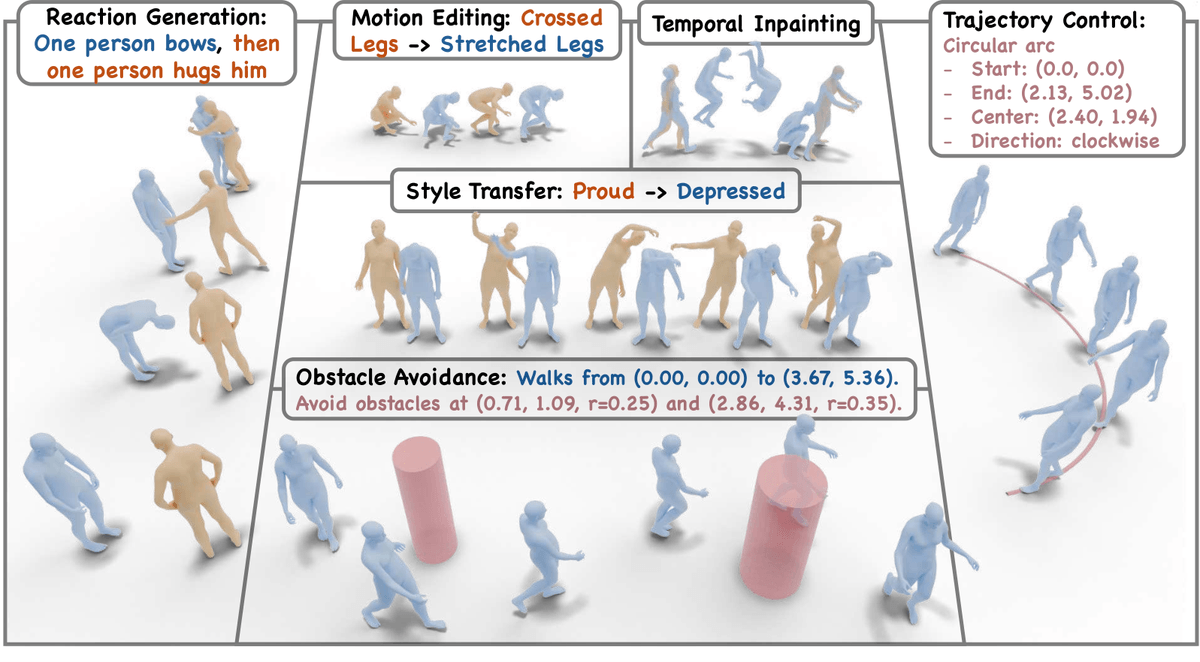
A single motion model handles inpainting, editing, trajectory control, obstacle avoidance and two-person reactions using three learnable per-frame operations.
 Pro
Takeaways
- UMO adapts a pretrained text-to-motion DiT to handle inpainting, editing, trajectory following, obstacle avoidance and reaction generation.
- Three learnable per-frame tokens (
[preserve],[generate],[edit]) express every task as a token pattern. - Temporal Fusion adds only 0.207M parameters and 0.01s latency, beating ControlNet, AdaLN and sequence concat.
- Achieves FID 9.46 on HumanML3D text-to-motion, 100% batch R@3 on MotionFix editing benchmark.
- Matches OmniControl on trajectory error while running roughly 90x faster; 95% obstacle-avoidance success rate.
- Code and model at github.com/Oliver-Cong02/UMO; paper accepted to ECCV 2026.
Text-to-motion foundation models have gotten remarkably good at turning a sentence into a 3D human animation, but they mostly do one thing. If you want to fill in missing frames, edit an existing sequence with a natural language instruction, force the character to follow a Bezier curve, or generate a second person reacting to the first, you typically need a separate task-specific model with its own architecture and training pipeline. A team from Brown, MIT, Meta Reality Lab, Max Planck, and the University of Hong Kong is proposing a simpler recipe. Their new framework, UMO (Unified in-context Motion Operations), unlocks all of these downstream tasks from a single pretrained text-to-motion diffusion transformer, using only three learnable embeddings and a lightweight fusion module.
One model, many jobs
The core problem UMO attacks is fragmentation. 3D human motion generation has progressed substantially across diverse tasks, yet the field remains splintered, with each task addressed by a specialized architecture that prevents knowledge sharing and cross-task generalization. Recent motion foundation models have scaled aggressively, but their rich priors stay locked behind a single interface focused on basic text-to-motion generation.
The authors' key observation is deceptively simple. For any target sequence, every frame stands in exactly one of three mutually exclusive relationships with the source motion context: it should be preserved as-is, generated from scratch, or edited from an existing frame. Whether a task involves temporal inpainting, text-guided editing, spatial control, or multi-identity reaction generation, the per-frame intent always reduces to one of these atomic meta-operations.
Three tokens to rule them all
UMO introduces three learnable frame-level embeddings named [preserve], [generate], and [edit], each a 201-dim vector matching the motion representation. Every frame in a target sequence gets tagged with one of these tokens, and the resulting task-aware sequence is fed into a pretrained HY-Motion DiT backbone. Different tasks become different token patterns:
- Prediction: first K frames tagged
[preserve], the rest[generate]. - In-betweening:
[preserve]at the ends,[generate]in the middle. - Keyframe infilling: sparse
[preserve]anchors, everything else generated. - Instruction-based editing: every frame tagged
[edit]with the source motion as input. - Reaction generation: one person
[preserve], the other[generate].
The language side is unified too. Semantic descriptions, editing instructions, parameterized trajectories, and obstacle-avoidance constraints are all expressed as text and encoded by the same LLM (Qwen3-8B) that HY-Motion already uses. A cubic Bezier trajectory becomes a JSON-like string like {type:cubic_bezier, params:{start:[0,0], end:[3.5,4.2], P1:..., P2:...}}. Obstacles become sentences like "A person walks from (0,0) to (3.67, 5.36). Avoiding 2 obstacles at (0.71, 1.09, r=0.25)...". No specialized spatial conditioning module needed.
Why temporal fusion beats the fancier alternatives
The remaining design question is how to inject the source motion plus meta-operation tokens into the frozen-ish DiT. The paper systematically ablates four options: temporal fusion, sequence concatenation, AdaLN, and ControlNet. Temporal Fusion, which simply adds the encoded context to the noisy input before the DiT blocks, wins on every axis.

On keyframe infilling, Temporal Fusion adds only 0.207M additional parameters while preserving full per-frame granularity, with just 0.01 seconds of extra latency. ControlNet, by comparison, adds 234M parameters and 0.49 seconds of latency for worse quality. AdaLN is fast but catastrophically fails to respect keyframe anchors because it collapses the entire source motion into a single global vector.
The numbers
UMO is trained jointly on all tasks for 100k steps on 4 B200 GPUs. Across benchmarks it beats training-free baselines and specialists trained end-to-end for a single task alike.
On text-to-motion using HumanML3D, UMO-Unified reaches FID 9.46 versus 11.79 for MotionStreamer and 12.23 for MoMask. The unified multi-task model beats its own single-task expert version, suggesting joint training provides complementary supervision rather than diluting performance.
On temporal inpainting (prediction, backcasting, in-betweening, keyframe infilling), UMO consistently sweeps FID, R-Precision, and MPJPE against CondMDI and MotionLab. For keyframe infilling specifically, FID drops from 0.117 (MotionLab) to 0.040. On instruction-based editing using the MotionFix dataset, UMO hits batch-level R@3 of 100%, versus 90.21% for the previous best specialist PartMotionEdit.

The most striking result comes from the stress tests. For trajectory following, UMO-Unified matches OmniControl's trajectory error while being roughly 90 times faster (0.759s vs 68.10s per sample). For obstacle avoidance, it hits a 95% success rate. For two-person reaction generation on InterHuman, a task with topology fundamentally absent from single-person pretraining, UMO still achieves the best FID (2.055) among all methods, including dedicated multi-person systems like InterGen and InterMask.
What this actually unlocks
The real breakthrough here goes beyond any single benchmark number. A single formulation can express radically different motion tasks without touching the backbone architecture. Adding a new task, say a new curve type or constraint format, requires only defining a new (source, token) pattern and a text prompt template. No new encoder, no new loss, no per-task fine-tuning.
The stress tests also hint at emergent capabilities in large motion foundation models. Encoding geometry entirely as language works because the LLM encoder has already internalized a latent capacity for structured geometric understanding through its pretraining on corpora rich in mathematical notation, code, and coordinate data. Single-person motion priors also transfer surprisingly well to two-person interactions, suggesting core body dynamics and temporal coherence are more universal than the training distribution would imply.
Limits and practicality
UMO has real gaps. The three meta-operations work at whole-body granularity, so part-level control (say, editing only the arms while preserving the legs) is not directly supported. The framework is language-only for now, which rules out audio-driven tasks like music-to-dance or speech-driven gesture without adding a multimodal encoder. Optimization-based methods like TLControl still edge it out on raw trajectory precision, though at orders-of-magnitude higher latency.
If you are building a motion pipeline for animation, games, VR avatars, or robotics research, this is a strong argument for consolidating around a single foundation model rather than stitching together specialists. Code and models are promised on GitHub, and the full paper includes extensive supplementary material on the geometric dataset construction and ablations. For anyone working with DiT-based generative models more broadly, the frame-level meta-operation idea is worth borrowing: it is essentially a masking scheme with learned semantics, and it could plausibly translate to video or audio generation.