
UMID Audits CLIP for Stolen Faces Without Touching a Single Biometric
A new auditing framework detects if faces or voices were memorized by CLIP and CLAP using only text queries, no biometric inputs required.
 Pro
Takeaways
- UMID audits CLIP and CLAP for memorized PII using only text queries, no biometric uploads needed.
- Method uses cross-modal latent inversion to extract similarity and variability signals per identity.
- A gibberish baseline plus ensemble anomaly detectors (Isolation Forest, LOF, One-Class SVM, AutoEncoder) makes the call.
- Sub-second per query, over 90% accuracy on ResNet-based CLIP, vs 4+ hours for shadow-model MIAs.
- Holds up under differential privacy defenses and covert gibberish input filters.
- Full paper at arxiv.org/abs/2603.14222; weaker on ViT-B/32 backbones.
Auditing whether a foundation model memorized someone's face or voice usually forces you into an uncomfortable trade-off: to check if a person's biometric data leaked into a training set, you often have to hand that same biometric data over to the model you distrust. A new paper from researchers at TeleAI, Beijing Electronic Science and Technology Institute, and Nanyang Technological University proposes a way out. Their method, called UMID (Unimodal Membership Inference Detector), audits contrastive models like CLIP and CLAP using text queries alone, with no shadow models and no biometric uploads.
The auditor's dilemma
Contrastive pretraining models are trained on web-scraped image-text or audio-text pairs, and their reliance on web-scale data raises growing concerns about memorizing Personally Identifiable Information (PII), while auditing them via membership inference is challenging in practice. Two problems make current methods impractical:
- Shadow-model MIAs (membership inference attacks) require training many proxy copies of the target model to learn its behavior. For multi-billion-parameter multimodal backbones, that is prohibitively expensive.
- Existing multimodal attacks like IDIA, WSA, and C-WSA require sending paired biometric inputs (a face image, a voice clip) into the target model to check for memorization, which itself leaks the sensitive data the audit is trying to protect.
The authors frame this as the "auditor's dilemma": a regulator auditing an open-weight model under regimes like the EU AI Act or GDPR often has weight access but is legally barred from handling raw biometric data. UMID is designed for exactly that gray-box, text-only setting.
How text-only inversion works
Given a target text (say, a person's name), UMID doesn't ask the model "do you know this face?" It instead reconstructs what the model thinks that person's face or voice should look like in latent space, and then measures how confident and stable that reconstruction is.
The pipeline runs in three logical steps:

- Randomized latent inversion. Starting from random noise, the auditor uses gradient ascent to optimize a fake modality input (a synthetic image or audio embedding) so that its embedding aligns with the queried text embedding. This is repeated across many independent runs with different random inits.
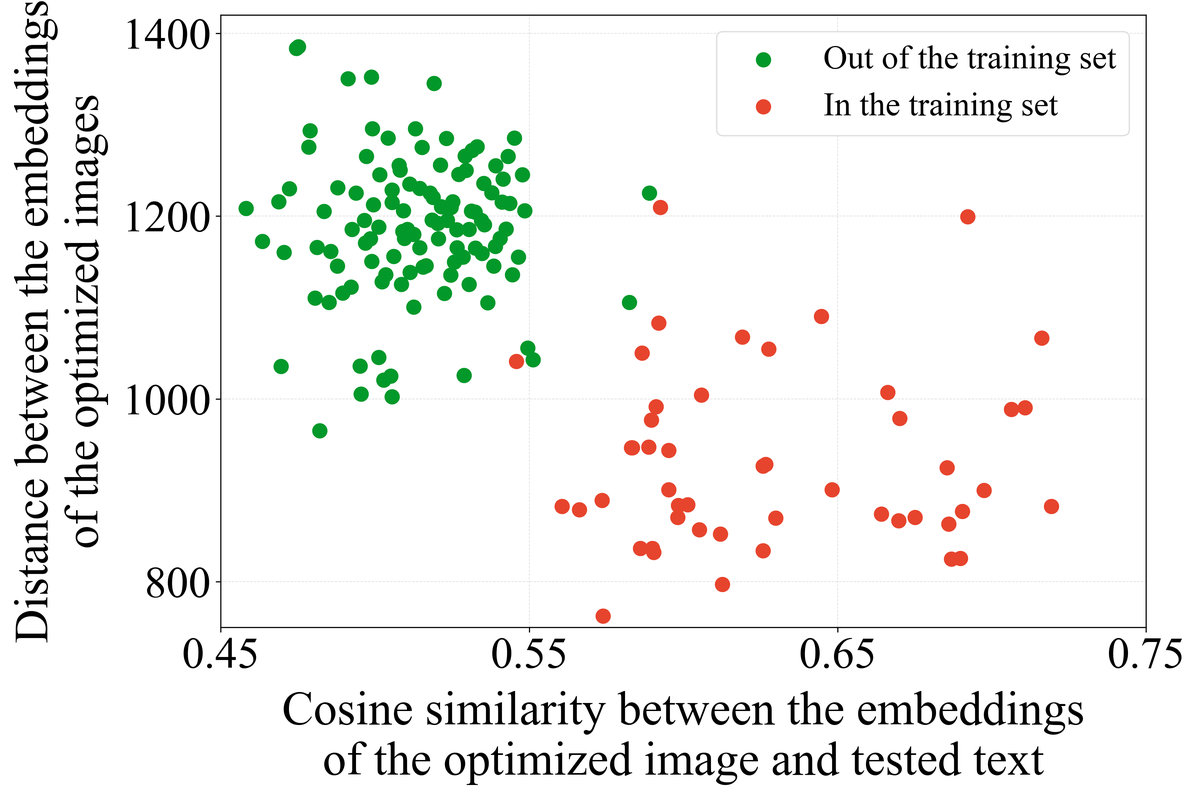
- Two feature signals. UMID extracts
similarity(average cosine alignment between optimized embedding and text embedding) andvariability(mean squared dispersion of optimized embeddings across runs). Members of the training set converge tightly to a specific latent prototype, so they show high similarity and low variability. Non-members bounce around isotropically in high-dimensional space. - Anomaly detection against a gibberish baseline. Instead of needing a labeled non-member set, UMID generates around 100 random gibberish strings via GPT-3.5-turbo, runs them through the same inversion, and trains an ensemble of Isolation Forest, Local Outlier Factor, One-Class SVM, and AutoEncoder detectors on their features. A test identity is flagged as a member if the majority of detectors classify its features as anomalous relative to this null distribution.
The paper backs the intuition with a finite-sample geometric separation theorem showing that with sufficient inversion runs, the member and non-member statistics fall on opposite sides of a threshold with high probability.
The numbers
The team evaluated on CLIP (ResNet-50, ResNet-50x4, ViT-B/32) using a CelebA-style split with 100 member and 100 non-member identities, and on CLAP using LibriSpeech and a 3,000-speaker CommonVoice18.0 setup. On ResNet-based CLIP, text-only UMID hit above 90% accuracy with 97 to 99% recall, running in roughly 0.6 seconds per query. Standard shadow-model MIA takes over four hours per query for comparable settings.
| Method | Input | Accuracy | Time/query |
|---|---|---|---|
| Standard MIA (shadow) | 1 image | 0.7042 | 4.32h |
| IDIA | 3 images | 0.6836 | 0.85s |
| C-WSA | 1 image | 0.7125 | 2141s |
| UMID (text only) | None | 0.9172 | 0.63s |
| UMID + 1 local image | 1 image (not sent to model) | 0.9528 | 0.75s |
On CLAP, UMID reached 91.3% accuracy on LibriSpeech with text alone, beating prior speaker-level attacks like SLMIA-SR and AuditMI while running an order of magnitude faster. It also holds up under defenses: differential privacy with an epsilon of 1.0 drops accuracy by 6 to 12%, and a covert-gibberish input filter costs only about 1.5% accuracy.
Where it works and where it doesn't
UMID's weak spot is ViT-B/32, where text-only accuracy falls to around 68 to 71%. The authors attribute this to Vision Transformers' stronger generalization, which produces weaker memorization signals in the latent geometry. Real biometric samples aren't strictly needed but can be added as an optional local coherence feature (computed with DeepFace, never submitted to the target model) to boost accuracy another 2 to 4%.
Practical use cases the authors call out include regulatory audits of open-weight models under the EU AI Act, third-party compliance checks against GDPR and HIPAA, and any scenario where an auditor has model weights but is legally prohibited from touching users' raw biometric data. The paper does not appear to release code or a public repository yet, but the algorithm is fully specified with hyperparameters (100 gibberish strings, 100 epochs, 1000 iterations per epoch, learning rate 3e-2) suitable for reimplementation.