
UMD's PCCL Beats NCCL and RCCL With 168x Faster GPU Communication
A new University of Maryland library rewrites GPU collectives from the ground up, delivering up to 168x speedups over RCCL at 2048 GPUs.
 Pro
Takeaways
- UMD's PCCL library delivers up to 168x reduce-scatter, 33x all-gather, 10x all-reduce speedups over RCCL on 2048 Frontier GCDs.
- DeepSpeed ZeRO-3 training sees up to 4.9x speedup, PyTorch DDP up to 2.4x speedup on Frontier.
- Root causes identified: Cray-MPICH uses one NIC and CPU reductions; NCCL/RCCL only ship ring algorithm for all-gather.
- PCCL uses hierarchical two-level design with recursive doubling/halving for inter-node phase, ring intra-node.
- SVM classifier trained per machine picks the best backend at runtime from NCCL, RCCL, Cray-MPICH, PCCL_ring, PCCL_rec.
- Currently validated only on Slingshot interconnects (Frontier, Perlmutter); InfiniBand evaluation planned as future work.
Training a modern language model across thousands of GPUs spends a shocking fraction of its wall clock time on one thing: moving tensors between accelerators. A team from the University of Maryland has now shown that the collective communication libraries everyone relies on, including NVIDIA's NCCL and AMD's RCCL, leave enormous performance on the table at scale, and their replacement library recovers most of it.
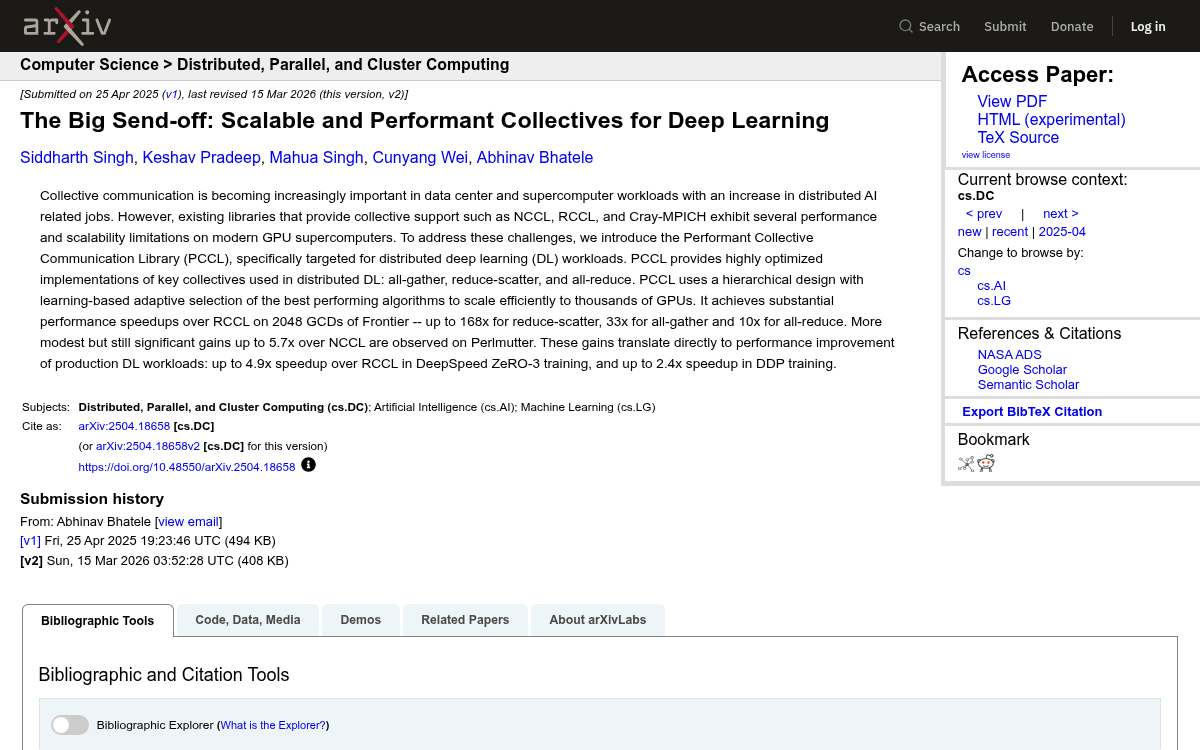
The paper, The Big Send-off: Scalable and Performant Collectives for Deep Learning, introduces PCCL (Performant Collective Communication Library). Evaluated on Frontier and Perlmutter, dragonfly-based supercomputers with AMD MI250X and NVIDIA A100 GPUs respectively, its implementations of all-gather, reduce-scatter, and all-reduce achieve significant speedups over all three libraries: Cray-MPICH, NCCL, and RCCL. The headline number is a 168x speedup for reduce-scatter, 33x for all-gather and 10x for all-reduce on 2048 GCDs of Frontier, with more modest but still substantial gains on NVIDIA hardware.
Where the incumbents break down
Distributed deep learning leans on three collectives. Sharded frameworks like DeepSpeed ZeRO-3 and FSDP use all-gather to reconstruct full parameter tensors from shards, and reduce-scatter to distribute averaged gradients. Plain data-parallel training uses all-reduce to synchronize gradients across replicas. The catch: DL message sizes are huge. Message sizes in DL applications are significantly larger, from tens to hundreds of MBs, and current implementations of collective libraries struggle with maintaining high performance in this regime.
The authors profiled the incumbents and found three distinct failure modes:
- Cray-MPICH wastes hardware. It routes all network traffic through a single NIC, and performs reduction operations on the CPU, instead of offloading them to the GPU. On a Frontier node with four NICs, that alone accounts for a roughly 4x deficit versus RCCL on bandwidth-bound all-gathers.
- NCCL and RCCL do not scale. Both rely solely on the ring algorithm for all-gather and reduce-scatter, leading to poor scaling in latency-bound scenarios. More efficient algorithms such as recursive doubling and halving are not supported. A ring pays a latency cost that grows linearly with GPU count, which is catastrophic at 2048 devices.
- Software-path fallbacks are expensive. The team traced RCCL's collapse partly to a Slingshot NIC counter showing RCCL triggered roughly 200x more overflow-list copies than PCCL, forcing slow software-side data movement instead of zero-copy delivery.
The three-part fix
PCCL is not a single new algorithm. It is a dispatcher wrapped around multiple backends, picking the right one for each workload. The design has three layers:
- Hierarchical two-level collectives. The global collective is split into an inter-node phase and an intra-node phase using sub-communicators. On Frontier, each node has four NICs connected to two GCDs each, and PCCL ensures each GCD exclusively uses its corresponding NIC, evenly distributing inter-node traffic across all NICs. Intra-node traffic is handed to NCCL or RCCL, which are already well-tuned for NVLink and Infinity Fabric.
- Latency-optimal inter-node algorithms. PCCL implements two backends over raw MPI point-to-point sends:
PCCL_ringfor bandwidth-bound cases andPCCL_recusing recursive doubling for all-gather and recursive halving for reduce-scatter. The recursive variants cut the number of communication steps fromp-1tolog2(p). Crucially, reductions run on the GPU rather than the CPU. - Learning-based dispatch. No single communication library or algorithm is universally fastest; performance depends on the specific configuration, with message size and GPU count being the dominant factors. PCCL trains one SVM classifier per (machine, collective) pair on empirical benchmark data spanning 1 MB to 1 GB messages and 4 to 2048 GPUs, then queries it at runtime to pick a backend. Reported test accuracies land between 75% and 95%.
What the speedups look like in practice
The isolated collective benchmarks show a clear pattern: for large messages on small clusters, the incumbents are fine and PCCL's dispatcher happily forwards to them. For latency-sensitive regimes (small-to-medium messages, thousands of GPUs), PCCL pulls ahead by one to two orders of magnitude. Around 1024 to 2048 processes and 16 to 32 MB message sizes on Perlmutter, PCCL achieves speedups over NCCL ranging from 3 to 5x.
Those gains carry through to real training runs. In DeepSpeed ZeRO-3 training of GPT-style transformers on Frontier, PCCL delivers a 2.5x speedup for the 7B model and a 1.6x speedup for the 13B model at 1024 GCDs, and 3.3 to 4.9x relative to RCCL at 2048 GCDs. For PyTorch DDP training a 1.3B GPT-3 model on Frontier, RCCL outperforms PCCL at smaller scales, but PCCL rapidly closes this gap and achieves 1.8x and 2.4x speedup over RCCL at 1024 and 2048 GCDs respectively.
Who benefits, and when
PCCL is not a drop-in that helps everyone equally. It targets a specific regime and has clear limits:
- Best suited for: ZeRO-3, FSDP, and AxoNN workloads at hundreds to thousands of GPUs on Slingshot-based systems like Frontier and Perlmutter, where all-gather and reduce-scatter dominate.
- Neutral to slightly worse for: Small clusters (128 to 256 GPUs), where the ring algorithm's flat bandwidth advantage still wins and PCCL's dispatcher will typically fall back to the vendor library anyway.
- Not yet validated on: InfiniBand clusters. The authors plan to benchmark PCCL on clusters with InfiniBand interconnects to evaluate its performance beyond Slingshot-based systems.
- Less dramatic gains for: Pure DDP with small models, where NCCL and RCCL already use log-latency double-binary tree all-reduce.
The deeper contribution is the demonstration that the ring algorithm, the workhorse of GPU collectives for a decade, is the wrong default at supercomputer scale, and that mixing algorithms via a learned dispatcher is a practical way to get scale-invariant performance. It also exposes an uncomfortable truth about how much of RCCL's runtime cost at 2000+ GPUs is coming from network stack fallbacks rather than the algorithm itself. Full artifacts, including the PCCL library and a modified nanoGPT for reproducing the ZeRO-3 and DDP benchmarks, are described in the paper's appendix and available through the University of Maryland's Parallel Software and Systems Group.