
UMass's SynPlanResearch-R1 Fixes AI Web Agents That Give Up Too Soon
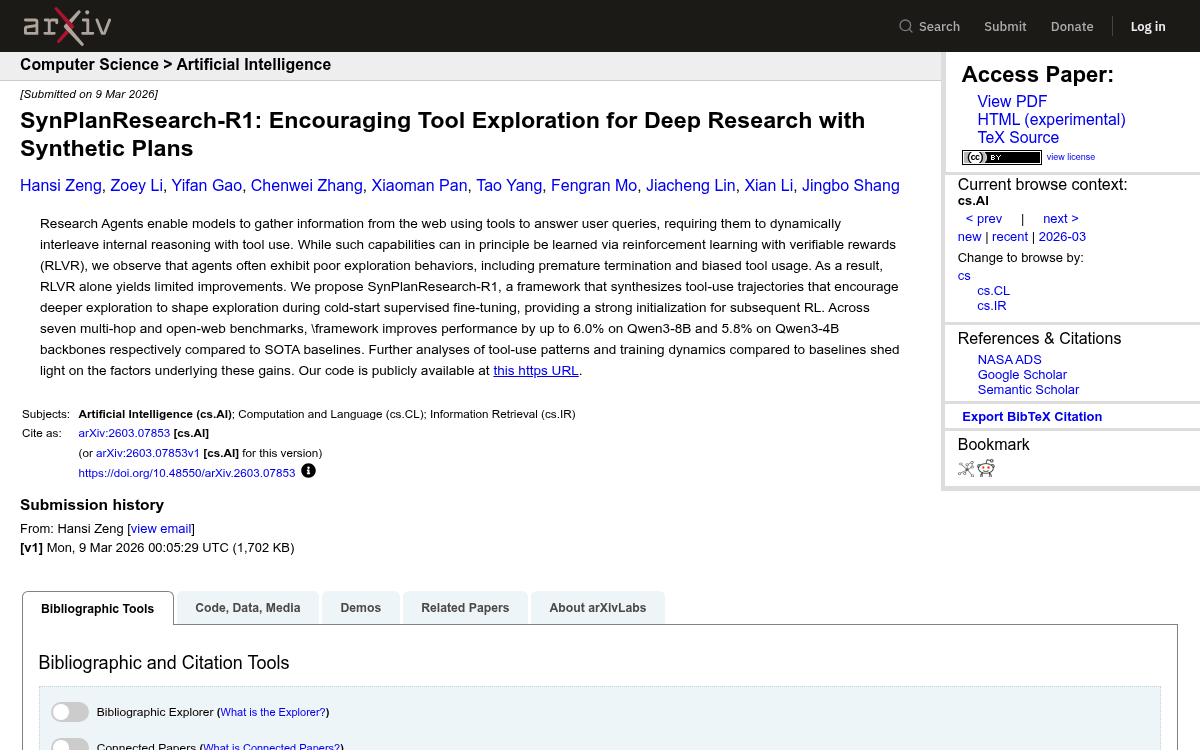
SynPlanResearch-R1 fixes a core flaw in RL-trained web agents — they stop searching too early — by teaching deeper tool exploration before RL even begins
 Pro
Takeaways
- Core finding: RL-trained web research agents fail because they explore too shallowly — SynPlanResearch-R1 fixes this by shaping the starting policy before RL begins.
- Method: Synthetic tool-use trajectories are generated using randomized tool plans (3–8 steps) and cue-injected thoughts that steer a large reasoning model toward deeper search and page-crawling behavior.
- Results: Up to +6.0% over SOTA on Qwen3-8B and +5.8% on Qwen3-4B across 7 benchmarks including GPQA, GAIA, and HotpotQA.
- Key insight: Cue injection is the critical component — plan adherence jumps from 28% to 77% with cues, and removing them causes the largest accuracy drops in ablations.
- Open source: Code, 4 model checkpoints (4B and 8B, SFT and RL), and all datasets are available on GitHub and HuggingFace.
- Practical limit: Requires Serper API for web search and an 8xA100 GPU setup for training; the synthesis pipeline also uses Qwen3-32B and Claude 3.7 Sonnet as teacher models.
Training a language model to browse the web and answer hard questions sounds straightforward: let it search, reward it when it gets the right answer, repeat. But researchers from UMass Amherst and Amazon found a stubborn problem hiding inside this loop. Left to its own devices, a model trained purely with reinforcement learning learns to give up too soon. It runs a search or two, then calls it done. The result is a shallow, overconfident agent that misses the deeper evidence it actually needs.
Their fix, SynPlanResearch-R1, attacks the problem one step earlier: before RL training starts, it teaches the model what deep exploration looks like by generating synthetic training trajectories that are deliberately richer and more diverse than anything the model would produce on its own.
Why RL alone keeps failing research agents
The dominant training recipe for research agents today is Reinforcement Learning with Verifiable Rewards (RLVR) , a paradigm popularized by DeepSeek-R1 and o1. The agent generates a multi-step trajectory of searches and page reads, and gets a reward signal based purely on whether its final answer is correct. No human labels, no dense reward model. Elegant in theory.
In practice, RLVR is on-policy: the model only learns from trajectories it generates itself. If the starting policy is weak, it generates weak trajectories, learns from weak trajectories, and never escapes. The authors observed two specific failure modes:
- Premature termination , the agent answers after one or two searches, before gathering enough evidence.
- Tool bias , when both
web_searchandcrawl_webpageare available, the agent almost exclusively uses search and rarely clicks into a page to read it deeply. Without crawling, it can only see search snippets, missing the detail needed for hard questions.
Vanilla prompting confirms the scale of this problem. A standard ReAct prompt produces an average of just 1.35 search calls and 0.05 crawl calls per query. That's barely a single search and almost no deep reading.
The plan-guided data synthesis pipeline
SynPlanResearch-R1 introduces a four-step pipeline to generate synthetic training data that encodes richer exploration behavior. The key insight is that you can steer a large reasoning model (LRM) into producing better trajectories by giving it a script to follow, then filtering for the ones that actually work.
- Tool-plan construction. For each training question, a random tool plan is sampled , a sequence of 3 to 8 tool calls like
web_search → crawl_webpage → crawl_webpage → web_search. The first action is always a search, and subsequent steps are sampled with equal probability between search and crawl. This randomization ensures the resulting dataset covers a wide range of exploration patterns. - Cue-injected thoughts. Simply telling the LRM to follow a plan doesn't work well , plan adherence without cues is only 28.3%. Instead, at each step, a short natural-language cue is injected at the start of the model's thinking block. For a
web_searchstep, the cue reads something like "I probably need to gather external information first." Forcrawl_webpage: "There are several promising links from the search results. Perhaps I should inspect one." These soft nudges push plan adherence to 76.96% and drive total tool calls from 1.4 to 4.36 per query. - Filtering and quality control. Each question generates 16 candidate trajectories. Only those that pass both a format check (correct ReAct structure with proper tags) and an answer correctness check are kept. This ensures the SFT corpus contains only valid, successful explorations.
- Thought rewriting. The injected cues leave unnatural phrasing in the reasoning traces. Claude 3.7 Sonnet is used to rewrite each thought step into fluent, concise language while keeping the actions and observations unchanged. The ablation shows this step has minor accuracy impact but improves linguistic quality.
The resulting dataset , 8k examples for SFT and ~9.6k for RL , is then used to first fine-tune the model (cold-start SFT) and then run GRPO-based RL on top of it.
GRPO with two stability tricks
The RL stage uses GRPO (Group Relative Policy Optimization), a value-network-free RL algorithm that compares multiple rollouts for the same question and updates the policy based on relative performance. Two engineering fixes make multi-turn tool-use training stable:
- Void trajectory masking. Around 10–15% of rollouts hit the token or turn limit without producing a final answer. Rather than treating these as negative examples (which destabilizes training), the paper excludes them from the policy loss while still using their rewards for group-relative advantage estimation.
- Hard JSON failure termination. When a tool call produces malformed JSON, smaller models (like Qwen3-4B) spiral into generating more and more broken calls if given error feedback. The fix: immediately terminate the trajectory and assign a format penalty, rather than trying to recover.
The reward function combines F1 answer accuracy with a format compliance bonus/penalty, with a correctness threshold of 0.8 F1 to count as a correct answer.
Benchmarks and results
The paper evaluates across seven benchmarks spanning two categories:
| Category | Benchmarks |
|---|---|
| Multi-hop QA | HotpotQA, 2WikiMultihopQA, MuSiQue, Bamboogle |
| Advanced / open-web | GPQA, WebWalkerQA, GAIA |
At the 8B scale (Qwen3-8B backbone), SynPlanResearch-R1 achieves an average F1 of 0.580 across all seven benchmarks. The gains over key baselines:
- +6.0% over SimpleDeepSearcher , the closest prior method, which focuses on curating high-quality training questions rather than synthesizing diverse trajectories.
- +13.2% over Search-R1 , a strong RL-only baseline, confirming that cold-start initialization matters enormously.
- +25.0% over rejection-sampling SFT , showing that RL's ability to learn from both positive and negative trajectories is critical.
On the harder open-web tasks, gains are even larger: up to 8.7% on GPQA (graduate-level science questions) and strong improvements on GAIA, a benchmark requiring multi-step web reasoning. The 4B model follows the same pattern, with +5.8% over SimpleDeepSearcher and +14.5% over Search-R1.
What the analysis reveals
The paper's analysis section is where the real insight lives. Tracking tool-call counts against accuracy across training checkpoints shows a clear monotonic relationship: more tool calls consistently means higher accuracy, across all seven benchmarks. The SynPlanResearch-R1 model starts with a higher tool-use baseline and maintains higher policy entropy throughout RL training , meaning it keeps exploring diverse strategies rather than collapsing to a narrow habit.
The ablation study confirms which pieces actually matter:
- Removing cue-injected thoughts causes the largest drops (up to -0.63 on WebWalkerQA), confirming they are the core mechanism.
- Restricting the agent to search-only (no crawling) causes a -0.80 drop on GAIA, showing that deep page reading is essential for complex web tasks.
- Reducing the max tool-use budget from 8 to 6 steps consistently hurts performance, reinforcing that exploration depth drives accuracy.
What's available
The full codebase is open-source, including SFT and RL training scripts built on top of verl and vLLM. Four model checkpoints are available on HuggingFace: syn-plan-research-8B and syn-plan-research-4B, each with both SFT-only and full RL variants. The SFT training data, RL training data, and evaluation sets are also published. The web search tool uses the Google Serper API, and the crawling tool uses crawl4AI with Playwright. A pre-built search cache is provided to reduce API costs during reproduction.
The core takeaway is architectural: the bottleneck for RL-trained research agents is not the RL algorithm itself, but the quality of the starting policy. Synthetic plan-guided data is a practical, reproducible way to build that starting point , and the gains compound once RL takes over from a stronger initialization.