
UMass's Bio-PM Beats Larger Wearable AI Models With Smarter Motion Tokens
Researchers borrow from motor neuroscience to tokenize wrist accelerometer streams into movement segments, boosting activity recognition macro-F1 by 6 to 18 points.
 Pro
Takeaways
- Bio-PM introduces movement-segment tokens for wrist accelerometers, grounded in submovement theory of motor control.
- Tokens are defined by acceleration zero-crossings, treating each segment like a word in NLP.
- Pretrained on NHANES corpus: 28k hours, 11k participants, masked-segment reconstruction objective.
- Beats TF-C, AugPred, Chronos, Moment on 6 HAR benchmarks with just 1.4M parameters (0.65 vs 0.59 avg F1).
- Removing the biological tokenization drops average Macro-F1 by 0.18, isolating the inductive bias.
- Code and weights available at prithvitarale.github.io/biopm-site.
Wearable activity recognition has quietly been running a decade behind natural language processing, and one reason is surprisingly simple: it never had a good notion of a token. A new paper called Bio-Inspired Self-Supervised Learning for Wrist-worn Accelerometer Data argues that treating an accelerometer stream as a raw time series, chopped into arbitrary fixed windows, throws away exactly the structure that would make self-supervised pretraining actually work.
The authors, from UMass Amherst, Google Health, Stevens, and the University of Maryland, propose Bio-PM, a Transformer encoder that tokenizes wrist motion into biologically meaningful chunks before doing masked reconstruction. On six subject-disjoint human activity recognition (HAR) benchmarks, it beats every controlled self-supervised baseline, and it does so with only 1.4M parameters.
Why arbitrary time windows hurt
Almost every wearable SSL method today treats sensor data as an unstructured 1D signal. Existing methods focus on features that characterize local time-series morphology within fixed-length sliding windows via unsupervised objectives such as contrastive learning, masked reconstruction, or augmentation prediction. The paper argues this is the wrong inductive bias. Each family has its own failure mode:
- Augmentation prediction relies on the assumption that signal-level transformations reflect realistic sensor variability, but unnatural jagged transitions created by chopping and shuffling often give the model an easy shortcut.
- Masked reconstruction provides dense supervision, but reconstructing raw sensor values can often be trivially solved via local interpolation, failing to capture broader contextual dependencies.
- Contrastive objectives like TF-C tend to learn broad big-picture patterns rather than fine-grained details of human movement.
The deeper issue: without meaningful tokens, the model burns capacity trying to recover structure from arbitrary fragments instead of learning relationships between coherent events.
Submovements as the phonemes of motion
The fix comes from motor neuroscience. The submovement theory of motor control treats the hand and wrist as the upper limb's end-effector and posits that its continuous motion can be described as a superposition of discrete, bell-shaped kinematic units known as submovements. Think of them as the atomic gestures your motor cortex plans, which then overlap and combine into what looks like a smooth reach or a swing.
Fitting submovement parameters directly is expensive, so the authors adopt a coarser, computationally tractable unit called the movement segment. Defined as the interval between successive velocity zero-crossings, a movement segment encapsulates one or more submovements bounded by moments of rest, and the authors view movement segments as analogous to words, whereas individual submovements function as phonemes or letters.

Because accelerometers actually measure acceleration, integrating to velocity introduces drift. The authors instead cut tokens at acceleration zero-crossings, called type 2 movement segments. This choice is kinematically justified because a bell-shaped velocity profile manifests as a biphasic acceleration profile, where peak velocity aligns with a zero-crossing in acceleration. There is also clinical evidence backing the choice: these segments have been shown to encode markers of motor impairment in stroke, Parkinson's, and Huntington's disease.
How Bio-PM works, end to end
The pipeline is described in the full paper and works like this:
- Gravity separation. A 0.5 Hz Butterworth high-pass filter isolates voluntary motion from gravitational acceleration on each of the three axes.
- Segmentation. Zero-crossings on each axis define token boundaries. A two-stage hysteresis filter merges any segment shorter than 50 ms or under 0.01 g to suppress noise-induced tokens.
- Resampling and encoding. Each variable-length segment is linearly resampled to 32 samples, fed through a 1D CNN, and concatenated with a learned axis embedding and its original duration. Tokens from all three axes are merged and sorted by midpoint time.
- Transformer with time-aware position encoding. Because segments have irregular spacing, standard sinusoidal positions do not work. An MLP encodes absolute normalized time, and pairwise time offsets are discretized and added as relative-position biases in attention.
- Masked reconstruction. A hybrid policy alternates random masking with contiguous 1 second time-bin masking at a 50% rate. To discourage trivial copying, 20% of unmasked tokens have their CNN embeddings replaced with one randomly sampled from another token in the same window, while leaving axis, duration, and time metadata intact. The decoder reconstructs the resampled waveform under an L1 loss.
- Downstream use. Encoder outputs are mean and std pooled, then concatenated with a flattened low-frequency gravity residual to restore postural context that tokenization discarded.

What the numbers say
Bio-PM was pretrained on the NHANES corpus, comprising approximately 28,000 hours of wrist accelerometer data from 11,000 participants. All SSL baselines were retrained on the same corpus under matched windowing and evaluated with a frozen linear probe on six subject-disjoint HAR datasets (UMH, PAMAP, WISDM, MHEALTH, WHARF, HAD).
| Model | Params | Avg Macro-F1 |
|---|---|---|
| Chronos (generic TS FM) | 8.3M | 0.42 |
| Mask-Recon (equal chunks) | 1.4M | 0.47 |
| AugPred | 10.5M | 0.54 |
| Moment (generic TS FM) | 35M | 0.59 |
| TF-C (contrastive) | 8.7M | 0.59 |
| Bio-PM | 1.4M | 0.65 |
Bio-PM tops every benchmark. Against the strongest contrastive baseline TF-C, it wins by an average of 6 F1 points and by 12 points on MHEALTH. A Wilcoxon signed-rank test across 41 folds gives p less than 0.0001. The ablation is arguably more interesting: replacing biologically grounded segments with uniform chunks of matched average duration causes average Macro-F1 to drop from 0.65 to 0.47, with the most severe degradations on the HAD, UMH, and MHEALTH datasets. Same architecture, same objective, same optimizer, minus the tokenization prior. That 0.18 F1 gap is the paper's real headline.
Where it actually helps
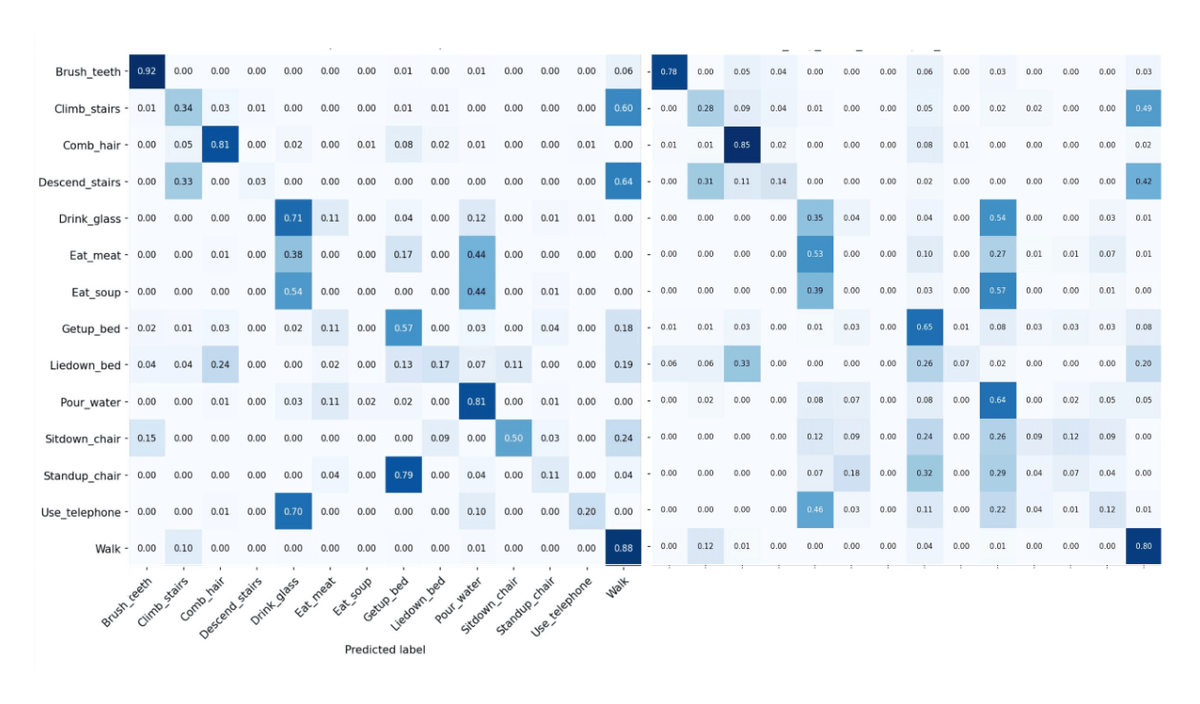
Two qualitative patterns emerge from the confusion matrices. First, Bio-PM crushes activities defined by the order of their sub-movements: transitional actions like sit-to-stand or lying-to-stand on WHARF (0.50 vs 0.21 and 0.17 vs 0.02 against TF-C), and compositional tasks like cleaning. Second, it separates activities with similar overall inertial signatures, such as stair climbing versus flat walking, or a tennis serve versus a right-hand throw.
The team also tested compositional generalization by clustering token embeddings into a discrete vocabulary and training a next-token classifier on a held-out bigram split where specific transitions were removed from training. Bio-PM's contextual embeddings consistently outperformed non-contextual baselines on unseen transitions, yielding improvements of 3.3 to 14.9 percentage points. That suggests the Transformer is learning structural rules over motion units, not just memorizing bigram statistics.
Caveats worth knowing
- Gravity is discarded during pretraining. Postural cues only re-enter at the linear probe stage by concatenating a low-passed gravity residual. Without it, average F1 drops from 0.65 to 0.56.
- Tokenization overhead. On a single CPU core, extracting movement segments takes roughly 2.7 times longer than naive equal chunking, though still under half a second per batch of 32 windows.
- Scripted benchmarks. All six HAR datasets consist of lab or semi-natural protocols; free-living generalization is untested.
- Scaling appears limited so far. Going from 1.4M to 13M parameters only nudged average F1 from 0.67 to 0.68 on the ablation subset. The signal is in the tokenization, not the depth.
Why this matters beyond HAR
The broader claim is that the missing piece in wearable foundation models is not more data or a bigger Transformer, but a domain-appropriate token. Submovement theory extends naturally to gyroscopes, ankle sensors, head movements, and lower-limb locomotion, all of which share the same bell-shaped kinematic primitives. That opens a path toward clinical motor-assessment models for stroke, Parkinson's, and Huntington's built on the same tokenization framework. Code and pretrained weights are available on the project site, which makes it straightforward to plug the encoder into an existing wearable pipeline and see whether the inductive bias holds up on your own data.